. 2018 Nov;24(6):1127-1137.
doi: 10.1007/s12298-018-0554-z. Epub 2018 Jun 3.

Adenine type and diphenyl urea derived cytokinins improve the postharvest performance of Iris germanica L. cut scapes

Affiliations

Adenine type and diphenyl urea derived cytokinins improve the postharvest performance of Iris germanica L. cut scapes

Syed Sabhi Ahmad et al. Physiol Mol Biol Plants. 2018 Nov.

Abstract

An experiment was designed to evaluate the effect of various adenine derived cytokinins (kinetin and 6-benzylaminopurine) and diphenyl urea cytokinin (thidiazuron) on the postharvest performance of cut scapes of Iris germanica. Flower scapes were harvested with the oldest bud at '1 day before anthesis stage', brought to laboratory under water, cut to a uniform length of 35 cm, divided into three sets viz., kinetin (KIN), 6-benzyl aminopurine (BAP) and thidiazuron (TDZ). Each set of scapes was treated with a particular cytokinin alone or in combination with 0.1 M sucrose. TDZ was effective than KIN and BAP in improving the postharvest life of the I. germanica scapes by 5.4 days as compared to the control (untreated scapes held in distilled water). This was because of the minimum percentage of bud abortion by TDZ application. Cytokinin application resulted in increased antioxidant activity, higher protein and phenolic content, besides a decrease in specific protease activity and α-amino acids in the tepal tissues. Application of TDZ resulted in the maximum increase in the superoxide dismutase, catalase and ascorbate peroxidase activity in the tepal tissues. The scapes treated with BAP and KIN maintained higher carbohydrate content in the tissue samples as compared to control and TDZ treated scapes. TDZ and BAP application resulted in increased membrane stability because of the decreased lipoxygenase activity which prevented membrane lipid peroxidation. Among the cytokinins tested, TDZ proved to be the promising cytokinin in improving the postharvest performance of beautiful flowers of I. germanica scapes.

Keywords: Antioxidant enzymes; Benzylaminopurine; Kinetin; Senescence; Thidiazuron.


Conflict of interest statement

Compliance with ethical standardsThe authors don’t have any conflict of interest regarding this manuscript.

Figures
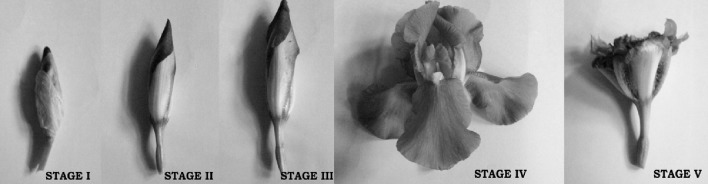
Fig. 1
Fig. 1
Stages of flower development and senescence in Iris germanica. Scapes with the oldest buds at stage III (1 day before anthesis) were used for the present study
Fig. 2
Fig. 2
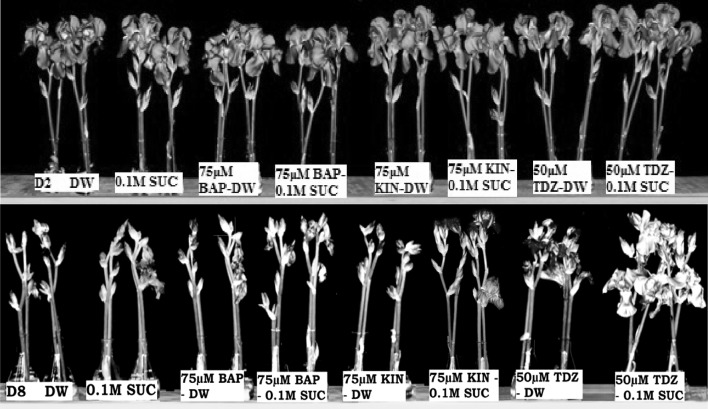
Effect of benzyl amino purine (BAP), kinetin (KIN) and thidiazuron (TDZ) on the postharvest performance and vase life of cut scapes of Iris germanica on day 2 and day 8 of transfer of the scapes to the respective vase solutions
Fig. 3
Fig. 3
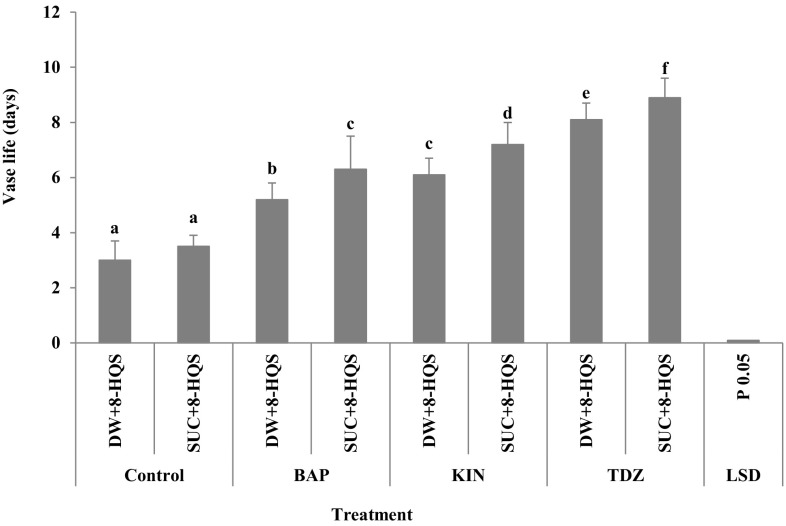
Effect of benzyl amino purine (BAP), kinetin (KIN) and thidiazuron (TDZ) on the vase life of cut scapes of Iris germanica. The letters a–f above the bars denote the statistical significance (Duncan’s multiple range test) of the differences between individual treatments (only those marked with different letter differ significantly at P < 0.05)
Fig. 4
Fig. 4
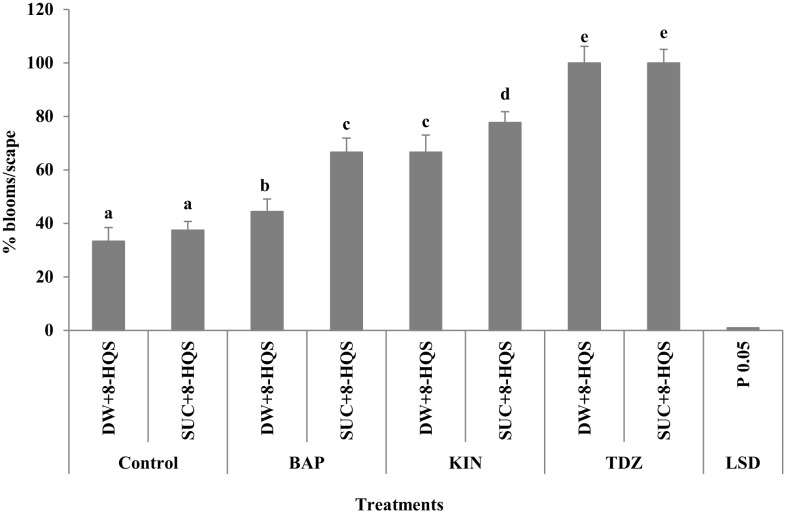
Effect of benzyl amino purine (BAP), kinetin (KIN) and thidiazuron (TDZ) on the percent blooms per scape in cut scapes of Iris germanica. The letters a–e above the bars denote the statistical significance (Duncan’s multiple range test) of the differences between individual treatments (only those marked with different letter differ significantly at P < 0.05)
Fig. 5
Fig. 5
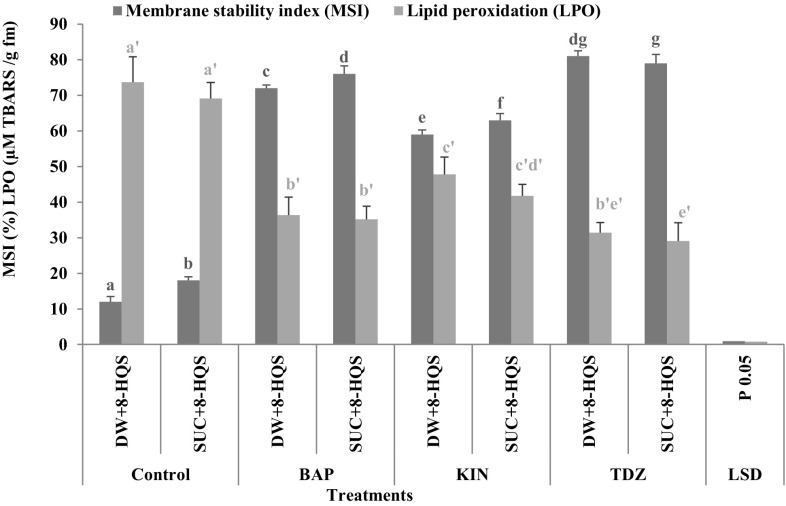
Effect of benzyl amino purine (BAP), kinetin (KIN) and thidiazuron (TDZ) on the membrane stability index (MSI) and lipid peroxidation (LPO) of the tepal tissue in cut scapes of Iris germanica. The letters a–g and a′–e′ above the bars denote the statistical significance (Duncan’s multiple range test) of the differences between individual treatments (only those marked with different letter differ significantly at P < 0.05)
Fig. 6
Fig. 6
Effect of benzyl amino purine (BAP), kinetin (KIN) and thidiazuron (TDZ) on the soluble proteins and specific protease activity of the tepal tissue in cut scapes of Iris germanica. The letters a–e and a′–c′ above the bars denote the statistical significance (Duncan’s multiple range test) of the differences between individual treatments (only those marked with different letter differ significantly at P < 0.05)
Fig. 7
Fig. 7
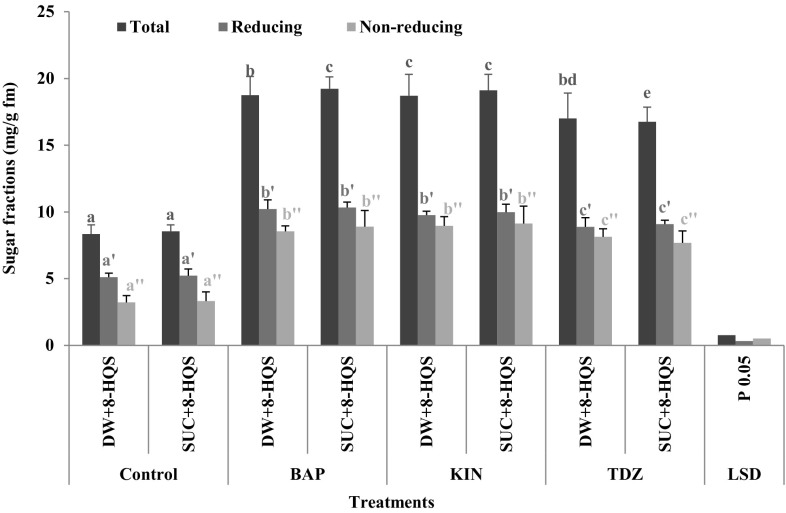
Effect of benzyl amino purine (BAP), kinetin (KIN) and thidiazuron (TDZ) on the sugar fractions (reducing, non-reducing and total) of the tepal tissue in cut scapes of Iris germanica. The letters a–e, a’–c’ and a′’–c′’ above the bars denote the statistical significance (Duncan’s multiple range test) of the differences between individual treatments (only those marked with different letter differ significantly at P < 0.05)
Fig. 8
Fig. 8
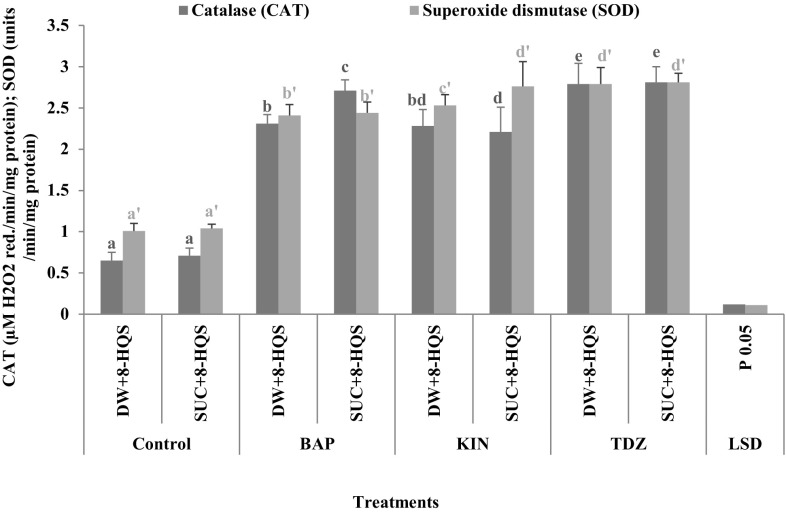
Effect of benzyl amino purine (BAP), kinetin (KIN) and thidiazuron (TDZ) on the catalase (CAT) and superoxide dismutase (SOD) activity of the tepal tissue in cut scapes of Iris germanica. The letters a–e and a′–d′ above the bars denote the statistical significance (Duncan’s multiple range test) of the differences between individual treatments (only those marked with different letter differ significantly at P < 0.05)
Fig. 9
Fig. 9
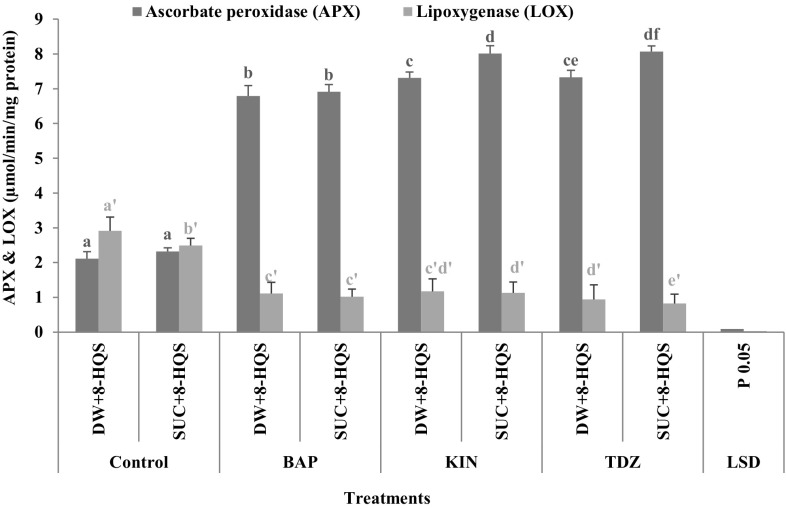
Effect of benzyl amino purine (BAP), kinetin (KIN) and thidiazuron (TDZ) on the ascorbate peroxidase (APX) and lipoxygenase (LOX) activity of the tepal tissue in cut scapes of Iris germanica. The letters a–f and a′–e′ above the bars denote the statistical significance (Duncan’s multiple range test) of the differences between individual treatments (only those marked with different letter differ significantly at P < 0.05)

References

    1. Aebi H. Catalase in vitro. Meth Enzymol. 1984;105:121–126. doi: 10.1016/S0076-6879(84)05016-3. - DOI - PubMed
    1. Ahmad SS, Tahir I. Storage protocol for improving the postharvest performance in cut scapes of Iris versicolor. Acta Hortic. 2015;1060:71–79. doi: 10.17660/ActaHortic.2015.1060.9. - DOI
    1. Ahmad SS, Tahir I. Increased oxidative stress, lipid peroxidation and protein degradation trigger senescence in Iris versicolor L. flowers. Physiol Mol Biol Plants. 2016;22(4):507–514. doi: 10.1007/s12298-016-0392-9. - DOI - PMC - PubMed
    1. Ahmad SS, Tahir I. How and why of flower senescence: understanding from models to ornamentals. Ind J Plant Physiol. 2016;21(4):446–456. doi: 10.1007/s40502-016-0267-7. - DOI
    1. Ahmad SS, Tahir I. Regulatory role of phenols in flower development and senescence in the genus Iris. Ind J Plant Physiol. 2017;22(1):135–140. doi: 10.1007/s40502-016-0278-4. - DOI

LinkOut - more resources