Review
. 2018 Oct 30:9:2309.
doi: 10.3389/fmicb.2018.02309. eCollection 2018.

Living at the Frontiers of Life: Extremophiles in Chile and Their Potential for Bioremediation

Affiliations
Review

Living at the Frontiers of Life: Extremophiles in Chile and Their Potential for Bioremediation

Roberto Orellana et al. Front Microbiol. .

Abstract

Extremophiles are organisms capable of adjust, survive or thrive in hostile habitats that were previously thought to be adverse or lethal for life. Chile gathers a wide range of extreme environments: salars, geothermal springs, and geysers located at Altiplano and Atacama Desert, salars and cold mountains in Central Chile, and ice fields, cold lakes and fjords, and geothermal sites in Patagonia and Antarctica. The aims of this review are to describe extremophiles that inhabit main extreme biotopes in Chile, and their molecular and physiological capabilities that may be advantageous for bioremediation processes. After briefly describing the main ecological niches of extremophiles along Chilean territory, this review is focused on the microbial diversity and composition of these biotopes microbiomes. Extremophiles have been isolated in diverse zones in Chile that possess extreme conditions such as Altiplano, Atacama Desert, Central Chile, Patagonia, and Antarctica. Interesting extremophiles from Chile with potential biotechnological applications include thermophiles (e.g., Methanofollis tationis from Tatio Geyser), acidophiles (e.g., Acidithiobacillus ferrooxidans, Leptospirillum ferriphilum from Atacama Desert and Central Chile copper ores), halophiles (e.g., Shewanella sp. Asc-3 from Altiplano, Streptomyces sp. HKF-8 from Patagonia), alkaliphiles (Exiguobacterium sp. SH31 from Altiplano), xerotolerant bacteria (S. atacamensis from Atacama Desert), UV- and Gamma-resistant bacteria (Deinococcus peraridilitoris from Atacama Desert) and psychrophiles (e.g., Pseudomonas putida ATH-43 from Antarctica). The molecular and physiological properties of diverse extremophiles from Chile and their application in bioremediation or waste treatments are further discussed. Interestingly, the remarkable adaptative capabilities of extremophiles convert them into an attractive source of catalysts for bioremediation and industrial processes.

Keywords: Altiplano; Antarctica; Atacama Desert; Chile; Patagonia; bioremediation; extremophile.


Figures
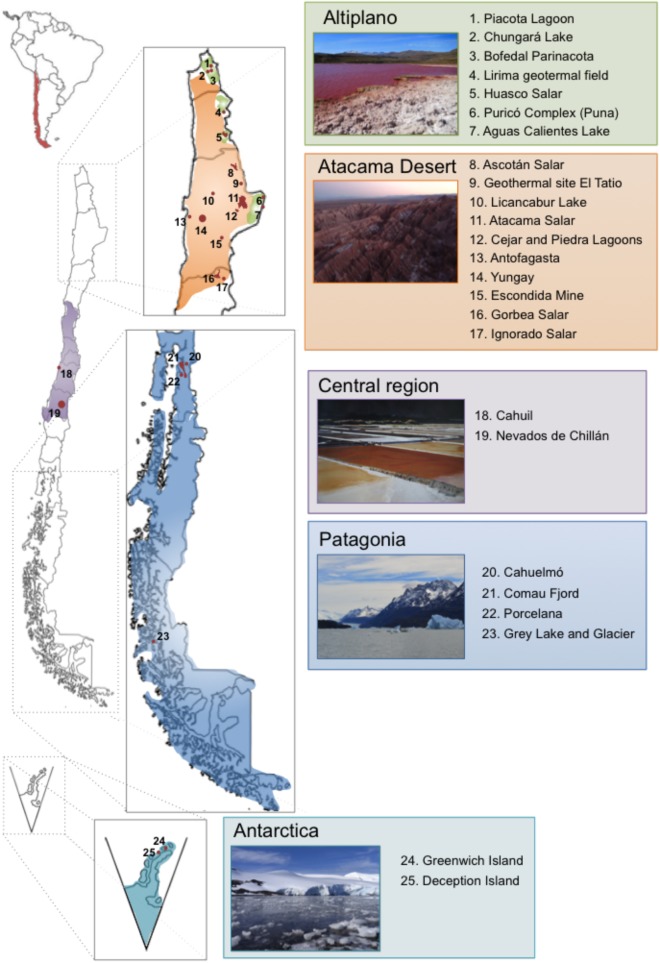
FIGURE 1
FIGURE 1
Distribution of different extreme ecosystems harboring extremophiles in five main biotopes throughout Chile. Altiplano (photography: Red Lagoon, Amuyo, Camarones, Parinacota Region), Atacama Desert (photography: Moon Valley, San Pedro de Atacama, Antofagasta Region), Central Region (photography: Cahuil Saltern, Nilahue, O’Higgins Region), Patagonia (photography: Grey Lake and Glacier, Magallanes Region), and Antarctica (photography: Arturo Prat Station, Greenwich Island).
FIGURE 2
FIGURE 2
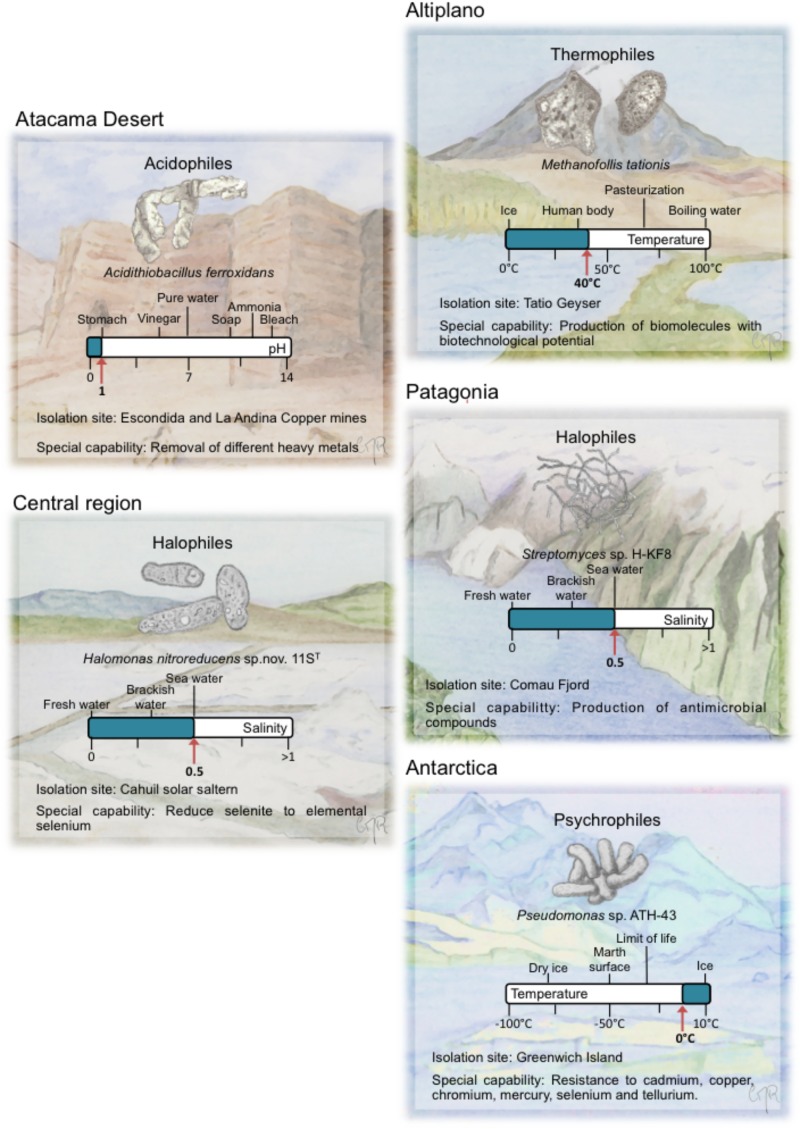
Representative extremophiles from five main biotopes in Chile. For each extremophile, a special capability is described and its ecosystem is drawn. A bar with well-known values and the isolation value for each of the extreme environmental variables is depicted.
FIGURE 3
FIGURE 3
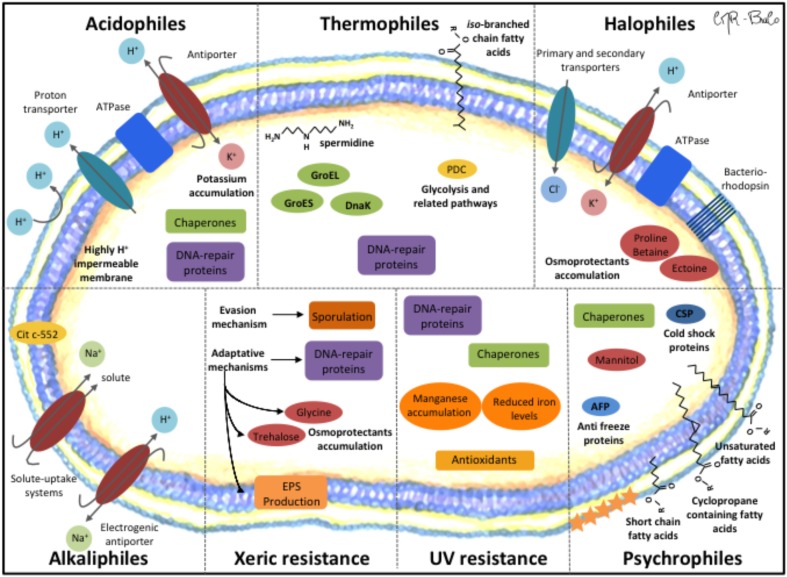
Molecular mechanisms of extremophiles for their adaptation to extreme environmental conditions. Acidophiles. (i) Potassium antiporter releases protons towards the extracellular medium, (ii) ATP synthase, (iii) membrane highly impermeable to protons, (iv) Chaperones, and (v) DNA-repair proteins. Thermophiles. (i) Upregulated glycolysis proteins (e.g., pyruvate dehydrogenase complex (PDC)), (ii) Lipids with iso-branched chain fatty acids and long chain dicarboxylic fatty acids, (iii) polyamines (spermidine), and (iv) Chaperones. Halophiles. (I) High salt-in strategy: (i) chloride transporters (primary or secondary), (ii) potassium uptake into cells by concerted action of bacteriorhodopsin and ATP synthase. (II) Low-salt strategy: (i) de novo synthesis or uptake of osmoprotectants (proline-betaine, ectoine) that maintain osmotic balance and establish the proper turgor pressure under different salt concentration. Psychrophiles. (i) high degree of unsaturated, cyclopropane containing fatty acids and short chain fatty acids, (ii) Cold shock proteins (CSP) (iii) Chaperones, (iv) Anti-freeze proteins (AFP) restrict the ice growth on protein surfaces, (v) Mannitol and other compatible solutes accumulate in the cell cytoplasm as cryo-protectants to prevent protein aggregation, and (vi) Carotenoids (star symbols) support maintenance of membrane fluidity and prevent cell damage by UV radiation. UV resistance. (i) Manganese accumulation and reduced iron levels, (ii) Antioxidants (glutathione), (iii) Chaperones, and (iv) DNA-repair proteins. Xeric resistance. (I) Evasion mechanism: (i) bacteria sporulation. (II) Adaptation mechanism: (i) increased extracellular polymeric substances (EPS), (ii) DNA-repair proteins, and (iii) accumulation of osmoprotectants (glycine, trehalose). Alkaliphiles. (i) Electrochemical gradient of Na+ and H+ by electrogenic antiporters for proton accumulation, (ii) Na+-solute uptake system, and (iii) Cytochrome c-552 enhance terminal oxidation function by electron and H+ accumulation.

References

    1. Abatzopoulos T., Kappas I., Beardmore J., Clegg J. S., Sorgeloos P. (2002). Artemia: Basic and Applied Biology. Dorcrecht: Kluwer Academic Publishers; 10.1007/978-94-017-0791-6 - DOI
    1. Acosta M., Galleguillos P. A., Guajardo M., Demergasso C. (2017). Microbial survey on industrial bioleaching heap by high-throughput 16S sequencing and metagenomics analysis. Solid State Phenom. 266 219–223. 10.4028/www.scientific.net/SSP.262.219 - DOI
    1. Aguayo P., Gonzáles P., Campos V., Maugeri T. L., Papale M., Gugliandolo C., et al. (2017). Comparison of prokaryotic diversity in cold, oligotrophic remote lakes of Chilean Patagonia. Curr. Microbiol. 74 598–613. 10.1007/s00284-017-1209-y - DOI - PubMed
    1. Aguilar A., Ingemansson T., Magniea E. (1998). Extremophile microorganisms as cell factories: support from the European Union. Extremophiles 2 367–373. 10.1007/s007920050080 - DOI - PubMed
    1. Ahring B. K. (1995). Methanogenesis in thermophilic biogas reactors. Antonie Van Leeuwenhoek 67 91–102. 10.1007/BF00872197 - DOI - PubMed