


Soy supplementation: Impact on gene expression in different tissues of ovariectomized rats and evaluation of the rat model to predict (post)menopausal health effect
- PMID: 30425930
- PMCID: PMC6222031
- DOI: 10.1016/j.toxrep.2018.10.012
Soy supplementation: Impact on gene expression in different tissues of ovariectomized rats and evaluation of the rat model to predict (post)menopausal health effect
Abstract
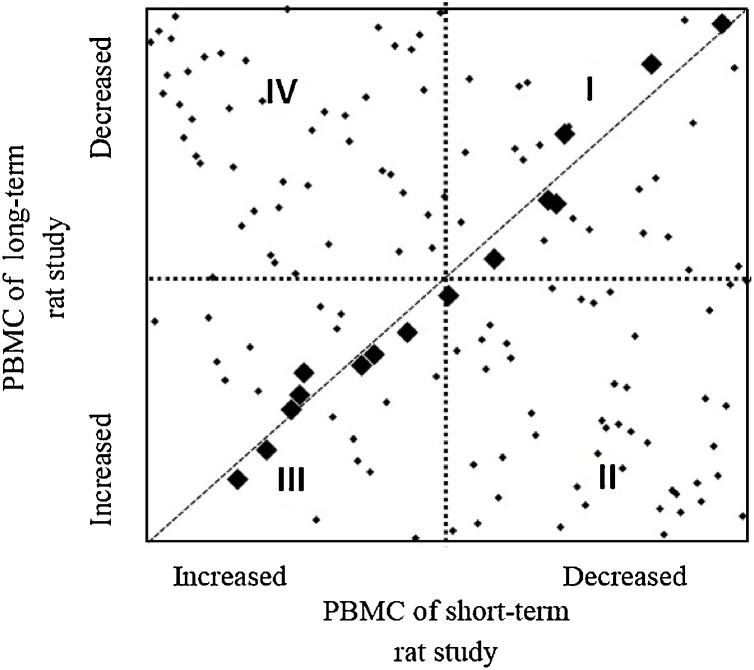
This toxicogenomic study was conducted to predict (post)menopausal human health effects of commercial soy supplementation using ovariectomized rats as a model. Different target tissues (i.e. breast, uterus and sternum) and non-target tissues (i.e. peripheral blood mononuclear cells (PBMC), adipose and liver) of ovariectomized F344 rats exposed to a commercially available soy supplement for eight weeks, were investigated. Changes in gene expression in these tissues were analysed using whole-genome microarray analysis. No correlation in changes in gene expression were observed among different tissues, indicating tissue specific effects of soy isoflavone supplementation. Out of 87 well-established estrogen responsive genes (ERGs), only 19 were found to be significantly regulated (p < 0.05) in different tissues, particularly in liver, adipose and uterus tissues. Surprisingly, no ERGs were significantly regulated in estrogen sensitive breast and sternum tissues. The changes in gene expression in PBMC and adipose tissue in rats were compared with those in (post)menopausal female volunteers who received the same supplement in a similar oral dose and exposure duration in human intervention studies. No correlation in changes in gene expression between rats and humans was observed. Although receiving a similar dose, in humans the plasma levels expressed as total free aglycones were several folds higher than in the rat. Therefore, the overall results in young ovariectomized female F344 rats indicated that using rat transcriptomic data does not provide a suitable model for human risk or benefit analysis of soy isoflavone supplementation.
Keywords: (Post)menopausal health effect; ERGs, estrogen responsive genes; ERα, estrogen receptor alpha; ERβ, estrogen receptor beta; Gene expression; Ovariectomized rat model; PBMC, peripheral blood mononuclear cells; Soy isoflavone supplementation.
Figures




References
-
- Sepehr E., Cooke G., Robertson P., Gilani G.S. Bioavailability of soy isoflavones in rats part I: application of accurate methodology for studying the effects of gender and source of isoflavones. Mol. Nutr. Food Res. 2007;51(7):799–812. - PubMed
-
- Sepehr E., Cooke G., Robertson P., Gilani G.S. Effect of glycosidation of isoflavones on their bioavailability and pharmacokinetics in aged male rats. Mol. Nutr. Food Res. 2009;53:16–26. - PubMed
-
- Hwang C.S., Kwak H.S., Lim H.J., Lee S.H. Isoflavone metabolites and their in vitro dual functions: they can act as an estrogenic agonist or antagonist depending on the estrogen concentration. J. Steroid Biochem. Mol. Biol. 2006;101(4-5):246–253. - PubMed
-
- van der Velpen V., Geelen A., Hollman P.C., Schouten E.G. Isoflavone supplement composition and equol producer status affect gene expression in adipose tissue: a double-blind, randomized, placebo-controlled crossover trial in postmenopausal women. Am. J. Clin. Nutr. 2014;100(5):1269–1277. - PubMed
-
- Messina M. Soy foods, isoflavones, and the health of postmenopausal women. Am. J. Clin. Nutr. 2014;100(Suppl 1):423S–430S. - PubMed
LinkOut - more resources
Full Text Sources
