


Interconversion of two commonly used performance tools: An analysis of 5844 paired assessments in 1501 lung cancer patients
- PMID: 30425939
- PMCID: PMC6230919
- DOI: 10.5306/wjco.v9.i7.140
Interconversion of two commonly used performance tools: An analysis of 5844 paired assessments in 1501 lung cancer patients
Abstract
Aim: To establish the Karnofsky performance status (KPS) categories which would facilitate the interconversion of the KPS scale to the Eastern Cooperative Oncology Group (ECOG) performance status (PS) scale.
Methods: This was a retrospective analysis of all patients attending the lung cancer clinic at a tertiary care center over a 5-year period (September 2009 to August 2014). All patients were assessed with both KPS and ECOG PS scales at each visit. Correlation between KPS and ECOG PS was assessed using Spearman's correlation coefficient. KPS categories equivalent to ECOG PS scores were compared using hit rate and weighted kappa (κw).
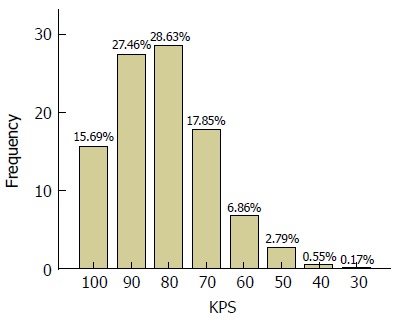
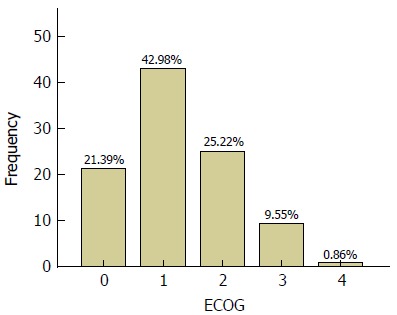
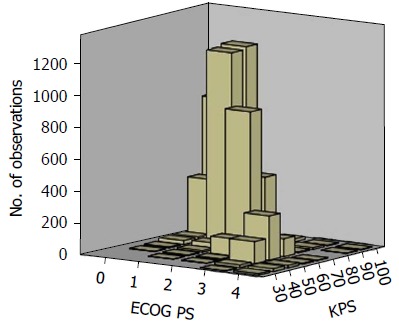
Results: A total of 1501 patients were assessed over the study period, providing 5844 paired KPS and ECOG PS assessments. The study cohort had a mean (standard deviation; SD) age of 58.4 (10.8) years, with the majority being current or ex-smokers (76.9%) and males (82.3%). Non-small cell lung cancer was the most common histological type (n = 1196, 79.7%) with the majority having advanced (stage IIIB/IV) disease (83.4%). Mean baseline KPS and ECOG PS scores were 77.6 (SD = 14.4) and 1.5 (SD = 1) respectively. The most frequent KPS score was 80 (29%), and the most frequent ECOG PS score was 1 (43%). The overall correlation between KPS and ECOG PS was good (Spearman r = -0.84, P < 0.0001) but ranged from -0.727 to -0.972 between visits. KPS categories derived from our cohort [10-40 (ECOG 4), 50-60 (ECOG 3), 70 (ECOG 2), 80-90 (ECOG 1), 100 (ECOG 0)] performed better [hit rate 78.1%, κw = 0.749 (0.736-0.762) P < 0.0001] than those suggested in the past literature.
Conclusion: The current study provides the largest set of paired KPS-ECOG assessments to date. We suggest that the KPS categories 10-40, 50-60, 70, 80-90, and 100 are equivalent to ECOG PS categories of 4, 3, 2, 1, and 0 respectively.
Keywords: Chemotherapy; Eastern Cooperative Oncology Group; Karnofsky performance status; Lung cancer; Performance status.
Conflict of interest statement
Conflict-of-interest statement: All authors declare no conflicts of interest related to this article.
Figures
References
-
- Stanley KE. Prognostic factors for survival in patients with inoperable lung cancer. J Natl Cancer Inst. 1980;65:25–32. - PubMed
-
- Downing M, Lau F, Lesperance M, Karlson N, Shaw J, Kuziemsky C, Bernard S, Hanson L, Olajide L, Head B, et al. Meta-analysis of survival prediction with Palliative Performance Scale. J Palliat Care. 2007;23:245–252; discussion 252-254. - PubMed
-
- Maltoni M, Caraceni A, Brunelli C, Broeckaert B, Christakis N, Eychmueller S, Glare P, Nabal M, Viganò A, Larkin P, et al. Prognostic factors in advanced cancer patients: evidence-based clinical recommendations--a study by the Steering Committee of the European Association for Palliative Care. J Clin Oncol. 2005;23:6240–6248. - PubMed
-
- Kawaguchi T, Takada M, Kubo A, Matsumura A, Fukai S, Tamura A, Saito R, Maruyama Y, Kawahara M, Ignatius Ou SH. Performance status and smoking status are independent favorable prognostic factors for survival in non-small cell lung cancer: a comprehensive analysis of 26,957 patients with NSCLC. J Thorac Oncol. 2010;5:620–630. - PubMed
-
- Paz-Ares LG, de Marinis F, Dediu M, Thomas M, Pujol JL, Bidoli P, Molinier O, Sahoo TP, Laack E, Reck M, et al. PARAMOUNT: Final overall survival results of the phase III study of maintenance pemetrexed versus placebo immediately after induction treatment with pemetrexed plus cisplatin for advanced nonsquamous non-small-cell lung cancer. J Clin Oncol. 2013;31:2895–2902. - PubMed
LinkOut - more resources
Full Text Sources
Miscellaneous
