. 2018 Dec 28;3(12):2613-2620.
doi: 10.1021/acssensors.8b01027. Epub 2018 Nov 28.

Impedance-Based Microfluidic Assay for Automated Antischistosomal Drug Screening

Affiliations

Impedance-Based Microfluidic Assay for Automated Antischistosomal Drug Screening

Ketki Chawla et al. ACS Sens. .

Abstract

Schistosomiasis is a neglected tropical disease, caused by parasitic worms, which affects almost 200 million people worldwide. For over 40 years, chemotherapeutic treatment has relied on the administration of praziquantel, an efficacious drug against schistosomiasis. However, concerns about developing drug resistance require the discovery of novel drug compounds. Currently, the drug-screening process is mostly based on the visual evaluation of drug effects on worm larvae in vitro by a trained operator. This manual process is extremely labor-intensive, has limited throughput, and may be affected by subjectivity of the operator evaluation. In this paper, we introduce a microfluidic platform with integrated electrodes for the automated detection of worm larvae viability using an impedance-based approach. The microfluidic analysis unit consists of two sets of electrodes and a channel of variable geometry to enable counting and size detection of single parasite larvae and the collective evaluation of the motility of the larvae as an unbiased estimator for their viability. The current platform also allows for multiplexing of the analysis units resulting in increased throughput. We used our platform to record size and motility variations of Schistosoma mansoni larvae exposed to different concentrations of mefloquine, a drug with established in vitro antischistosomal properties. The developed platform demonstrates the potential of integrated microfluidic platforms for high-throughput antischistosomal drug screening.

Keywords: Schistosoma mansoni; drug-screening; electrical impedance spectroscopy; microfluidics; schistosomiasis.


Conflict of interest statement

Conflict of Interest

The authors declare no competing financial interest.

Figures
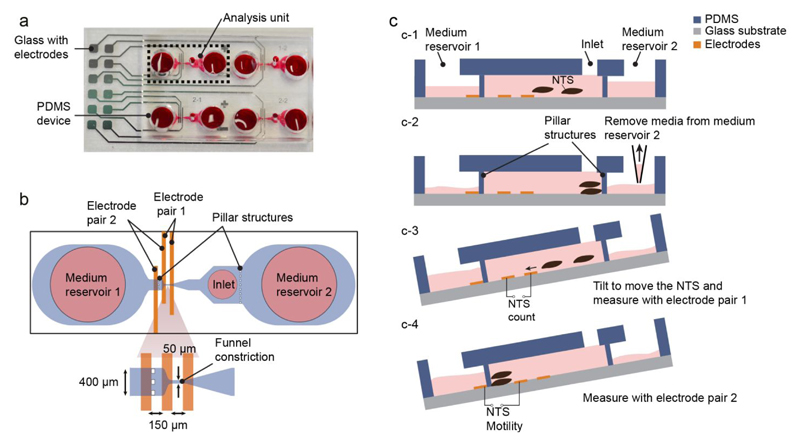
Figure 1
Figure 1
(a) Photograph of the microfluidic platform, which consists of a top PDMS part, aligned and bonded to a platinum-patterned glass slide; (b) schematic of the analysis unit marked in (a). The unit is composed of two medium reservoirs, separated from the sensing region by pillar structures. The sensing region is composed of: a funnel constriction, aligned with an electrode pair (electrode pair 1), which allows for the passage of single NTS and is used for counting the number of loaded larvae; a larger sensing area, aligned with a second electrode pair (electrode pair 2), which is used to measure the collective motility of the NTS. (c) Loading and operation of the chip (c1- c4). First, 20 µL of NTS suspension are loaded through the inlet with a pipette; 5 µL of medium are removed from medium reservoir 1 to generate a hydrostatic pressure and ensure that no NTS are in the sensing area before starting the measurement. The platform is then tilted to drive the NTS through the funnel constriction for counting and EIS size estimation, and to subsequently measure their motility
Figure 2
Figure 2
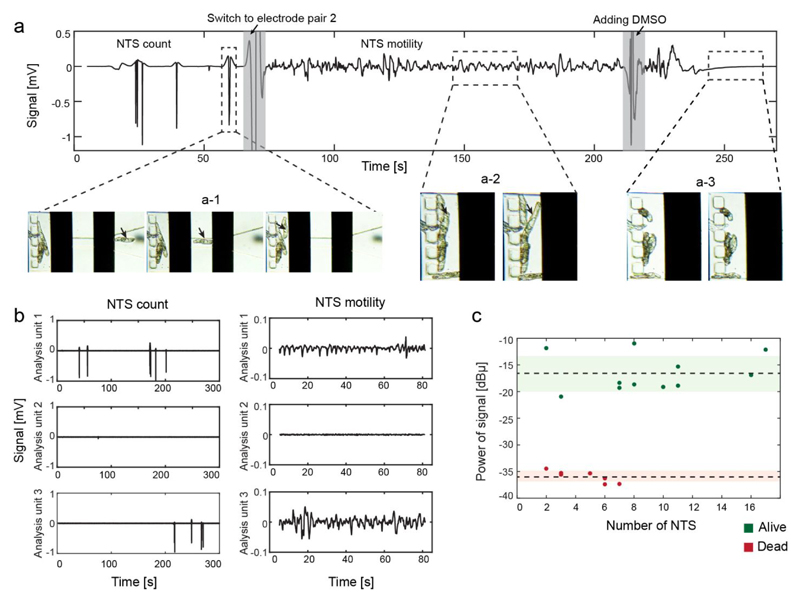
(a) Magnitude of the output signal after high-pass filtering. First, electrode pair 1 was selected and NTS flowing through the channel constriction (denoted by the arrow in a-1) induced a transient peak in the trace. Once all the NTS have passed, electrode pair 2 was switched on, and the movement of the NTS between the electrodes (a-2) caused fluctuations in the recorded signal. After addition of DMSO, the NTS died and stopped moving (a-3), and a flat line was recorded. (b) Signal recordings from three different analysis units in parallel. Analysis units 1 and 3 were loaded with NTS, while only medium was present in analysis unit 2. No crosstalk was observed between the analysis units. (c) Signal power in a 1-3 Hz bandwidth as a function of the number of NTS between the electrodes. The x-axis displays number of larvae used in each measurement. To compare the measurements, the signal power was normalized to the respective number of NTS in the analysis unit. The dotted line indicates the mean value of the signal power for alive (green) and dead (red) NTS. The shaded areas show the standard deviation. The signal power for live and dead NTS falls within narrow ranges and were significantly different (at least 4 times SD) from each other.
Figure 3
Figure 3
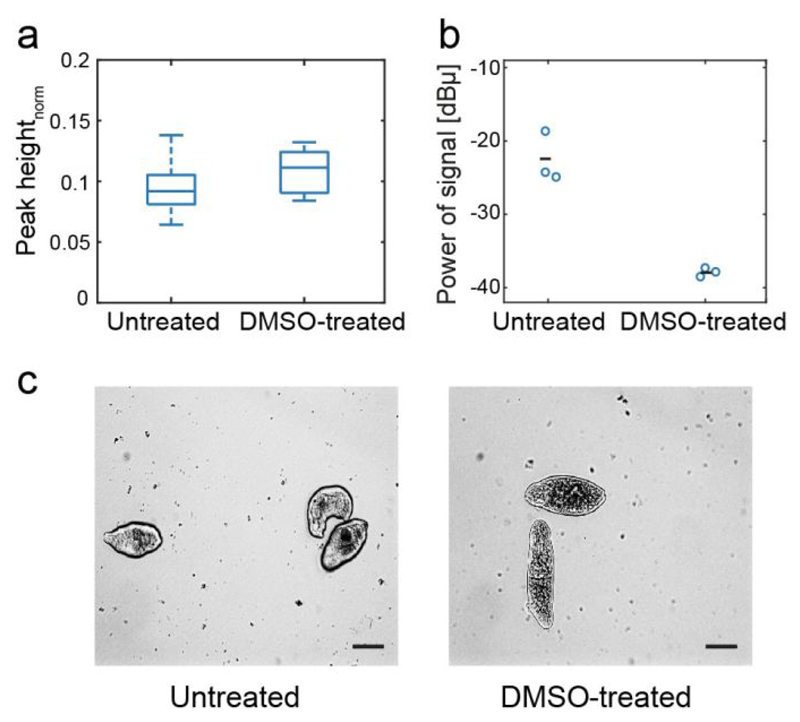
(a) Normalized absolute amplitude of the peaks, generated by the passage of the NTS through the funnel constriction, of untreated and DMSO-treated NTS. The number of NTS was nuntreated = 35 in the untreated and ntreated = 13 in the DMSO-treated case. The peaks were measured with a 48 kHz carrier signal. No significant increase in size was detected by the EIS measurements, as has been confirmed by the micrographs displayed in (c). Scale bar 50 µm. (b) Normalized signal power, measured at 333 kHz for untreated and DMSO-treated NTS. Three replicates were acquired for each condition. Each circle represents a measurement of an analysis unit, and the mean is represented by the black line. (c) Micrographs of untreated and DMSO-treated NTSs.
Figure 4
Figure 4
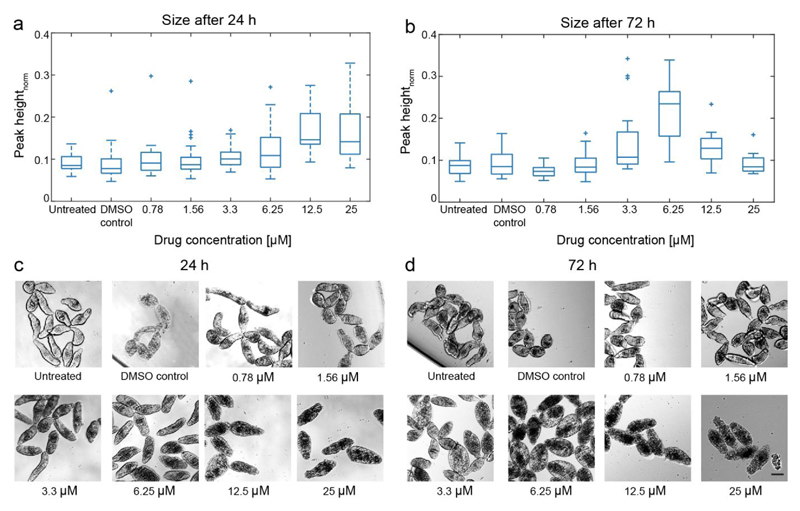
(a) EIS-size measurements of NTS, incubated with six different concentrations of mefloquine (nuntreated = 26, nDMSO control = 37, n0.78 =22, n1.56 = 32, n3.3 = 47, n6.25 = 23, n12.5= 15, n25 = 21) after 24 h. The size increased with increasing drug concentration. (b) Impedance-based size detection of NTS (nuntreated = 42, nDMSO control = 29, n0.78 =25, n1.56 = 23, n3.3 = 22, n6.25 = 20, n12.5= 11, n25 = 8) after 72 h of incubation. A drastic increase in NTS size for 6.25 µM of mefloquine was detected. As controls, also NTS incubated in pure medium and 0.5% DMSO were measured. (c),(d) – Micrographs of NTS after 24 h and 72 h of incubation with different concentrations of mefloquine and the DMSO control. Scale bar 50 µm.
Figure 5
Figure 5
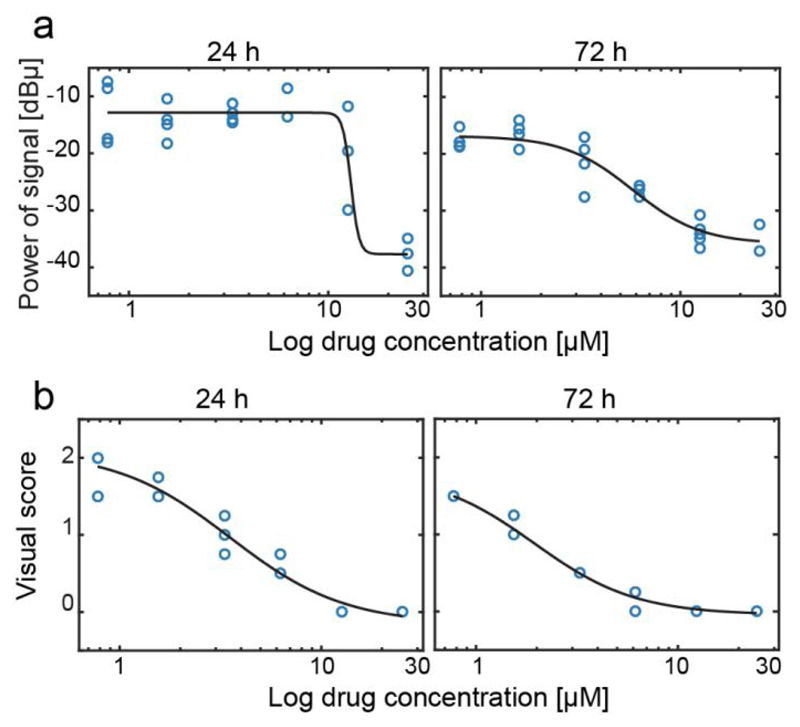
(a) Signal power recorded from NTS incubated with different concentrations of mefloquine (0.78, 1.56, 3.3, 6.25, 12.5, 25 µM), for 24 h and 72 hours. Each circle represents a measurement of an analysis unit. The total numbers of samples that have been used for each concentration are given in the caption of figure 4. (b). Visual score evaluation of NTS (n = 200), incubated with mefloquine for 24 hours and 72 hours. A sigmoidal fit (in black) was used to calculate the IC50 values for the impedance-based evaluation and for the standard evaluation of NTS viability.

References

    1. Vos T, Abajobir AA, Abate KH, Abbafati C, Abbas KM, Abd-Allah F, Abdulkader RS, Abdulle AM, Abebo TA, Abera SF, et al. Global, Regional, and National Incidence, Prevalence, and Years Lived with Disability for 328 Diseases and Injuries for 195 Countries, 1990–2016: A Systematic Analysis for the Global Burden of Disease Study 2016. Lancet. 2017;390(10100):1211–1259. doi: 10.1016/S0140-6736(17)32154-2. - DOI - PMC - PubMed
    1. Colley DG, Bustinduy AL, Secor WE, King CH. Human Schistosomiasis. Lancet (London, England) 2014;383(9936):2253–2264. doi: 10.1016/S0140-6736(13)61949-2. - DOI - PMC - PubMed
    1. Gryseels B. Schistosomiasis. Infect Dis Clin North Am. 2012;26(2):383–397. doi: 10.1016/j.idc.2012.03.004. - DOI - PubMed
    1. Ezeamama AE, Friedman JF, Acosta LP, Bellinger DC, Langdon GC, Manalo DL, Olveda RM, Kurtis JD, McGarvey ST. Helminth Infection and Cognitive Impairment among Filipino Children. Am J Trop Med Hyg. 2005;72(5):540–548. - PMC - PubMed
    1. Webster JP, Molyneux DH, Hotez PJ, Fenwick A. The Contribution of Mass Drug Administration to Global Health: Past, Present and Future. Philos Trans R Soc B Biol Sci. 2014;369(1645) doi: 10.1098/rstb.2013.0434. 20130434–20130434. - DOI - PMC - PubMed

Publication types

MeSH terms