Review
. 2018 Nov 13;19(11):3576.
doi: 10.3390/ijms19113576.

Revisiting Bacterial Ubiquitin Ligase Effectors: Weapons for Host Exploitation

Affiliations
Review

Revisiting Bacterial Ubiquitin Ligase Effectors: Weapons for Host Exploitation

Antonio Pisano et al. Int J Mol Sci. .

Abstract

Protein ubiquitylation plays a central role in eukaryotic cell physiology. It is involved in several regulatory processes, ranging from protein folding or degradation, subcellular localization of proteins, vesicular trafficking and endocytosis to DNA repair, cell cycle, innate immunity, autophagy, and apoptosis. As such, it is reasonable that pathogens have developed a way to exploit such a crucial system to enhance their virulence against the host. Hence, bacteria have evolved a wide range of effectors capable of mimicking the main players of the eukaryotic ubiquitin system, in particular ubiquitin ligases, by interfering with host physiology. Here, we give an overview of this topic and, in particular, we detail and discuss the mechanisms developed by pathogenic bacteria to hijack the host ubiquitination system for their own benefit.

Keywords: T3SS; T4SS; ubiquitin ligase.


Conflict of interest statement

The authors declare no conflict of interest.

Figures
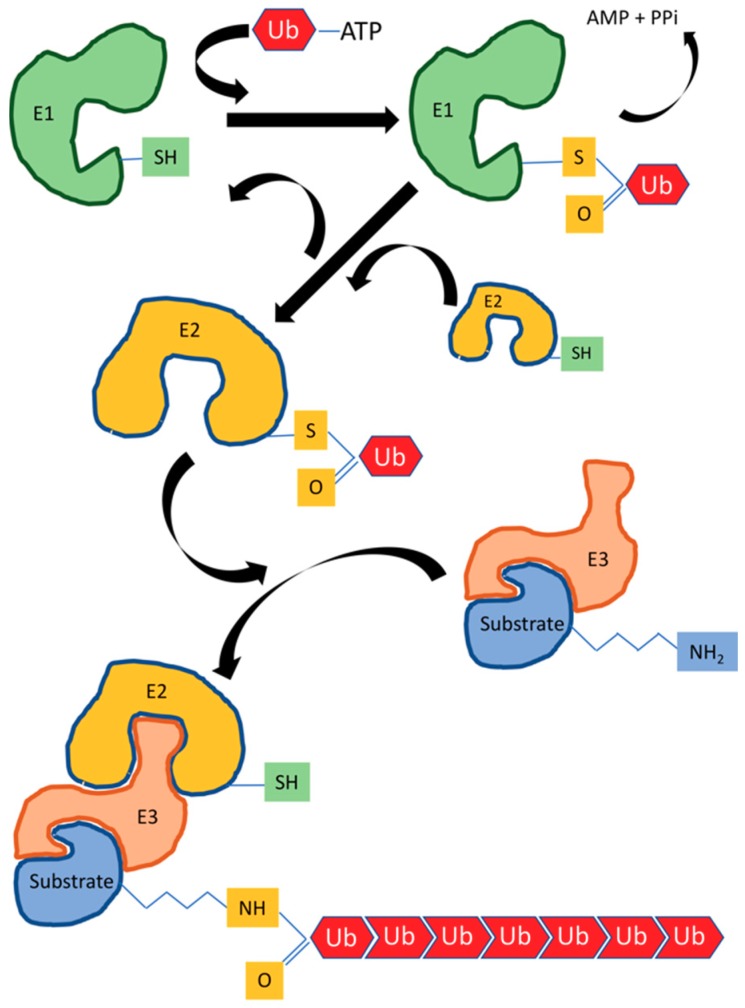
Figure 1
Figure 1
The sequential steps of ubiquitylation reaction. Three enzymes work sequentially in the reactions cascade of ubiquitylation: E1, the activating enzyme; E2, the conjugating enzyme; and E3, the ligase enzyme. The glycine carboxy-terminal of ubiquitin is firstly linked to a specific cysteine of the E1 enzyme by a thioester bond through ATP hydrolysis, and subsequently transferred to a cysteine of the E2 enzyme, which in turn catalyze the transfer of ubiquitin to the E3 enzyme and eventually to protein substrate.
Figure 2
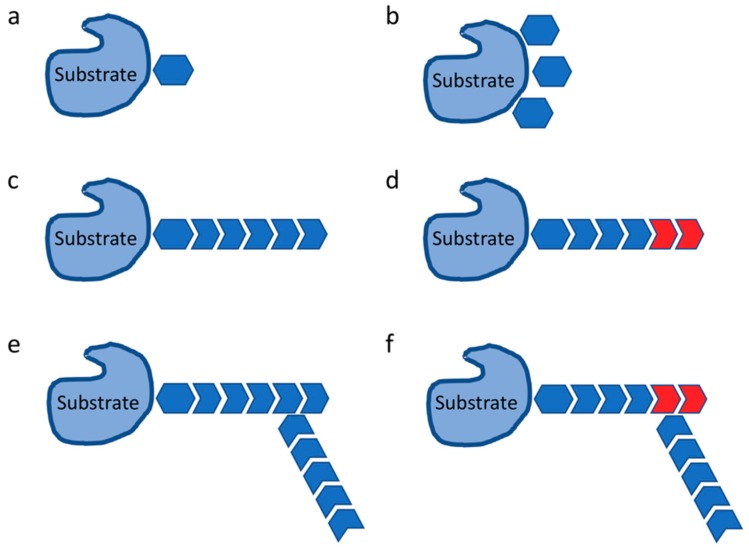
Figure 2
Ubiquitylation signals. Depending on the intracellular pathway the substrate proteins are part of/involved into, as well as on their final outcome (i.e., protein degradation and turn-over vs. change in localization, differential interaction, etc.), several types of ubiquitylation signals can be generated, such as mono-ubiquitylation signals, bearing (on the substrate protein) either a single (a) or multiple (b) ubiquitin monomers. Poly-ubiquitylation signals can determine more complex moieties, leading to homotypic (c), mixed (d), branched (e), or branched and mixed chains (f) of ubiquitin.
Figure 3
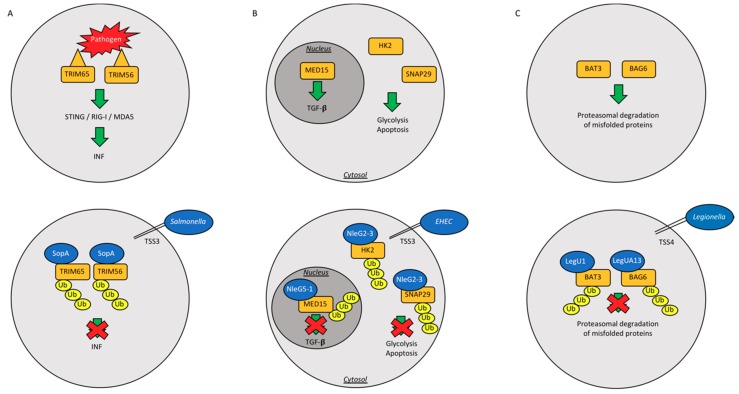
Figure 3
Paradigmatic examples of bacterial exploiting strategies. Schematic drawings depicting the three major and most common exploiting strategies adopted by bacteria to: infect host cells, escape their immune response and neutralize the activation of apoptotic/cell death pathways, and ultimately allow a full a pathogen propagation. In particular, the physiological pathways that are targeted by Salmonella (A), enterohemorrhagic Escherichia Coli (B), and Legionella (C), respectively, are reported in the upper panels. Human proteins are showed in yellow squares, whereas bacterial proteins are showed in blue circles.

References

    1. Laney J.D., Hochstrasser M. Substrate targeting in the ubiquitin system. Cell. 1999;97:427–430. doi: 10.1016/S0092-8674(00)80752-7. - DOI - PubMed
    1. Pickart C.M., Eddins M.J. Ubiquitin: Structures, functions, mechanisms. Biochim. Biophys. Acta. 2004;1695:55–72. doi: 10.1016/j.bbamcr.2004.09.019. - DOI - PubMed
    1. Sadowski M., Sarcevic B. Mechanisms of mono- and poly-ubiquitination: Ubiquitination specificity depends on compatibility between the e2 catalytic core and amino acid residues proximal to the lysine. Cell Div. 2010;5:19. doi: 10.1186/1747-1028-5-19. - DOI - PMC - PubMed
    1. Pisano A., Ceglia S., Palmieri C., Vecchio E., Fiume G., de Laurentiis A., Mimmi S., Falcone C., Iaccino E., Scialdone A., et al. Crl3ibtk regulates the tumor suppressor pdcd4 through ubiquitylation coupled to proteasomal degradation. J. Biol. Chem. 2015;290:13958–13971. doi: 10.1074/jbc.M114.634535. - DOI - PMC - PubMed
    1. McDowell G.S., Philpott A. Non-canonical ubiquitylation: Mechanisms and consequences. Int. J. Biochem. Cell Biol. 2013;45:1833–1842. doi: 10.1016/j.biocel.2013.05.026. - DOI - PubMed

MeSH terms