Review
. 2018 Nov 13;10(11):627.
doi: 10.3390/v10110627.

Causes and Consequences of Spatial Within-Host Viral Spread

Affiliations
Review

Causes and Consequences of Spatial Within-Host Viral Spread

Molly E Gallagher et al. Viruses. .

Abstract

The spread of viral pathogens both between and within hosts is inherently a spatial process. While the spatial aspects of viral spread at the epidemiological level have been increasingly well characterized, the spatial aspects of viral spread within infected hosts are still understudied. Here, with a focus on influenza A viruses (IAVs), we first review experimental studies that have shed light on the mechanisms and spatial dynamics of viral spread within hosts. These studies provide strong empirical evidence for highly localized IAV spread within hosts. Since mathematical and computational within-host models have been increasingly used to gain a quantitative understanding of observed viral dynamic patterns, we then review the (relatively few) computational modeling studies that have shed light on possible factors that structure the dynamics of spatial within-host IAV spread. These factors include the dispersal distance of virions, the localization of the immune response, and heterogeneity in host cell phenotypes across the respiratory tract. While informative, we find in these studies a striking absence of theoretical expectations of how spatial dynamics may impact the dynamics of viral populations. To mitigate this, we turn to the extensive ecological and evolutionary literature on range expansions to provide informed theoretical expectations. We find that factors such as the type of density dependence, the frequency of long-distance dispersal, specific life history characteristics, and the extent of spatial heterogeneity are critical factors affecting the speed of population spread and the genetic composition of spatially expanding populations. For each factor that we identified in the theoretical literature, we draw parallels to its analog in viral populations. We end by discussing current knowledge gaps related to the spatial component of within-host IAV spread and the potential for within-host spatial considerations to inform the development of disease control strategies.

Keywords: Influenza virus; spatial spread; within-host evolution; within-host viral dynamics.


Conflict of interest statement

The authors declare no conflict of interest.

Figures
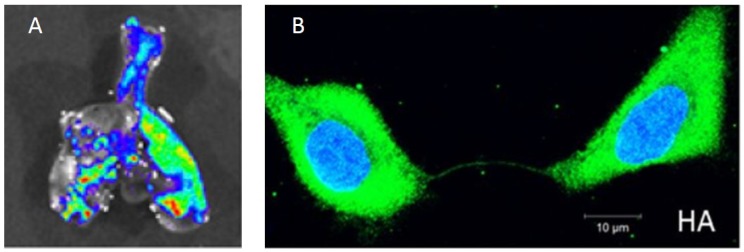
Figure 1
Figure 1
Experimental findings of within-host influenza virus spread. (A) Influenza virus spread visualized through bioluminescent imaging. The figure shows fluorescence from excised lungs of infected mice. Figure reproduced from [31]; (B) The genome and proteins of influenza virus can be transferred between cells via intercellular pathways called tunneling nanotubes. Figure reproduced from [34].
Figure 2
Figure 2
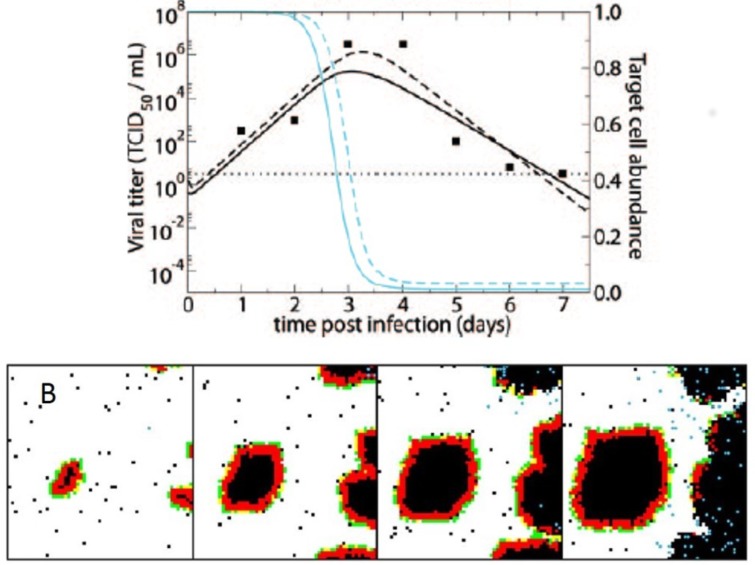
(A) Fit of a non-spatial, target-cell-limited within-host influenza model to viral load data from a human subject experimentally infected with influenza A subtype H1N1. The data are shown as black points. The black lines show model fits of viral load data. The blue lines show model-predicted declines in the number of target cells. Solid lines show the fits of the basic model; dashed lines show the fits of a more complex model with an eclipse phase before infected cells produce virus. Figure is reproduced from [60]; (B) Cellular automata model of within-host influenza infection under assumptions of local cell regeneration and localized recruitment of immune cells. Panels, from left to right, show the time evolution of the cellular automata model. Simulations reproduce the appearance of infected foci. Figure reproduced from [67].
Figure 3
Figure 3
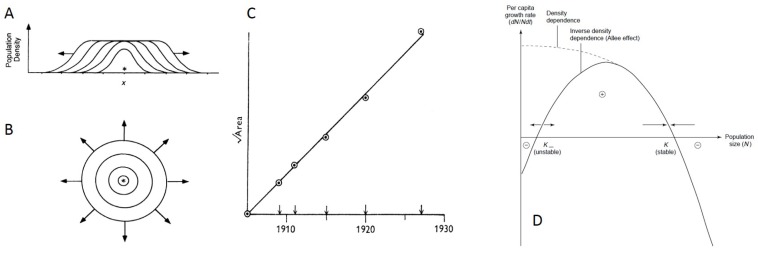
Patterns and dynamics of spatial spread from the ecological literature. (A) Populations expand as a traveling wave in a single spatial dimension; (B) Populations expand as a traveling wave in two-dimensional space. Figures (A) and (B) reproduced from [78]; (C) When populations expand in two spatial dimensions, the square root of the area that is inhabited is expected to grow linearly in time. Figure reproduced from [79]; (D) Types of density-dependence. Negative density-dependence (curve labeled “density dependence") occurs when per capita growth rates decrease with increases in local population densities. Allee effects occur when per capita growth rates (y-axis) first increase, and then decrease, with increases in local population densities or sizes (x-axis). Figure reproduced from [80].
Figure 4
Figure 4
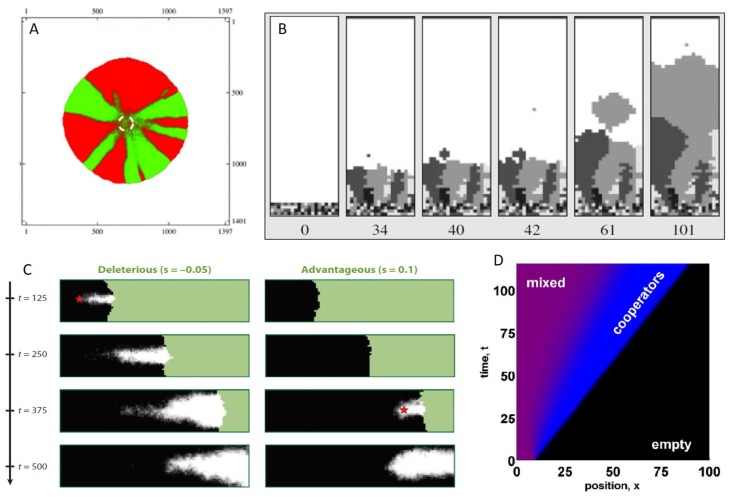
The effects of spatial spread on a population’s evolutionary dynamics. (A) Local movement in two-dimensional space leads to the generation of genetically homogeneous ‘sectors’. Figure reproduced from [109]; (B) Intermediate levels of long-distance dispersal result in major reductions in genetic diversity, as described by the ‘embolism effect’. Panels, from left to right, show time evolution of the simulation. Figure reproduced from [105]; (C) Mutations can ‘surf’ to high frequencies, regardless of whether they are deleterious (left), beneficial (right), or neutral (not shown). Figure reproduced from [100]; (D) Spatially expanding populations can select for cooperative phenotypes at the leading edge. Figure reproduced from [110].

References

    1. Furuse Y., Oshitani H. Global Transmission Dynamics of Measles in the Measles Elimination Era. Viruses. 2017;9:82. doi: 10.3390/v9040082. - DOI - PMC - PubMed
    1. Salje H., Lessler J., Berry I.M., Melendrez M.C., Endy T., Kalayanarooj S., A-Nuegoonpipat A., Chanama S., Sangkijporn S., Klungthong C., et al. Dengue diversity across spatial and temporal scales: Local structure and the effect of host population size. Science. 2017;355:1302–1306. doi: 10.1126/science.aaj9384. - DOI - PMC - PubMed
    1. Viboud C., Bjornstad O.N., Smith D.L., Simonsen L., Miller M.A., Grenfell B.T. Synchrony, Waves, and Spatial Hierarchies in the Spread of Influenza. Science. 2006;312:447–451. doi: 10.1126/science.1125237. - DOI - PubMed
    1. Bozick B.A., Real L.A. The Role of Human Transportation Networks in Mediating the Genetic Structure of Seasonal Influenza in the United States. PLoS Pathog. 2015;11:e1004898. doi: 10.1371/journal.ppat.1004898. - DOI - PMC - PubMed
    1. Charu V., Zeger S., Gog J., Bjørnstad O.N., Kissler S., Simonsen L., Grenfell B.T., Viboud C. Human mobility and the spatial transmission of influenza in the United States. PLoS Comput. Biol. 2017;13:e1005382. doi: 10.1371/journal.pcbi.1005382. - DOI - PMC - PubMed

Publication types