. 2018 Nov 14;8(1):16790.
doi: 10.1038/s41598-018-34882-x.

Regional variations in human milk oligosaccharides in Vietnam suggest FucTx activity besides FucT2 and FucT3

Affiliations

Regional variations in human milk oligosaccharides in Vietnam suggest FucTx activity besides FucT2 and FucT3

Sander S van Leeuwen et al. Sci Rep. .

Abstract

Breastfeeding is the normal way of providing young infants with the nutrients they need for healthy growth and development (WHO). Human milk oligosaccharides (hMOS) constitute a highly important class of nutrients that are attracting strong attention in recent years. Several studies have indicated that hMOS have prebiotic properties, but also are effective in anti-adhesion of pathogens, modulating the immune system and providing nutrients for brain growth and development. Most of the latter functions seem to be linked to the presence of fucose-containing immunodeterminant epitopes, and Neu5Ac-bearing oligosaccharides. Analysis of hMOS isolated from 101 mothers' milk showed regional variation in Lewis- and Secretor based immunodeterminants. Lewis-negative milk groups could be sub-divided into two sub-groups, based on the activity of a third and hitherto unidentified fucosyltransferase enzyme. Analysis of hMOS remaining in faeces showed three sub-groups based on hMOS surviving passage through the gut, full consumption, specific partial consumption and non-specific partial consumption, fitting previous findings.


Conflict of interest statement

The authors declare no competing interests.

Figures
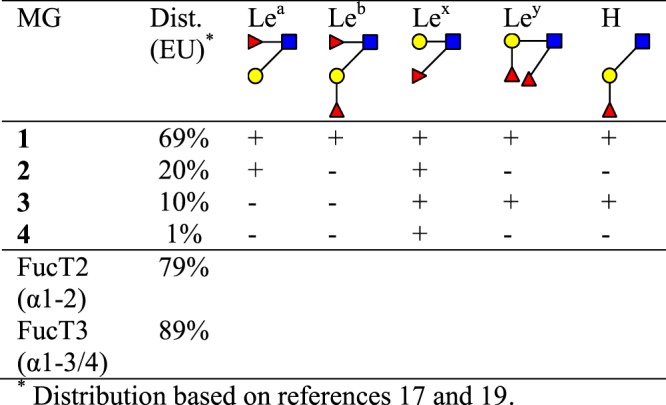
Figure 1
Figure 1
Expected structural epitopes and relative occurrence are indicated for the four milk groups (MG). The bottom part shows the derived presence of actively expressed FucT2 and FucT3 enzymes.
Figure 2
Figure 2
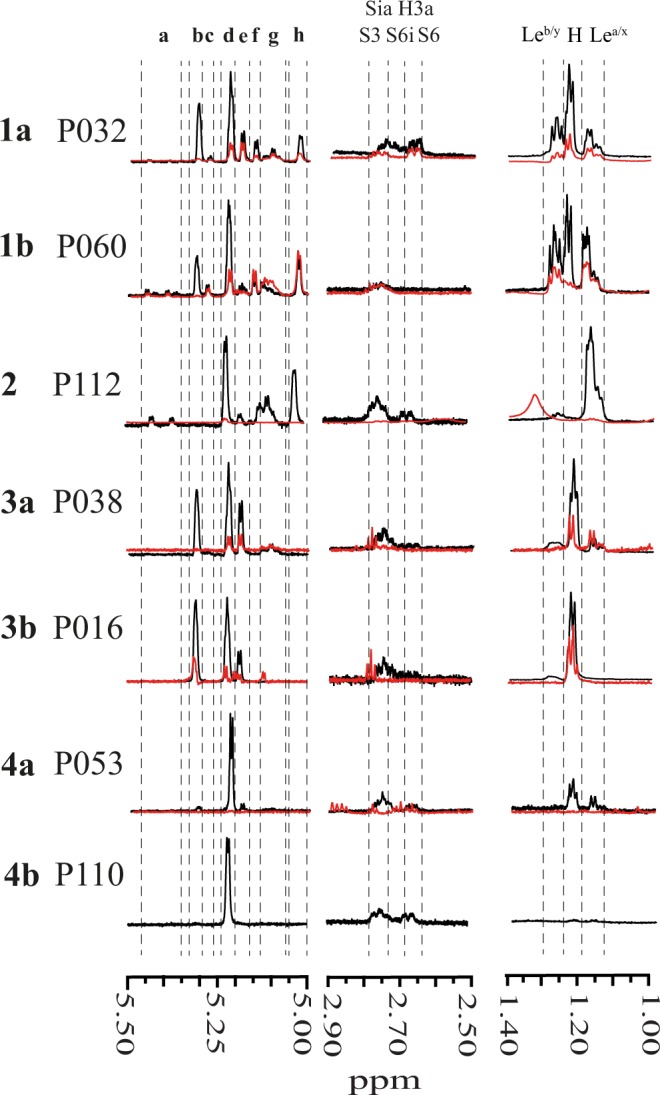
Example 1D 1H NMR spectra for milk groups 1a, 1b, 2, 3a, 3b, 4a and 4b. Black line is the spectrum for mothers’ milk and the red line (where present) is for the corresponding infant faeces sample. Structural-reporter-group signals are indicated; anomeric region δ5.00–5.50: (a) Fuc(α1–3)- H-1 in pseudo-Lex (3-FL) and pseudo-Ley (DF-L) epitopes, (b) Fuc(α1–2)- H-1 in 2′-FL, (c) Fuc(α1–2)- H-1 in Ley epitopes, (d) α-D-Glcp H-1, (e) Fuc(α1–2)- H-1 in H-antigen epitopes and α-D-Glcp H-1 in 3-FL and DF-L, (f) Fuc(α1–2)- H-1 in Leb epitopes, (g) Fuc(α1–3)- H-1 in Lex and Ley epitopes (h). Fuc(α1–4)- in Lea and Leb epitopes, Neu5Ac region δ2.50–2.90 ppm: S3 Neu5Ac(α2–3)- H-3e, S6 Neu5Ac(α2–6)-Gal H-3e, and S6i Neu5Ac(α2–6)-GlcNAc H-3e; Fuc CH3 region δ 1.00–1.40: Leb/y CH3 signals of Fuc residues in Leb and Ley epitopes, H, CH3 signals of Fuc residues in H-antigen epitopes and Lea/x, CH3 signals of Fuc residues in Lea and Lex epitopes.
Figure 3
Figure 3
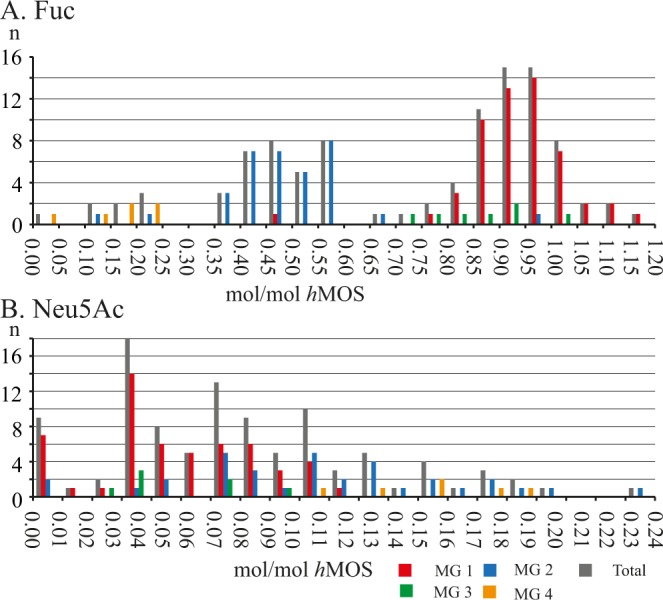
Molar-ratio distributions for the different regions and the total Vietnamese population of A. Fuc and B. Neu5Ac, in mol/mol hMOS based on HPAEC-PAD peak integrations of known peaks. Level of Fuc is based on peaks 1–7 and 10 in relation to all 14 peaks. Levels of Neu5Ac is based on peaks 10–14 in relation to all 14 peaks. Di-fucosylated structures count for 2 Fuc and structure 14 counts for 2 Neu5Ac.
Figure 4
Figure 4
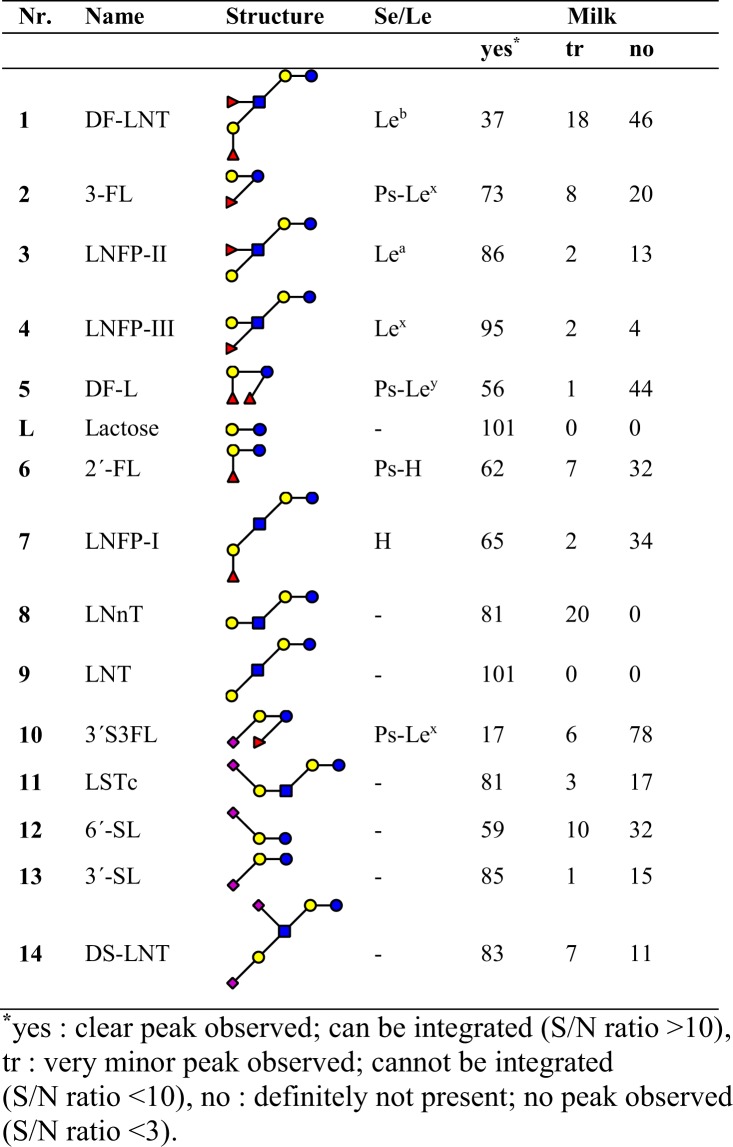
HPAEC-PAD analysis of 14 reference compounds. Secretor and Lewis based histo-blood groups. The occurrence in milk samples based HPAEC-PAD analysis is shown.
Figure 5
Figure 5
Distribution plots of (A) Fuc and (B) Neu5Ac in mol/mol hMOS derived from HPAEC-PAD for the total sample population (grey), compared with milk group 1 (red), milk group 2 (blue), milk group 3 (green) and milk group 4 (orange).

References

    1. Czank, C., Mitoulas, L. & Hartmann, P. E. Human milk composition – Carbohydrate In: Hale & Hartmann’s Textbook of Human Lactation, First edition. Hale, T. W. & Hartmann, P. E. Eds Hale Publishing L. P, Amarillo, TX, USA (2007).
    1. Bode L. Human milk oligosaccharides: Every baby needs a sugar mama. Glycobiology. 2012;22:1147–1162. doi: 10.1093/glycob/cws074. - DOI - PMC - PubMed
    1. Bode L. Human milk oligosaccharides: prebiotics and beyond. Nutr. Rev. 2009;67:S183–S191. doi: 10.1111/j.1753-4887.2009.00239.x. - DOI - PubMed
    1. Bode L, et al. Inhibition of monocyte, lymphocyte, and neutrophil adhesion to endothelial cells by human milk oligosaccharides. Thromb. Haemost. 2004;92:1402–1410. doi: 10.1160/TH04-01-0055. - DOI - PubMed
    1. Wang B. Sialic acid is an essential nutrient for brain development and cognition. Annu. Rev. Nutr. 2009;29:177–222. doi: 10.1146/annurev.nutr.28.061807.155515. - DOI - PubMed

Publication types