


Disease Severity in Treatment Resistant Schizophrenia Patients Is Mainly Affected by Negative Symptoms, Which Mediate the Effects of Cognitive Dysfunctions and Neurological Soft Signs
- PMID: 30429802
- PMCID: PMC6220073
- DOI: 10.3389/fpsyt.2018.00553
Disease Severity in Treatment Resistant Schizophrenia Patients Is Mainly Affected by Negative Symptoms, Which Mediate the Effects of Cognitive Dysfunctions and Neurological Soft Signs
Abstract
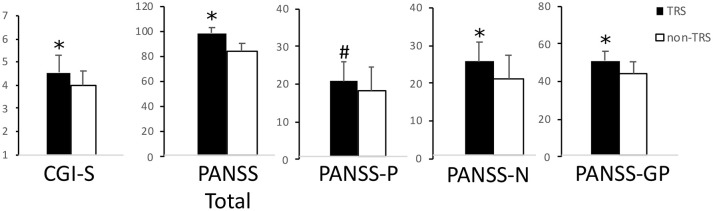
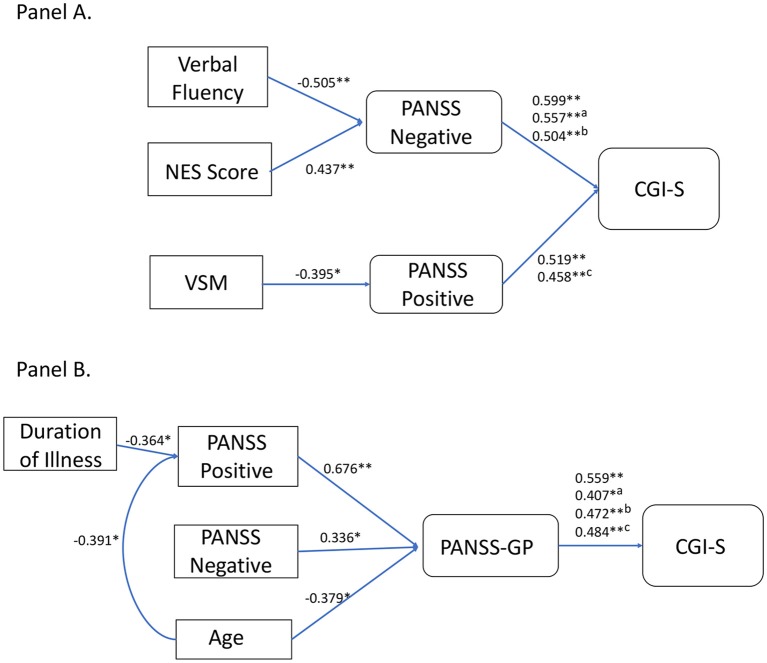
This post-hoc study was aimed at assessing whether disease severity was higher in a sample of Treatment Resistant Schizophrenia patients (TRS) compared to schizophrenia patients responsive to antipsychotics (non-TRS). Determinants of disease severity were also investigated in these groups. Eligible patients were screened by standardized diagnostic algorithm to categorize them as TRS or non-TRS. All patients underwent the following assessments: CGI-S; PANSS; DAI; NES; a battery of cognitive tests. Socio-demographic and clinical variables were also recorded. TRS patients exhibited significantly higher disease severity and psychotic symptoms, either as PANSS total score or subscales' scores. A preliminary correlation analysis ruled out clinical and cognitive variables not associated with disease severity in the two groups. Hierarchical linear regression showed that negative symptoms were the clinical variable explaining the highest part of variation in disease severity in TRS, while in non-TRS patients PANSS-General Psychopathology was the variable explaining the highest variation. Mediation analysis showed that negative symptoms mediate the effects of verbal fluency dysfunctions and high-level neurological soft signs (NSS) on TRS' disease severity. These results show that determinants of disease severity sharply differ in TRS and non-TRS patients, and let hypothesize that TRS may stem from cognitive disfunctions and putatively neurodevelopmental aberrations.
Keywords: antipsychotics; clozapine; positive symptoms; psychosis; refractory; response.
Figures
References
-
- Howes OD, McCutcheon R, Agid O, de Bartolomeis A, van Beveren NJ, Birnbaum ML, et al. Treatment-Resistant Schizophrenia: Treatment Response and Resistance in Psychosis (TRRIP) working group consensus guidelines on diagnosis and terminology. Am J Psychiatry (2017) 174:216–29. 10.1176/appi.ajp.2016.16050503 - DOI - PMC - PubMed
-
- Iasevoli F, Giordano S, Balletta R, Latte G, Formato MV, Prinzivalli E, et al. Treatment resistant schizophrenia is associated with the worst community functioning among severely-ill highly-disabling psychiatric conditions and is the most relevant predictor of poorer achievements in functional milestones. Prog Neuropsychopharmacol Biol Psychiatry (2016) 65:34–48. 10.1016/j.pnpbp.2015.08.010 - DOI - PubMed
-
- Iasevoli F, Avagliano C, Altavilla B, Barone A, Ciccarelli M, D'Ambrosio L, et al. Evaluation of a few discrete clinical markers may predict categorization of actively symptomatic non-acute schizophrenia patients as treatment resistant or responders: a study by ROC curve analysis and multivariate analyses. Psychiatry Res. (2018) 269:481–93. 10.1016/j.psychres.2018.08.109 - DOI - PubMed
LinkOut - more resources
Full Text Sources
