. 2018 Oct 31:9:2596.
doi: 10.3389/fmicb.2018.02596. eCollection 2018.

Seasonal Genetic Drift of Human Influenza A Virus Quasispecies Revealed by Deep Sequencing

Affiliations

Seasonal Genetic Drift of Human Influenza A Virus Quasispecies Revealed by Deep Sequencing

Cyril Barbezange et al. Front Microbiol. .

Abstract

After a pandemic wave in 2009 following their introduction in the human population, the H1N1pdm09 viruses replaced the previously circulating, pre-pandemic H1N1 virus and, along with H3N2 viruses, are now responsible for the seasonal influenza type A epidemics. So far, the evolutionary potential of influenza viruses has been mainly documented by consensus sequencing data. However, like other RNA viruses, influenza A viruses exist as a population of diverse, albeit related, viruses, or quasispecies. Interest in this quasispecies nature has increased with the development of next generation sequencing (NGS) technologies that allow a more in-depth study of the genetic variability. NGS deep sequencing methodologies were applied to determine the whole genome genetic heterogeneity of the three categories of influenza A viruses that circulated in humans between 2007 and 2012 in France, directly from clinical respiratory specimens. Mutation frequencies and single nucleotide polymorphisms were used for comparisons to address the level of natural intrinsic heterogeneity of influenza A viruses. Clear differences in single nucleotide polymorphism profiles between seasons for a given subtype also revealed the constant genetic drift that human influenza A virus quasispecies undergo.

Keywords: NGS; genetic drift; influenza season; influenza virus; quasispecies.


Figures
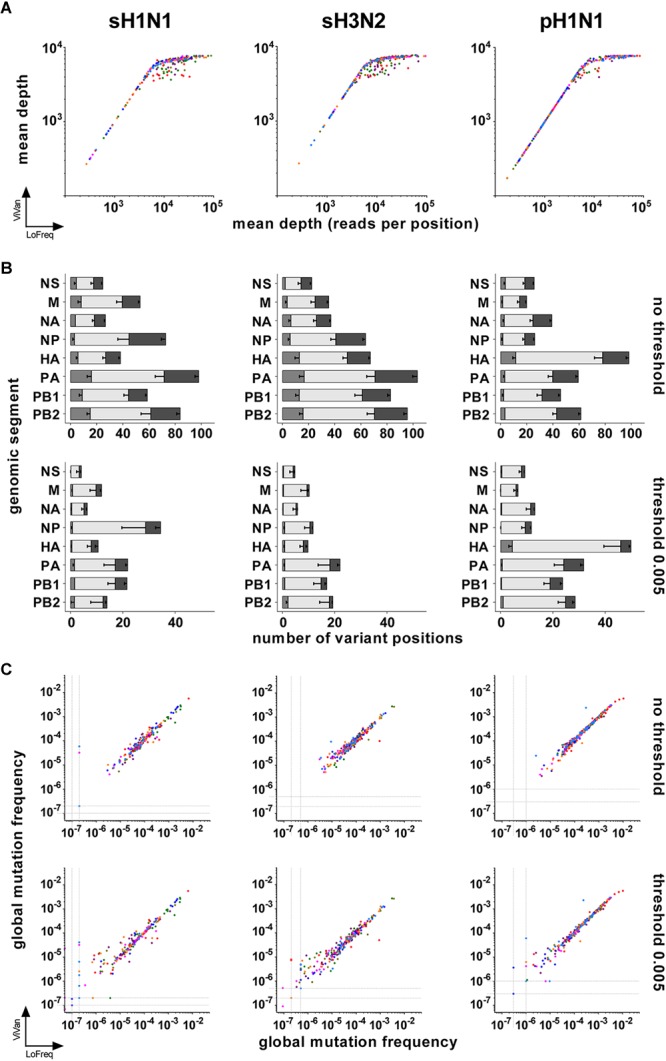
FIGURE 1
FIGURE 1
Comparison of LoFreq and ViVAN. (A) Correlation of the mean depths of sequencing (in number of reads per position) obtained by both pipelines. X-axis: LoFreq; Y-axis: ViVAN. Each dot represents one segment of one sample: polymerase sub-unit PB2: olive; polymerase sub-unit PB1: green; polymerase sub-unit PA: purple; hemagglutinin HA: red; nucleoprotein NP: dark blue; neuraminidase NA: pink; matrix and ion channel proteins M: orange; non-structural protein and nuclear export protein NS: light blue. (B) Mean number of variant positions identified by the pipelines, without or with setting a mutation frequency threshold. For each bar, from left to right: gray, specific to LoFreq; light gray, common to LoFreq and ViVAN; dark gray, specific to ViVAN. Error bars represent the Standard Error to the Mean. (C) Correlation of the global mutation frequencies obtained with both pipelines with or without setting a mutation frequency threshold. X-axis: LoFreq; Y-axis: ViVAN. Each dot represents one segment of one sample: PB2: olive; PB1: green; PA: purple; HA: red; NP: dark blue; NA: pink; M: orange; NS: light blue.
FIGURE 2
FIGURE 2
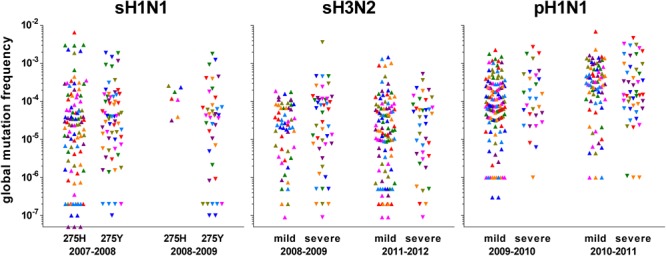
Representation of the global mutation frequencies according to season and group of interest. Values were calculated from the data obtained with LoFreq at a 0.005 threshold. Each symbol represents one segment of one sample: polymerase sub-unit PB2: olive; polymerase sub-unit PB1: green; polymerase sub-unit PA: purple; hemagglutinin HA: red; nucleoprotein NP: dark blue; neuraminidase NA: pink; matrix and ion channel proteins M: orange; non-structural protein and nuclear export protein NS: light blue. For pre-pandemic sH1N1 viruses, groups were based on the oseltamivir-resistance mutation H275Y (275H: sensitive; 275Y: resistant) in the neuraminidase; for both H3N2 and pandemic pH1N1 viruses, groups were based on the severity according to the network of sampling (mild through community physicians, severe through hospitals).
FIGURE 3
FIGURE 3
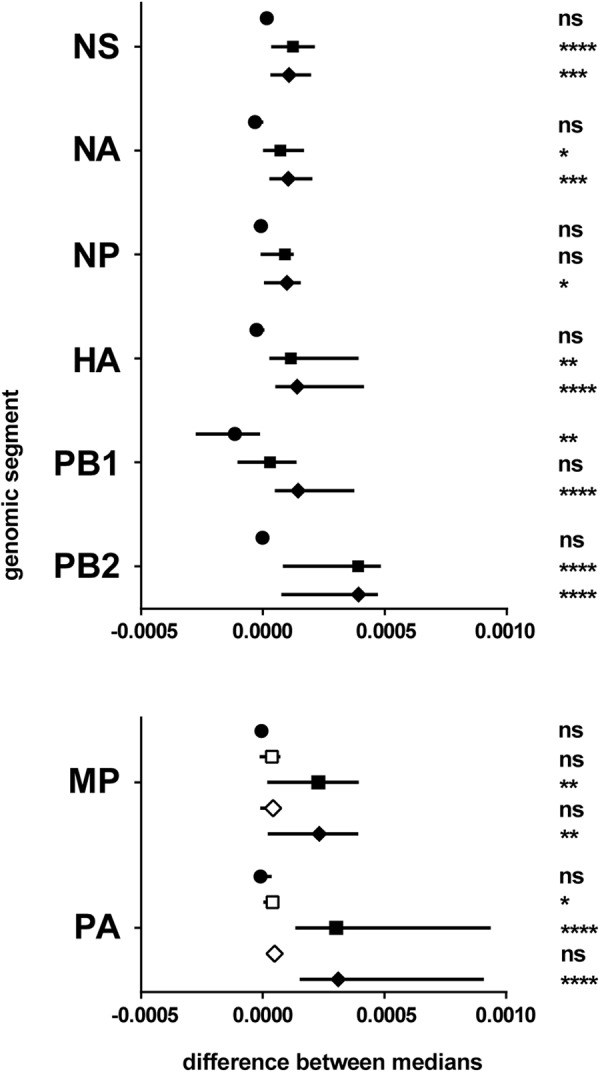
Differences between subtypes. Results of the pairwise comparisons by Mann–Whitney–Wilcoxon test of the global mutation frequency distributions (Supplementary Table 4). The genomic segments considered are mentioned on the left. X-axis: difference between the medians (symbol) and 95% CI of the difference (line). Symbols: circle, sH1N1 vs. sH3N2; square, sH1N1 vs. pH1N1 (for MP and PA, open square for pH1N1 season 2009–2010, plain square for pH1N1 season 2010–2011); diamond, sH3N2 vs. pH1N1 (for MP and PA, open square for pH1N1 season 2009–2010, plain square for pH1N1 season 2010–2011). ns, non-significant; 0.05 ≥p-value > 0.01; ∗∗0.01 ≥p-value > 0.001; ∗∗∗0.001 ≥p-value > 0.0001; ∗∗∗∗p-value ≤ 0.0001.
FIGURE 4
FIGURE 4
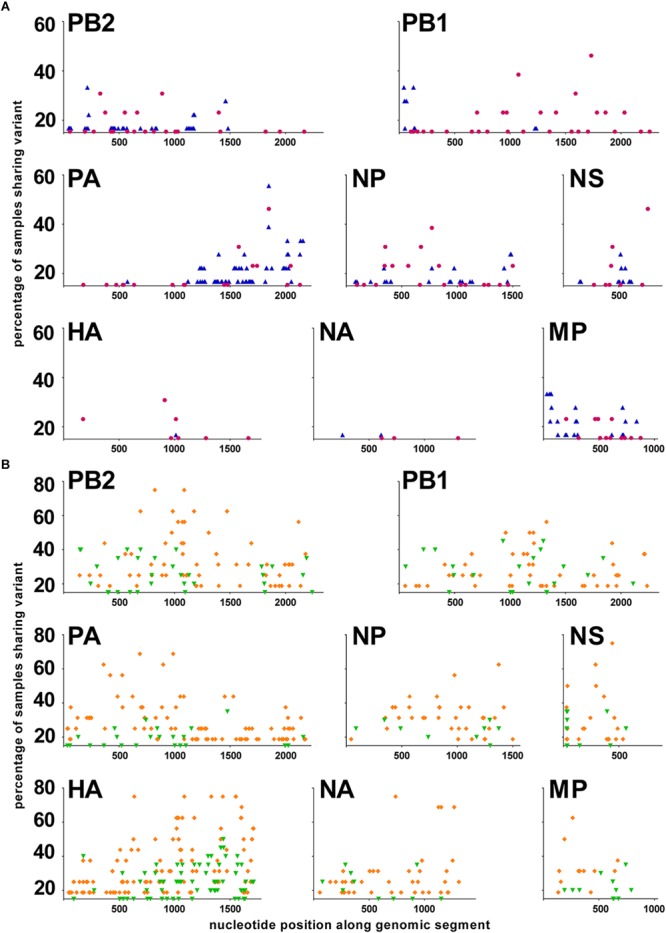
Distribution of vSNPs along the genome. A viral Single Nucleotide Polymorphism (vSNP) is a position with a significant variant that has been identified in at least 15% of the samples in a group. X-axis: nucleotide position along each genomic segment; Y-axis: percentage of samples sharing a significant variant. (A) sH3N2 samples. In purple: season 2008–2009; in blue: season 2011–2012. (B) pH1N1 samples. In green: season 2009–2010; in orange: season 2010–2011.

References

    1. Acevedo A., Andino R. (2014). Library preparation for highly accurate population sequencing of RNA viruses. Nat. Protoc. 9 1760–1769. 10.1038/nprot.2014.118 - DOI - PMC - PubMed
    1. Barr I. G., Russell C., Besselaar T. G., Cox N. J., Daniels R. S., Donis R., et al. (2014). WHO recommendations for the viruses used in the 2013-2014 Northern Hemisphere influenza vaccine: epidemiology, antigenic and genetic characteristics of influenza A(H1N1)pdm09, A(H3N2) and B influenza viruses collected from October 2012 to January 2013. Vaccine 32 4713–4725. 10.1016/j.vaccine.2014.02.014 - DOI - PubMed
    1. Beerenwinkel N., Gunthard H. F., Roth V., Metzner K. J. (2012). Challenges and opportunities in estimating viral genetic diversity from next-generation sequencing data. Front. Microbiol. 3:329. 10.3389/fmicb.2012.00329 - DOI - PMC - PubMed
    1. Briat A., Dulioust E., Galimand J., Fontaine H., Chaix M. L., Letur-Konirsch H., et al. (2005). Hepatitis C virus in the semen of men coinfected with HIV-1: prevalence and origin. AIDS 19 1827–1835. 10.1097/01.aids.0000189847.98569.2d - DOI - PubMed
    1. Chen H., Wen X., To K. K., Wang P., Tse H., Chan J. F., et al. (2010). Quasispecies of the D225G substitution in the hemagglutinin of pandemic influenza A(H1N1) 2009 virus from patients with severe disease in Hong Kong, China. J. Infect. Dis. 201 1517–1521. 10.1086/652661 - DOI - PubMed

LinkOut - more resources