A real-time PCR assay for quantification of parasite burden in murine models of leishmaniasis
- PMID: 30430041
- PMCID: PMC6231426
- DOI: 10.7717/peerj.5905
A real-time PCR assay for quantification of parasite burden in murine models of leishmaniasis
Abstract
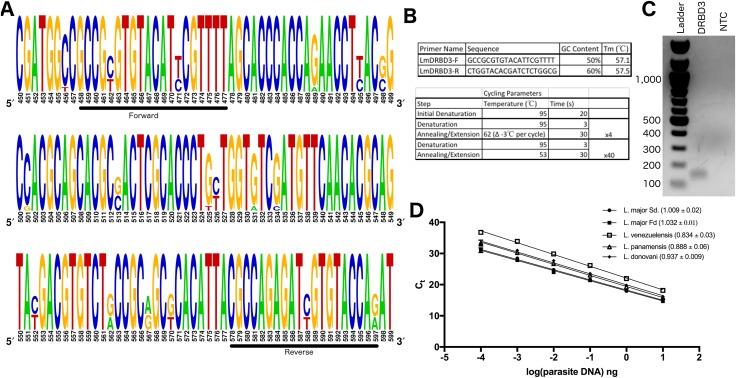
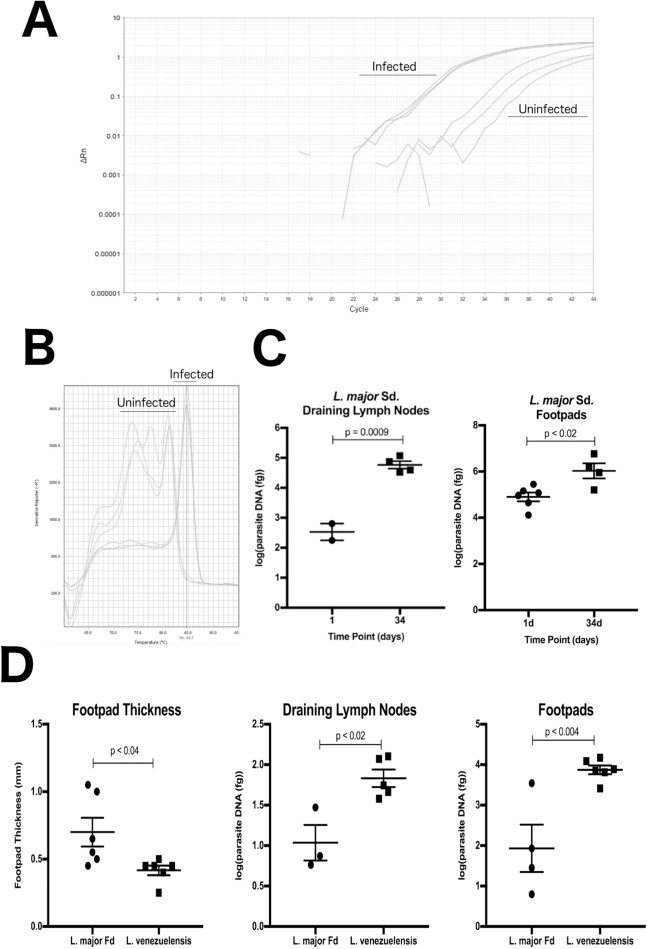
Eukaryotic parasites in the genus Leishmania place approximately 350 million people per year at risk of disease. In addition to their global health significance, Leishmania spp. have served as an important model for delineating basic concepts in immunology such as T-helper cell polarization. There have been many qPCR-based assays reported for measuring parasite burden in humans and animals. However, these are largely optimized for use in clinical diagnosis and not specifically for animal models. This has led several of these assays to have suboptimal characteristics for use in animal models. For example, multi-copy number genes have been frequently used to increase sensitivity but are subject to greater plasticity within the genome and thus may confound effects of experimental manipulations in animal models. In this study, we developed a sybr-green based quantitative touchdown PCR assay for a highly conserved and single-copy putative RNA-binding protein, DRBD3. With primers that share greater than 90% sequence identity across all sequenced Leishmania spp., we demonstrate that this assay has a lower limit of detection of 100 fg of parasite DNA for Leishmania major, L. donovani, L. venezuelensis, and L. panamensis. Using C57BL6/J mice, we used this assay to monitor parasite burden over 1 month of infection with two strains of L. major (Seidman and Friedlin), and L. venezeuelensis. These characteristics rival the sensitivity of previously reported qPCR based methods of parasite quantitation while amplifying a stable, single copy gene. Use of this protocol in the future will lead to improved accuracy in animal based models and help to tease apart differences in biology of host-parasite interactions.
Keywords: DRBD3; Leishmania; Leishmaniasis; Mouse; Parasite burden; Quantitative real-time PCR.
Conflict of interest statement
The authors declare that they have no competing interests.
Figures
References
-
- Akopyants NS, Matlib RS, Bukanova EN, Smeds MR, Brownstein BH, Stormo GD, Beverley SM. Expression profiling using random genomic DNA microarrays identifies differentially expressed genes associated with three major developmental stages of the protozoan parasite Leishmania major. Molecular and Biochemical Parasitology. 2004;136(1):71–86. doi: 10.1016/j.molbiopara.2004.03.002. - DOI - PubMed
-
- Aoki JI, Muxel SM, Zampieri RA, Laranjeira-Silva MF, Muller KE, Nerland AH, Floeter-Winter LM. RNA-seq transcriptional profiling of Leishmania amazonensis reveals an arginase-dependent gene expression regulation. PLOS Neglected Tropical Diseases. 2017;11(10):e0006026. doi: 10.1371/journal.pntd.0006026. - DOI - PMC - PubMed
-
- Aslett M, Aurrecoechea C, Berriman M, Brestelli J, Brunk BP, Carrington M, Depledge DP, Fischer S, Gajria B, Gao X, Gardner MJ, Gingle A, Grant G, Harb OS, Heiges M, Hertz-Fowler C, Houston R, Innamorato F, Iodice J, Kissinger JC, Kraemer E, Li W, Logan FJ, Miller JA, Mitra S, Myler PJ, Nayak V, Pennington C, Phan I, Pinney DF, Ramasamy G, Rogers MB, Roos DS, Ross C, Sivam D, Smith DF, Srinivasamoorthy G, Stoeckert CJ, Jr, Subramanian S, Thibodeau R, Tivey A, Treatman C, Velarde G, Wang H. TriTrypDB: a functional genomic resource for the Trypanosomatidae. Nucleic Acids Research. 2010;38(Suppl_1):D457–462. doi: 10.1093/nar/gkp851. - DOI - PMC - PubMed
-
- Bailey F, Mondragon-Shem K, Hotez P, Ruiz-Postigo JA, Al-Salem W, Acosta-Serrano A, Molyneux DH. A new perspective on cutaneous leishmaniasis–Implications for global prevalence and burden of disease estimates. PLOS Neglected Tropical Diseases. 2017;11(8):e0005739. doi: 10.1371/journal.pntd.0005739. - DOI - PMC - PubMed
Grants and funding
LinkOut - more resources
Full Text Sources
Miscellaneous