Gene Promoter Methylation in Endometrial Carcinogenesis
- PMID: 30430425
- PMCID: PMC6449282
- DOI: 10.1007/s12253-018-0489-2
Gene Promoter Methylation in Endometrial Carcinogenesis
Abstract
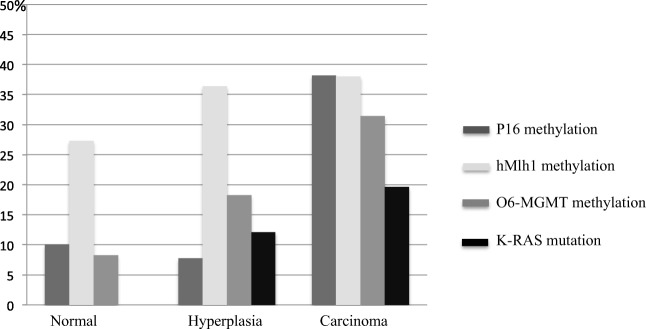
Up to 60% of untreated atypical hyperplastic endometrium will develop into endometrial carcinoma (EC), and for those who underwent a hysterectomy a coexisting EC is found in up to 50%. Gene promoter methylation might be related to the EC development. The aim of this study is to determine changes in gene promoter profiles in normal endometrium, atypical hyperplasia (AH) and EC in relation to K-Ras mutations. A retrospective study was conducted in patients diagnosed with endometrial hyperplasia with and without subsequent EC. Promoter methylation of APC, hMLh1, O6-MGMT, P14, P16, RASSF1, RUNX3 was analysed on pre-operative biopsies, and correlated to the final histological diagnosis, and related to the presence of K-Ras mutations. In the study cohort (n=98), differences in promoter methylation were observed for hMLH1, O6-MGMT, and P16. Promoter methylation of hMLH1 and O6-MGMT gradually increased from histologically normal endometrium to AH to EC; 27.3, 36.4% and 38.0% for hMLH1 and 8.3%, 18.2% and 31.4% for O6-MGMT, respectively. P16 promoter methylation was significantly different in AH (7.7%) compared to EC (38%). K-Ras mutations were observed in 12.1% of AH, and in 19.6% of EC cases. No association of K-Ras mutation with promoter methylation of any of the tested genes was found. In conclusion, hMLH1 and O6-MGMT promoter methylation are frequently present in AH, and thus considered to be early events in the carcinogenesis of EC, whereas P16 promoter methylation was mainly present in EC, and not in precursor lesions supporting a late event in the carcinogenesis.
Keywords: Endometrial cancer; Endometrial hyperplasia; K-Ras; Methylation; P16; hMLH1.
Conflict of interest statement
The authors declare that they have no conflict of interest.
Figures

References
-
- Siegel R, Naishadham D, Jemal A. Cancer statistics, 2013. CA Cancer J Clin. 2013;63(1):11–30. - PubMed
-
- Boll D, Karim-Kos HE, Verhoeven RH, Burger CW, Coebergh JW, van de Poll-Franse LV, et al. Increased incidence and improved survival in endometrioid endometrial cancer diagnosed since 1989 in The Netherlands: a population based study. Eur J Obstet Gynecol Reprod Biol. 2013;166(2):209–214. - PubMed
-
- Albertini AF, Devouassoux-Shisheboran M, Genestie C. Pathology of endometrioid carcinoma. Bull Cancer. 2012;99(1):7–12. - PubMed
-
- Muraki Y, Banno K, Yanokura M, Kobayashi Y, Kawaguchi M, Nomura H, et al. Epigenetic DNA hypermethylation: clinical applications in endometrial cancer (Review) Oncol Rep. 2009;22(5):967–972. - PubMed
MeSH terms
Substances
LinkOut - more resources
Full Text Sources
Research Materials
Miscellaneous