


Involvement of the long noncoding RNA NEAT1 in carcinogenesis
- PMID: 30430751
- PMCID: PMC6322192
- DOI: 10.1002/1878-0261.12404
Involvement of the long noncoding RNA NEAT1 in carcinogenesis
Abstract
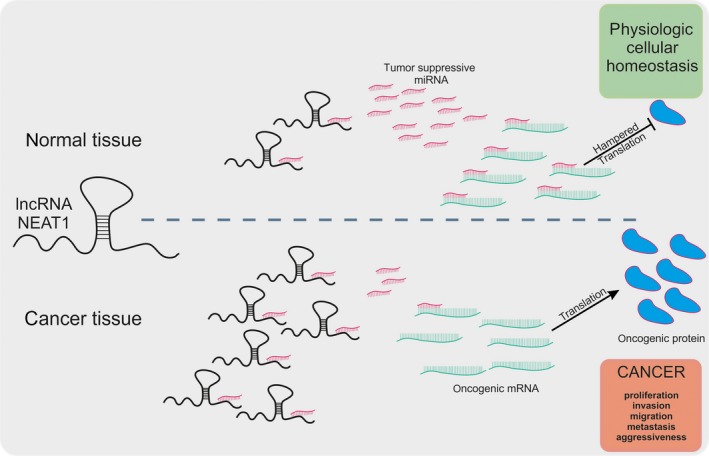
Altered expression levels of the long noncoding RNA (lncRNA) nuclear-enriched abundant transcript 1 (NEAT1) have been reported in different types of cancer. More than half of the NEAT1 studies in cancer have been published within the last 2 years. In this review, we discuss very recent developments and insights into NEAT1 contribution to carcinogenesis. Summarizing the literature, it becomes obvious that NEAT1 is a lncRNA highly de-/upregulated in a variety of cancer entities, in which it primarily acts as a competing endogenous RNA (ceRNA) which sponges tumor-suppressive microRNA (miRNA). The sponged miRNA lose their ability to degrade, silence, or hamper translation of their downstream-mostly oncogenic-target transcripts, ultimately promoting carcinogenesis. This role of NEAT1 function in tumorigenesis suggests it may be a prognostic biomarker as well as potential therapeutic target, pending the completion of further studies into the underlying mechanisms.
Keywords: NEAT1; cancer; ceRNA; lncRNA; miRNA.
© 2018 The Authors. Published by FEBS Press and John Wiley & Sons Ltd.
Figures
References
-
- Adriaens C, Standaert L, Barra J, Latil M, Verfaillie A, Kalev P, Boeckx B, Wijnhoven PW, Radaelli E, Vermi W et al (2016) p53 induces formation of NEAT1 lncRNA‐containing paraspeckles that modulate replication stress response and chemosensitivity. Nat Med 22, 861–868. - PubMed
-
- Avalle L, Camporeale A, Camperi A and Poli V (2017) STAT3 in cancer: a double edged sword. Cytokine 98, 42–50. - PubMed
Publication types
MeSH terms
Substances
LinkOut - more resources
Full Text Sources
