


Bladder Preservation With Twice-a-Day Radiation Plus Fluorouracil/Cisplatin or Once Daily Radiation Plus Gemcitabine for Muscle-Invasive Bladder Cancer: NRG/RTOG 0712-A Randomized Phase II Trial
- PMID: 30433852
- PMCID: PMC6354769
- DOI: 10.1200/JCO.18.00537
Bladder Preservation With Twice-a-Day Radiation Plus Fluorouracil/Cisplatin or Once Daily Radiation Plus Gemcitabine for Muscle-Invasive Bladder Cancer: NRG/RTOG 0712-A Randomized Phase II Trial
Erratum in
-
Erratum.J Clin Oncol. 2021 Apr 10;39(11):1309. doi: 10.1200/JCO.21.00602. J Clin Oncol. 2021. PMID: 33826868 Free PMC article. No abstract available.
Abstract
Purpose: Fluorouracil plus cisplatin and radiation twice a day (FCT) is an established chemoradiation (CRT) regimen for selective bladder-sparing treatment of muscle-invasive bladder cancer. Gemcitabine and once daily radiation (GD) is a well-supported alternative. The current trial evaluates these regimens.
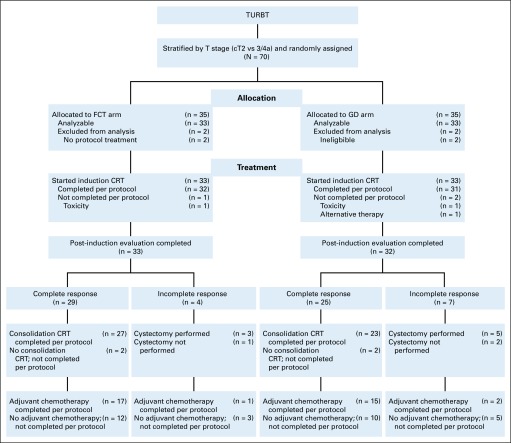
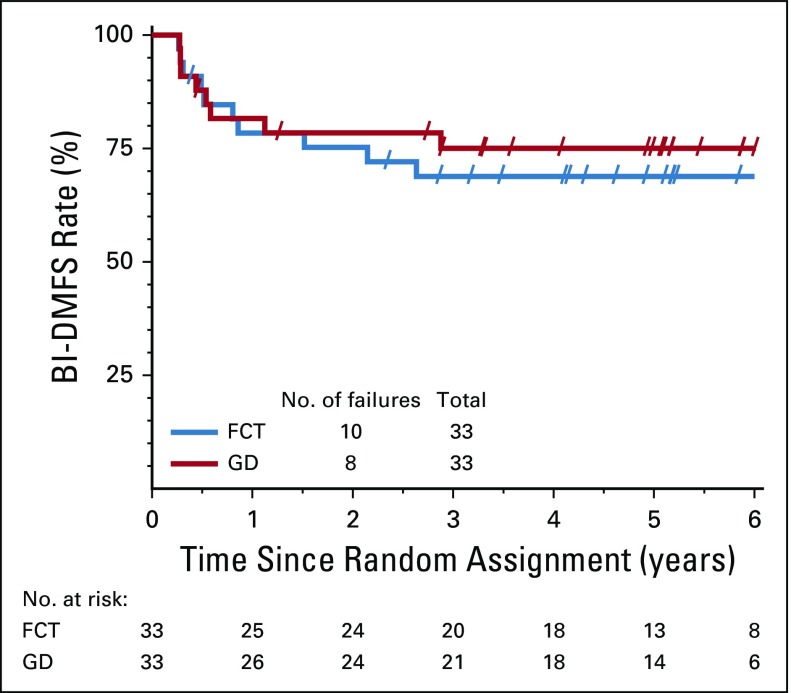
Methods: Patients with cT2-4a muscle-invasive bladder cancer were randomly assigned to FCT or GD. Patients underwent transurethral resection and induction CRT to 40 Gy. Patients who achieved a complete response (CR) received consolidation CRT to 64 Gy and others underwent cystectomy. We administered adjuvant gemcitabine/cisplatin chemotherapy. The primary end point was the rate of freedom from distant metastasis at 3 years (DMF3). The trial was not statistically powered to compare regimens, but to assess whether either regimen exceeded a DMF3 benchmark of 75%. Toxicity and efficacy end points, including CR and bladder-intact distant metastasis free survival at 3 years (BI-DMFS3), were assessed.
Results: From December 2008 to April 2014, 70 patients were enrolled, of which 66 were eligible for analysis, 33 per arm. Median follow-up was 5.1 years (range, 0.4 to 7.8 years) for eligible living patients. DMF3 was 78% and 84% for FCT and GD, respectively. BI-DMFS3 was 67% and 72%, respectively. Postinduction CR rates were 88% and 78%, respectively. Of 33 patients in the FCT arm, 21 (64%) experienced treatment-related grade 3 and 4 toxicities during protocol treatment, with 18 (55%), two (6%), and two patients (6%) experiencing grade 3 and 4 hematologic, GI, and genitourinary toxicity, respectively. For the 33 patients in the GD arm, these figures were 18 (55%) overall and 14 (42%), three (9%) and two patients (6%), respectively.
Conclusion: Both regimens demonstrated DMF3 greater than 75%. There were fewer toxicities observed in the GD arm. Either gemcitabine and once daily radiation or a cisplatin-based regimen could serve as a base for future trials of systemic therapy.
Figures
Comment in
-
Re: Bladder Preservation with Twice-a-day Radiation plus Fluorouracil/Cisplatin or Once Daily Radiation plus Gemcitabine for Muscle-invasive Bladder Cancer: NRG/RTOG 0712-A Randomized Phase II Trial.Eur Urol. 2019 Jun;75(6):1033-1034. doi: 10.1016/j.eururo.2019.02.020. Epub 2019 Feb 26. Eur Urol. 2019. PMID: 30819527 No abstract available.
-
Re: Bladder Preservation with Twice-a-Day Radiation plus Fluorouracil/Cisplatin or Once Daily Radiation plus Gemcitabine for Muscle-Invasive Bladder Cancer: NRG/RTOG 0712-A Randomized Phase II Trial.J Urol. 2020 Jul;204(1):183. doi: 10.1097/JU.0000000000001055. Epub 2020 Apr 9. J Urol. 2020. PMID: 32272037 No abstract available.
References
-
- Mak RH, Hunt D, Shipley WU, et al. : Long-term outcomes in patients with muscle-invasive bladder cancer after selective bladder-preserving combined-modality therapy: A pooled analysis of Radiation Therapy Oncology Group protocols 8802, 8903, 9506, 9706, 9906, and 0233. J Clin Oncol 32:3801-3809, 2014 - PMC - PubMed
-
- Efstathiou JA, Spiegel DY, Shipley WU, et al. : Long-term outcomes of selective bladder preservation by combined-modality therapy for invasive bladder cancer: The MGH experience. Eur Urol 61:705-711, 2012 - PubMed
-
- Rödel C, Grabenbauer GG, Kühn R, et al. : Combined-modality treatment and selective organ preservation in invasive bladder cancer: Long-term results. J Clin Oncol 20:3061-3071, 2002 - PubMed
-
- Stein JP, Lieskovsky G, Cote R, et al. : Radical cystectomy in the treatment of invasive bladder cancer: Long-term results in 1,054 patients. J Clin Oncol 19:666-675, 2001 - PubMed
-
- Chang SS, Bochner BH, Chou R, et al. : Treatment of nonmetastatic muscle-invasive bladder cancer: American Urological Association/American Society of Clinical Oncology/American Society for Radiation Oncology/Society of Urologic Oncology clinical practice guideline summary. J Oncol Pract 13:621-625, 2017 - PubMed
Publication types
MeSH terms
Substances
Grants and funding
LinkOut - more resources
Full Text Sources
Medical
Research Materials
Miscellaneous
