


Metagenomic Next-Generation Sequencing Reveals Individual Composition and Dynamics of Anelloviruses during Autologous Stem Cell Transplant Recipient Management
- PMID: 30441786
- PMCID: PMC6266913
- DOI: 10.3390/v10110633
Metagenomic Next-Generation Sequencing Reveals Individual Composition and Dynamics of Anelloviruses during Autologous Stem Cell Transplant Recipient Management
Abstract
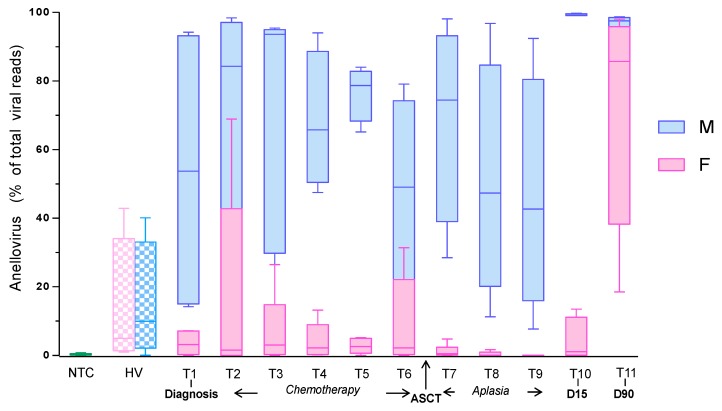
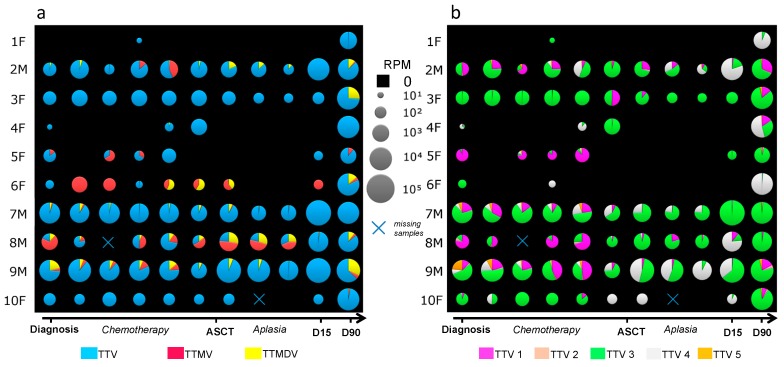
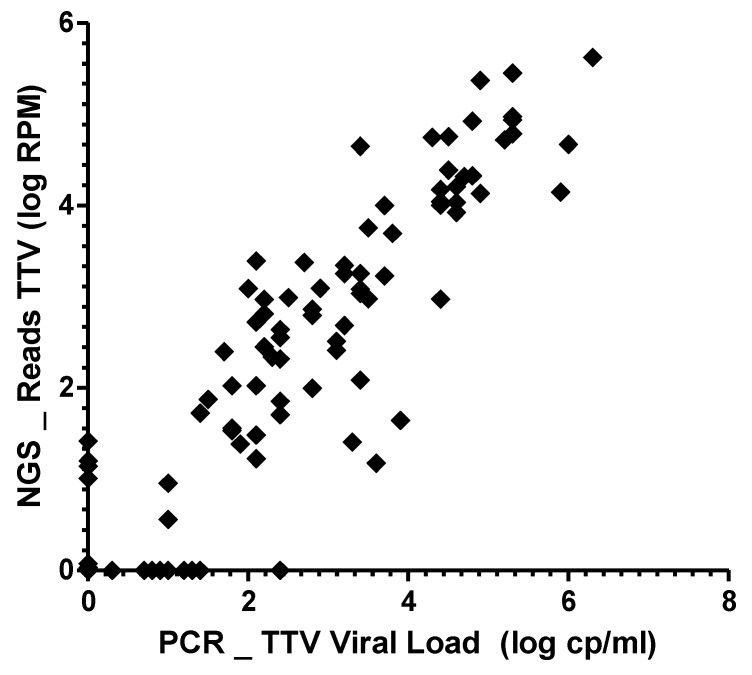
Over recent years, there has been increasing interest in the use of the anelloviruses, the major component of the human virome, for the prediction of post-transplant complications such as severe infections. Due to an important diversity, the comprehensive characterization of this viral family over time has been poorly studied. To overcome this challenge, we used a metagenomic next-generation sequencing (mNGS) approach with the aim of determining the individual anellovirus profile of autologous stem cell transplant (ASCT) patients. We conducted a prospective pilot study on a homogeneous patient cohort regarding the chemotherapy regimens that included 10 ASCT recipients. A validated viral mNGS workflow was used on 108 plasma samples collected at 11 time points from diagnosis to 90 days post-transplantation. A complex interindividual variability in terms of abundance and composition was noticed. In particular, a strong sex effect was found and confirmed using quantitative PCR targeting torque teno virus, the most abundant anellovirus. Interestingly, an important turnover in the anellovirus composition was observed during the course of the disease revealing a strong intra-individual variability. Although more studies are needed to better understand anellovirus dynamics, these findings are of prime importance for their future use as biomarkers of immune competence.
Keywords: Anelloviridae; immunocompromised patients; next-generation sequencing; stem cell transplant recipients; torque teno virus; viral metagenomics.
Conflict of interest statement
K.B.-P., V.C., G.O. are employees of bioMérieux. F.R., J.B. are employees of Bioaster. A.B. has served as consultant to bioMérieux, and received a research grant from bioMérieux.
Figures
References
-
- Moreto A., Fariñas-Alvarez C., Puente M., Ocejo-Vinyals J.G., Sánchez-Velasco P., Horcajada J.P., Batlle A., Montes C., Santos F., Conde E., et al. Mannose-binding lectin gene variants and infections in patients receiving autologous stem cell transplantation. BMC Immunol. 2014;15:17. doi: 10.1186/1471-2172-15-17. - DOI - PMC - PubMed
-
- Strassl R., Schiemann M., Doberer K., Görzer I., Puchhammer-Stöckl E., Eskandary F., Kikic Ž., Gualdoni G.A., Vossen M.G., Rasoul-Rockenschaub S., et al. Quantification of Torque Teno Virus Viremia as a Prospective Biomarker for Infectious Disease in Kidney Allograft Recipients. J. Infect. Dis. 2018;218:1191–1199. doi: 10.1093/infdis/jiy306. - DOI - PMC - PubMed
Publication types
MeSH terms
Substances
LinkOut - more resources
Full Text Sources
Other Literature Sources
Medical
