


Spectrum and Prevalence of Pathogenic Variants in Ovarian Cancer Susceptibility Genes in a Group of 333 Patients
- PMID: 30441849
- PMCID: PMC6266089
- DOI: 10.3390/cancers10110442
Spectrum and Prevalence of Pathogenic Variants in Ovarian Cancer Susceptibility Genes in a Group of 333 Patients
Abstract
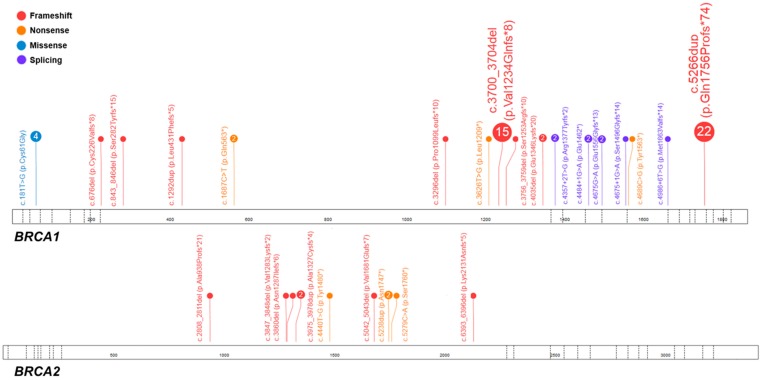
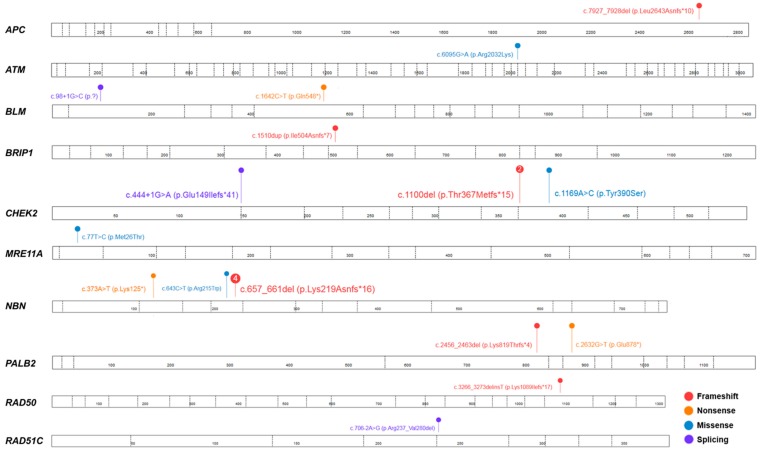
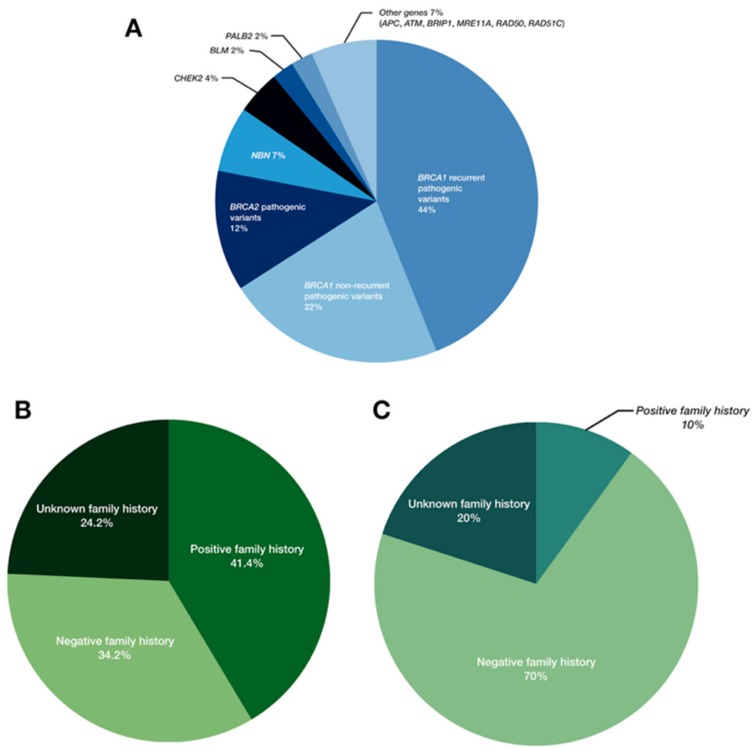
Constitutional loss-of-function pathogenic variants in the tumor suppressor genes BRCA1 and BRCA2 are widely associated with an elevated risk of ovarian cancer (OC). As only ~15% of OC individuals carry the BRCA1/2 pathogenic variants, the identification of other potential OC-susceptibility genes is of great clinical importance. Here, we established the prevalence and spectrum of the germline pathogenic variants in the BRCA1/2 and 23 other cancer-related genes in a large Polish population of 333 unselected OC cases. Approximately 21% of cases (71/333) carried the BRCA1/2 pathogenic or likely pathogenic variants, with c.5266dup (p.Gln1756Profs*74) and c.3700_3704del (p.Val1234Glnfs*8) being the most prevalent. Additionally, ~6% of women (20/333) were carriers of the pathogenic or likely pathogenic variants in other cancer-related genes, with NBN and CHEK2 reported as the most frequently mutated, accounting for 1.8% (6/333) and 1.2% (4/333) of cases, respectively. We also found ten pathogenic or likely pathogenic variants in other genes: 1/333 in APC, 1/333 in ATM, 2/333 in BLM, 1/333 in BRIP1, 1/333 in MRE11A, 2/333 in PALB2, 1/333 in RAD50, and 1/333 in RAD51C, accounting for 50% of all detected variants in moderate- and low-penetrant genes. Our findings confirmed the presence of the additional OC-associated genes in the Polish population that may improve the personalized risk assessment of these individuals.
Keywords: BARD1; BRCA1/2; CHEK2; NBN; PARP1 inhibitor; low-penetrance gene; mismatch repair genes; next-generation sequencing; ovarian cancer.
Conflict of interest statement
The authors declare no conflict of interest.
Figures
References
-
- Noone A.M., Krapcho M., Miller D., Brest A., Yu M., Ruhl J., Tatalovich Z., Mariotto A., Lewis D.R., Chen H.S., et al. SEER Cancer Statistics Review, 1975–2015. [(accessed on April 2018)]; Available online: https://seer.cancer.gov/csr/1975_2015/
Grants and funding
LinkOut - more resources
Full Text Sources
Research Materials
Miscellaneous
