Pattern of anaesthetic equipment contamination and infection prevention in anaesthesia practice at university hospitals
- PMID: 30443062
- PMCID: PMC6190425
- DOI: 10.4103/ija.IJA_41_18
Pattern of anaesthetic equipment contamination and infection prevention in anaesthesia practice at university hospitals
Abstract
Background and aims: Infection control is essential in anaesthetic practice for both personnel and equipment used. This study aims to evaluate knowledge of anaesthesiologists about infection control practices and to detect the pattern of anaesthetic devices contamination.
Methods: Cross-sectional observational study at two university hospitals was done. Self-administered questionnaires were distributed to 80 anaesthesiologists and 90 nursing staff. Forty-four samples were taken from rigid laryngoscopes (22 pairs from handle and blade) for detection of bacterial or fungal contamination. Same laryngoscopes were tested for occult blood.
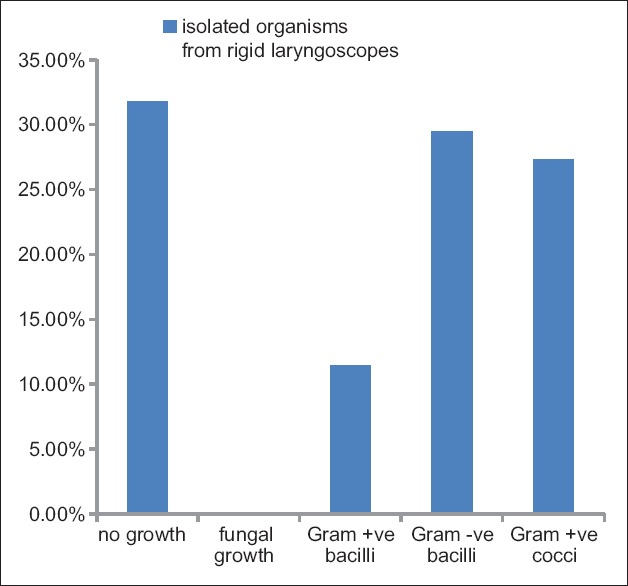
Results: The response rate among the physicians was 72% while for nurses 94.4%. The responses were variable reflecting lack of adequate knowledge and unsatisfactory compliance to infection control practices. Tested samples showed no fungal growth. Fourteen (31.8%) samples were negative for bacteriological contamination and 5/44 (11.4%) showed gram-positive bacilli; gram-positive cocci were isolated from 12 samples (27.3%) where Staphylococcus epidermidis and Staphylococcus aureus, respectively, shared 18.2% and 9.1% of the total samples. Gram-negative bacilli were isolated from 13 samples (29.5%), of which Klebsiella spp. were most frequent (11.4%). Both Pseudomonas aeruginosa and Acinetobacter baumannii were isolated from 6.8% each. Citerobacter spp. was isolated from 4.5%. Occult blood was found in 45.5% of samples.
Conclusion: The current study showed contamination of ready-to-use laryngoscopes in operative theatres and ICUs.
Keywords: Anaesthesia; equipment; infection control.
Conflict of interest statement
There are no conflicts of interest.
Figures
References
-
- Machan MD. Infection control practices of laryngoscope blades: A review of the literature. AANA J. 2012;80:274–8. - PubMed
-
- Richard CH, Teng KH, Kuo ML, Fu CK, Ying HC, Edmund CS. Profile of anesthetic infection control in Taiwan a questionnaire report. J Clin Anesthesia. 2009;2:13–8. - PubMed
-
- Recommended practices for cleaning, handling, and processing equipment Association of periOperative Registered Nurses (AORN) AORN J. 2005;81:856–70. - PubMed
-
- Guidelines for infection control in anaesthesia in South Africa. South Afr J Anaesth Analg. 2014;20:S1–39.
-
- Nishiyama T. Changes in the light intensity of the fiberoptic laryngoscope blade by steam sterilization. Anesth Analg. 2007;104:908–10. - PubMed
LinkOut - more resources
Full Text Sources
Miscellaneous