The Pivotal Role of Thymus in Atherosclerosis Mediated by Immune and Inflammatory Response
- PMID: 30443178
- PMCID: PMC6216065
- DOI: 10.7150/ijms.27238
The Pivotal Role of Thymus in Atherosclerosis Mediated by Immune and Inflammatory Response
Abstract
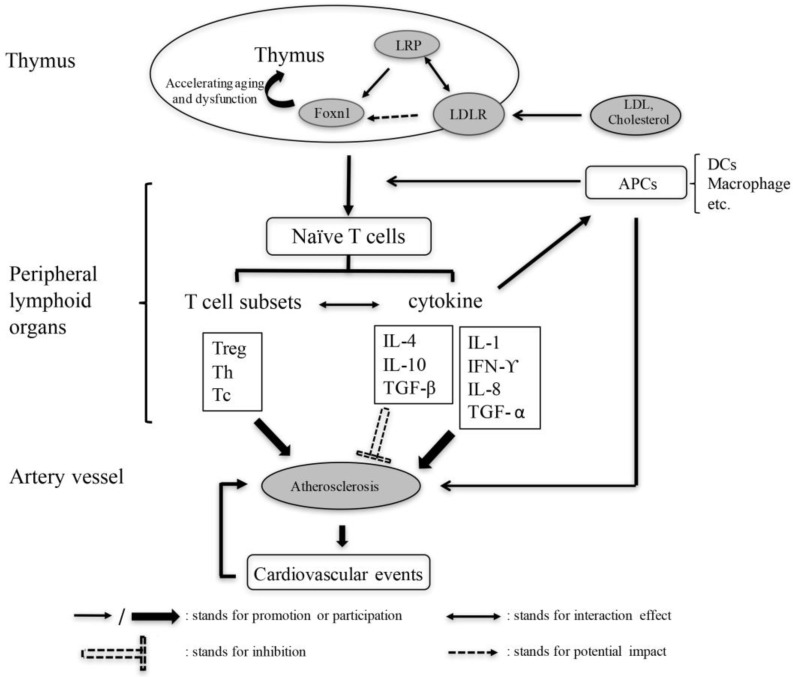
Atherosclerosis is one kind of chronic inflammatory disease, in which multiple types of immune cells or factors are involved. Data from experimental and clinical studies on atherosclerosis have confirmed the key roles of immune cells and inflammation in such process. The thymus as a key organ in T lymphocyte ontogenesis has an important role in optimizing immune system function throughout the life, and dysfunction of thymus has been proved to be associated with severity of atherosclerosis. Based on previous research, we begin with the hypothesis that low density lipoprotein or cholesterol reduces the expression of the thymus transcription factor Foxn1 via low density lipoprotein receptors on the membrane surface and low density lipoprotein receptor related proteins on the cell surface, which cause the thymus function decline or degradation. The imbalance of T cell subgroups and the decrease of naive T cells due to thymus dysfunction cause the increase or decrease in the secretion of various inflammatory factors, which in turn aggravates or inhibits atherosclerosis progression and cardiovascular events. Hence, thymus may be the pivotal role in coronary heart disease mediated by atherosclerosis and cardiovascular events and it can imply a novel treatment strategy for the clinical management of patients with atherosclerosis in addition to different commercial drugs. Modulation of immune system by inducing thymus function may be a therapeutic approach for the prevention of atherosclerosis. Purpose of this review is to summarize and discuss the recent advances about the impact of thymus function on atherosclerosis by the data from animal or human studies and the potential mechanisms.
Keywords: Foxn1; aging; atherosclerosis; immune; inflammatory; mechanisms; thymus.
Conflict of interest statement
Competing Interests: The authors have declared that no competing interest exists.
Figures
References
-
- Chistiakov DA, Sobenin IA, Orekhov AN. Regulatory T cells in atherosclerosis and strategies to induce the endogenous atheroprotective immune response. Immunol Lett. 2013;151(1-2):10–22. - PubMed
-
- Sasaki N, Yamashita T, Takeda M, Hirata K. Regulatory T cells in atherogenesis. J Atheroscler Thromb. 2012;19(6):503–15. - PubMed
-
- Hansson GK, Libby P. The immune response in atherosclerosis: a double-edged sword. Nat Rev Immunol. 2006;6(7):508–19. - PubMed
Publication types
MeSH terms
Substances
LinkOut - more resources
Full Text Sources
Medical