. 2018 Nov 1:9:1576.
doi: 10.3389/fpls.2018.01576. eCollection 2018.

A Phospholipase C-Like Protein From Ricinus communis Increases Hydroxy Fatty Acids Accumulation in Transgenic Seeds of Camelina sativa

Affiliations

A Phospholipase C-Like Protein From Ricinus communis Increases Hydroxy Fatty Acids Accumulation in Transgenic Seeds of Camelina sativa

Niranjan Aryal et al. Front Plant Sci. .

Abstract

There have been strong interests in producing unusual fatty acids in oilseed crops to provide renewable industrial feedstock. Results are so far largely disappointing since much lower amounts of such fatty acids accumulate in genetically engineered seeds than in their original natural sources. It has been suggested that the flux of unusual fatty acids through phosphatidylcholine (PC) represents a major bottleneck for high accumulation of such fatty acids in triacylglycerol (TAG). We show here that a phospholipase C-like protein (RcPLCL1) from castor bean, which accumulates nearly 90% of the hydroxylated ricinoleic acid in its seed TAG, increases the amount of hydroxy fatty acids (HFAs) when co-expresses with the fatty acid hydroxylase (RcFAH12) in transgenic seed of Camelina sativa. RcPLCL1 shows hydrolyzing activities on both PC and phosphatidylinositol substrates in our in vitro assay conditions. The PC-PLC activity of the RcPLCL1 may have increased the efficiency of HFA-PC to diacylglycerol conversion, which explains our observation of increased HFA contents in TAG concomitant with decreased HFA in the membrane lipid PC during seed development. Consequently, this may also alleviate the potential detrimental effect of HFA on germination of the engineered camelina seeds. Our results provide new knowledge that will help design effective strategies to engineer high levels of HFAs in transgenic oilseeds.

Keywords: Camelina sativa; castor; hydroxy fatty acids; phospholipase C-like; triacylglycerol.


Figures
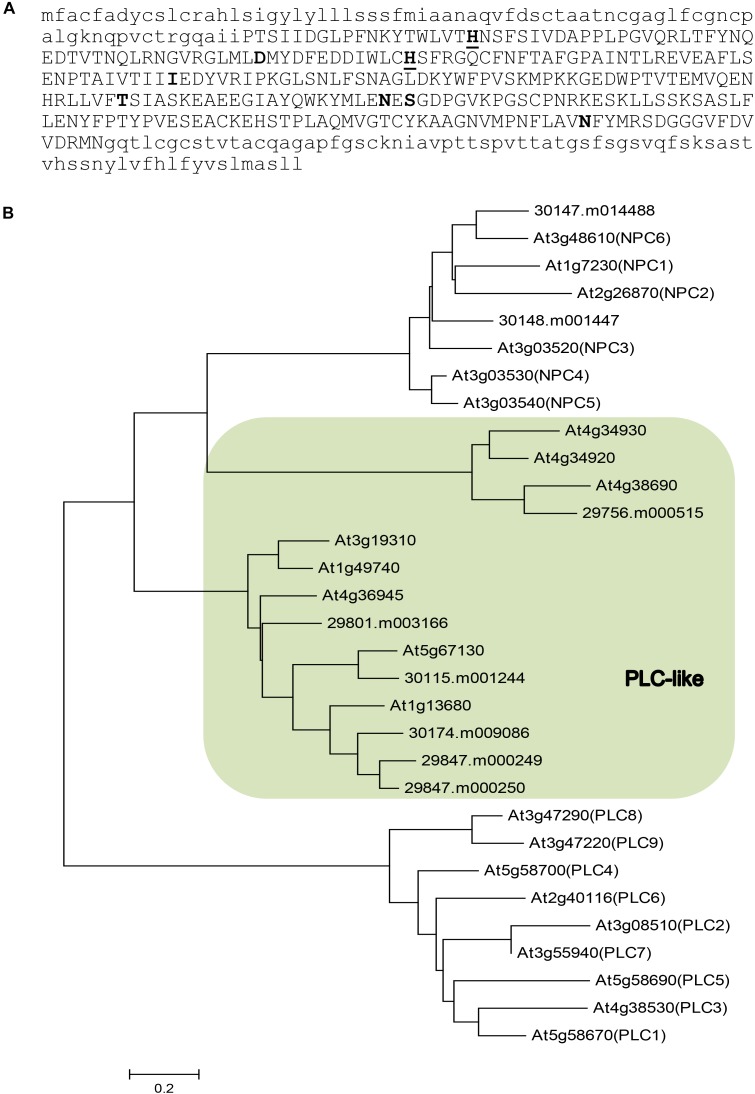
FIGURE 1
FIGURE 1
Sequence analysis of putative phospholipase Cs in castor (Ricinus communis) and their homologs in Arabidopsis. (A) Amino acid sequence of RcPLCL1 (30115.m001244). The PI-PLC X domain is shown in upper case letters. Active histidine (underlined) and putative active sites are shown in bold. (B) A neighbor-joining tree for putative phospholipases in castor and their homologs in Arabidopsis. Shaded area indicates genes encoding putative PLC-like proteins.
FIGURE 2
FIGURE 2
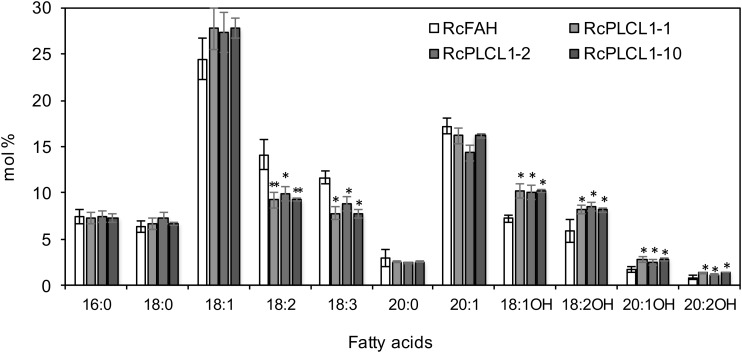
Fatty acid profiles of camelina transgenic seeds. RcFAH, Camelina expressing RcFAH12 alone; RcPLCL1, Camelina coexpressing RcFAH12 and RcPLCL1. Data are average ± SD from seeds of homozygous T3 lines showing highest HFA contents. Two-tailed Student’s t-test. P < 0.05; ∗∗P < 0.01.
FIGURE 3
FIGURE 3
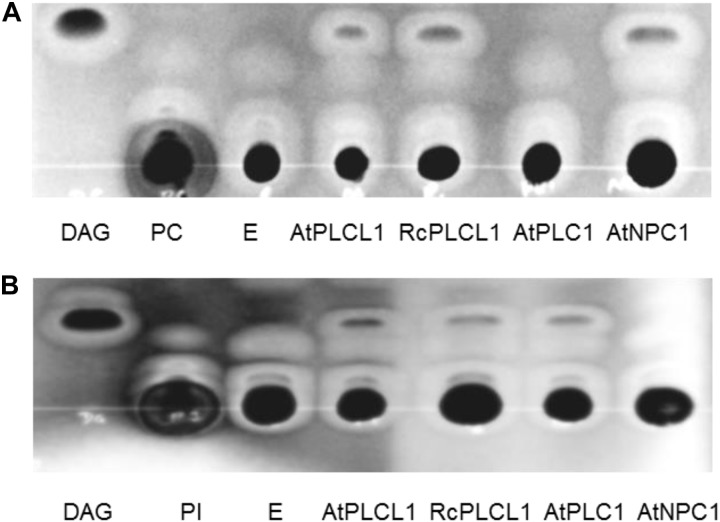
Phospholipase activity assay for RcPLCL1 and AtPLCL1. Lipids were separated on TLC plates after being extracted from reactions with substrates (A) 1,2-dipalmitoyl-sn-glycero-3-phosphocholine (di16:0 PC) or (B) 1-palmitoyl-2-oleoyl-sn-glycero-3-phosphoinositol (16:0-18:1 PI) with yeast microsomes containing genes cloned in the pYES2 vector. E, pYES2 empty vector.
FIGURE 4
FIGURE 4
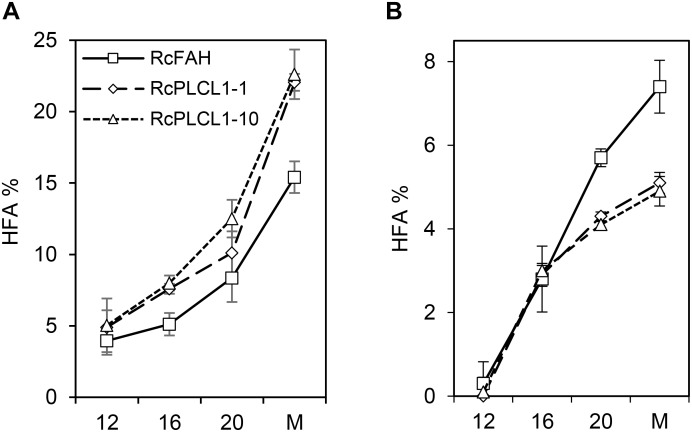
Hydroxy fatty acid (HFA) accumulation in camelina developing seeds. (A) Percentage of HFA in total seed oils. (B) Percentage of HFA in polar lipid (PC) fraction. M, Mature seeds. Data represent average ± SD of three replicates.
FIGURE 5
FIGURE 5
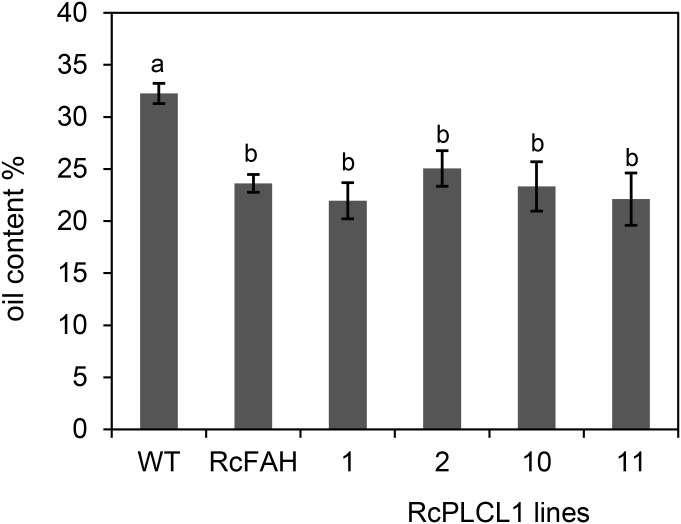
Total fatty acid content of camelina seeds. WT, non-transgenic camelina variety Suneson; RcFAH, RcFAH12 transgenic line #7-1; 1, 2, 10, and 11 are transgenic seeds of T4 RcPLCL1 homozygous lines. Data represent average ± SD for seeds harvested from three plants of each line. One-tailed Student’s t-test, columns with different letters are significantly different.
FIGURE 6
FIGURE 6
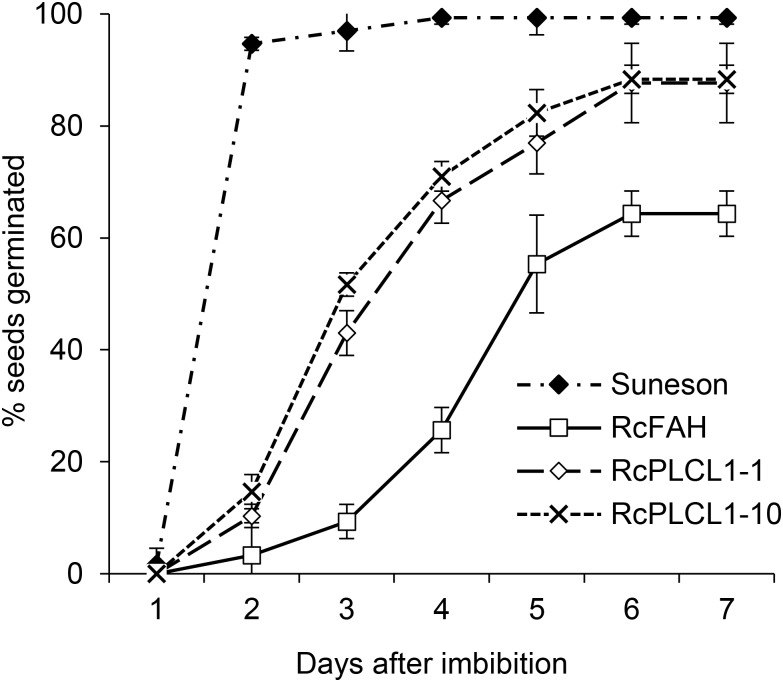
Germination rates of camelina wild type and transgenic seeds. Data are the average of three replicated experiments.

References

    1. Atsmon D. (1989). “Castor,” in Oil Crops of the World, eds Robbelen G., Downey K. R., Ashri A. (New York, NY: McGraw-Hill; ), 438–447.
    1. Bafor M., Smith M. A., Jonsson L., Stobart K., Stymne S. (1991). Ricinoleic acid biosynthesis and triacylglycerol assembly in microsomal preparations from developing castor-bean (Ricinus communis) endosperm. Biochem. J. 280(Pt 2), 507–514. 10.1042/bj2800507 - DOI - PMC - PubMed
    1. Bates P. D., Browse J. (2011). The pathway of triacylglycerol synthesis through phosphatidylcholine in Arabidopsis produces a bottleneck for the accumulation of unusual fatty acids in transgenic seeds. Plant J. 68 387–399. 10.1111/j.1365-313X.2011.04693.x - DOI - PubMed
    1. Bates P. D., Browse J. (2012). The significance of different diacylgycerol synthesis pathways on plant oil composition and bioengineering. Front. Plant Sci. 3:147. 10.3389/fpls.2012.00147 - DOI - PMC - PubMed
    1. Bates P. D., Fatihi A., Snapp A. R., Carlsson A. S., Browse J., Lu C., et al. (2012). Acyl editing and headgroup exchange are the major mechanisms that direct polyunsaturated fatty acid flux into triacylglycerols. Plant Physiol. 160 1530–1539. 10.1104/pp.112.204438 - DOI - PMC - PubMed

LinkOut - more resources