. 2015 Jan-Mar;5(1):011005.
doi: 10.1103/PhysRevX.5.011005. Epub 2015 Jan 23.

Observability and Controllability of Nonlinear Networks: The Role of Symmetry

Affiliations

Observability and Controllability of Nonlinear Networks: The Role of Symmetry

Andrew J Whalen et al. Phys Rev X. 2015 Jan-Mar.

Abstract

Observability and controllability are essential concepts to the design of predictive observer models and feedback controllers of networked systems. For example, noncontrollable mathematical models of real systems have subspaces that influence model behavior, but cannot be controlled by an input. Such subspaces can be difficult to determine in complex nonlinear networks. Since almost all of the present theory was developed for linear networks without symmetries, here we present a numerical and group representational framework, to quantify the observability and controllability of nonlinear networks with explicit symmetries that shows the connection between symmetries and nonlinear measures of observability and controllability. We numerically observe and theoretically predict that not all symmetries have the same effect on network observation and control. Our analysis shows that the presence of symmetry in a network may decrease observability and controllability, although networks containing only rotational symmetries remain controllable and observable. These results alter our view of the nature of observability and controllability in complex networks, change our understanding of structural controllability, and affect the design of mathematical models to observe and control such networks.

Keywords: Biological Physics; Complex Systems; Nonlinear Dynamics.


Figures

FIG. 1.
FIG. 1.
The eight different 3-node network connection motifs studied.
FIG. 2.
FIG. 2.
Calculation of (a),(c) observability and (b),(d) controllability indices for motif 1 for a chaotic dynamical regime, as measured from each node (green triangles, 1; blue crosses, 2; red dots, 3). The thick lines and symbols mark the mean values of each distribution of indices for each coupling strength, while the smaller symbols and dotted lines represent the 1 standard deviation confidence intervals. Plots in the top row represent the results computed with symmetry-breaking heterogeneous couplings while plots in the bottom row are those with identical coupling strengths.
FIG. 3.
FIG. 3.
Same as Fig. 2, except calculations are for motif 3. The calculations show that the reflection symmetry in the network topology causes zero observability and controllability for the symmetric case of observing or controlling from node 2 with identical coupling strengths (c),(d).
FIG. 4.
FIG. 4.
Same as Fig. 2, except calculations are for motif 7. The calculations show that the particular rotational symmetry in the network topology has no ill effect on observability and controllability for the symmetric case of identical coupling strengths (c), (d) as compared to the broken symmetry in panels (a) and (b).
FIG. 5.
FIG. 5.
Calculation of observability indices for each of the FN network motifs with no underlying group symmetries for a pulsed input limit-cycle dynamical regime, as measured from each node (green squares, 1; blue crosses, 2; red dots, 3). The thick lines and symbols mark the mean values while the smaller symbols and dotted lines represent the 1 standard deviation confidence intervals. Plots in the top row are computed with heterogeneous couplings while identical coupling strengths are in the bottom row. The calculations show the effect of network coupling strength on observability; motifs 5, 6, and 8 show no observability from node 3 in motif 5, and from nodes 2 and 3 in motifs 6 and 8 due to structural isolation.
FIG. 6.
FIG. 6.
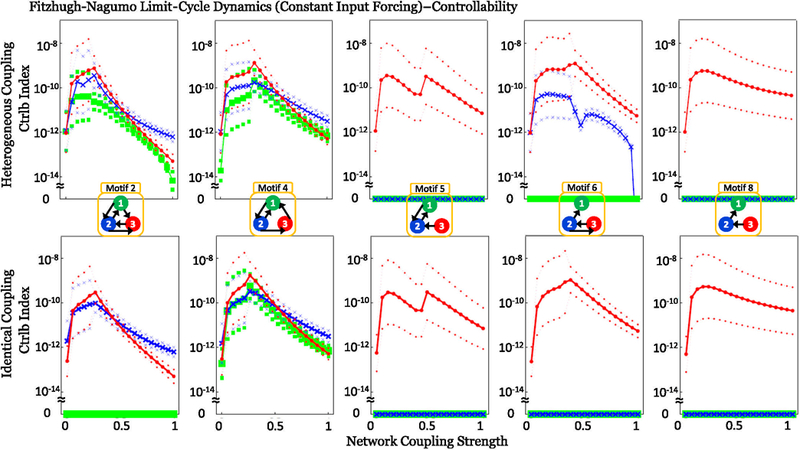
Calculation of controllability indices for each of the FN network motifs with no underlying group symmetries for a limit-cycle dynamical regime with constant input current I = −0.45; all other details are the same as in Fig. 5. In particular, notice that local input-output symmetries cause zero controllability when controlling motif 2 from node 1 or motif 6 from node 2.
FIG.7.
FIG.7.
The three dimensional phase space for v and w, showing trajectories in motif 1 as measured from node 1 for arrange of connection strengths(weak to strong heterogeneous coupling K,from left to right,respectively).In the first row,blue triangles mark locations in phase space where observability is higher than the mean for the trajectory, while the second row contains a phase space trajectory for w and red triangles mark the higher than average controllability. The broken symmetry of the heterogeneous network has trajectories that visit locations in the phase space that vary widely in observability and controllability with a log-normal distribution (see the Appendix).
FIG. 8.
FIG. 8.
Graphic illustration of symmetry axes σn with n = 1;2;3 and the cyclic rotation symmetry C3 about an axis perpendicular to the plane of the page.
FIG. 9.
FIG. 9.
Histogram of the log-scaled controllability indices for motif 1 with heterogeneous coupling and chaotic dynamics.

References

    1. Schiff SJ, Neural Control Engineering (MIT Press, Cambridge, MA, 2012).
    1. Voss HU, Timmer J, and Kurths J, Nonlinear Dynamical System Identification from Uncertain and Indirect Measurements, Int. J. Bifurcation Chaos Appl. Sci. Eng 14, 1905 (2004).
    1. Sauer TD and Schiff SJ, Data Assimilation for Heterogeneous Networks: The Consensus Set, Phys. Rev. E 79, 051909 (2009). - PMC - PubMed
    1. Kalnay E, Atmospheric Modeling, Data Assimilation and Predictability (Cambridge University Press, Cambridge, England, 2003).
    1. Kalman RE, Mathematical Description of Linear Dynamical Systems, SIAM J. Control 1, 152 (1963).

LinkOut - more resources