


Dynamic Control of ERG20 and ERG9 Expression for Improved Casbene Production in Saccharomyces cerevisiae
- PMID: 30443546
- PMCID: PMC6221901
- DOI: 10.3389/fbioe.2018.00160
Dynamic Control of ERG20 and ERG9 Expression for Improved Casbene Production in Saccharomyces cerevisiae
Abstract
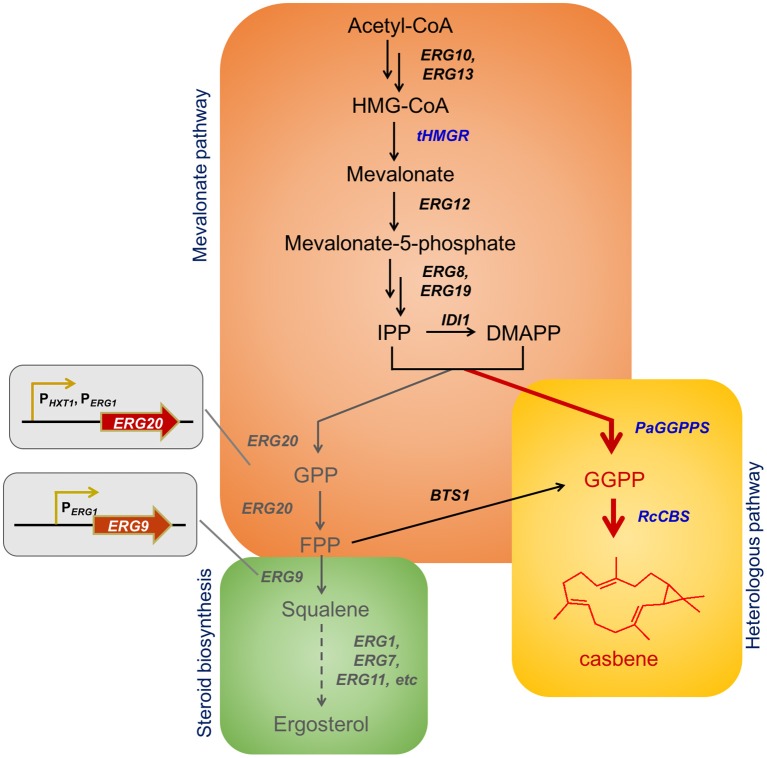
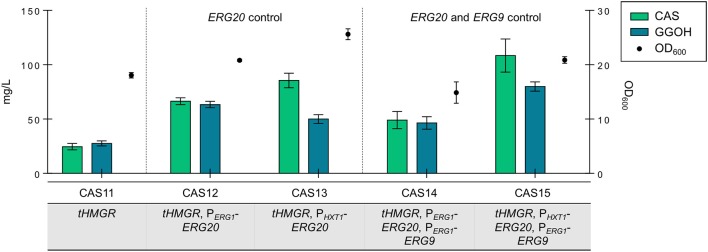
Production of plant metabolites in microbial hosts represents a promising alternative to traditional chemical-based methods. Diterpenoids are compounds with interesting applications as pharmaceuticals, fragrances and biomaterials. Casbene, in particular, serves as a precursor to many complex diterpenoids found in plants from the Euphorbiaceae family that have shown potential therapeutic effects. Here, we engineered the budding yeast Saccharomyces cerevisiae for improved biosynthesis of the diterpene casbene. We first expressed, in yeast, a geranylgeranyl diphosphate synthase from Phomopsys amygdali in order to boost the geranylgeranyl diphosphate pool inside the cells. The enzyme uses isopentenyl diphosphate and dimethylallyl diphosphate to directly generate geranylgeranyl diphosphate. When co-expressing a casbene synthase from Ricinus communis the yeast was able to produce casbene in the order of 30 mg/L. Redirecting the flux from FPP and sterols, by means of the ergosterol sensitive promoter of ERG1, allowed for plasmid-based casbene production of 81.4 mg/L. Integration of the target genes into the yeast genome, together with the replacement of the promoter regions of ERG20 and ERG9 with combinations of ergosterol- and glucose-sensitive promoters, generated a titer of 108.5 mg/L of casbene. We here succeeded to engineer an improved route for geranylgeranyl diphosphate synthesis in yeast. Furthermore, we showed that the concurrent dynamic control of ERG20 and ERG9 expression, using ergosterol and carbon source regulation mechanisms, could substantially improve diterpene titer. Our approach will pave the way for a more sustainable production of GGPP- and casbene-derived products.
Keywords: ERG20; ERG9; casbene; diterpene; dynamic control; metabolic engineering; mevalonate pathway; yeast.
Figures


References
-
- Callari R. (2018). Pathway Engineering Towards Heterologous Production of Complex Diterpenoids in Yeast. PhD thesis. Department of Plant and Environmental Sciences, Faculty of Science, University of Copenhagen.
-
- Caniard A., Zerbe P., Legrand S., Cohade A., Valot N., Magnard J. L., et al. (2012). Discovery and functional characterization of two diterpene synthases for sclareol biosynthesis in Salvia sclarea (L.) and their relevance for perfume manufacture. BMC Plant Biol. 12:119. 10.1186/1471-2229-12-119 - DOI - PMC - PubMed
-
- Chambon C., Ladeveze V., Servouse M., Blanchard L., Javelot C., Vladescu B., et al. (1991). Sterol pathway in yeast. Identification and properties of mutant strains defective in mevalonate diphosphate decarboxylase and farnesyl diphosphate synthetase. Lipids 26, 633–636. 10.1007/BF02536428 - DOI - PubMed
LinkOut - more resources
Full Text Sources
Molecular Biology Databases
