


Review
doi: 10.1039/c8cs00606g.
Epub 2018 Nov 16.
A guide to maximizing the therapeutic potential of protein-polymer conjugates by rational design
Affiliations
- PMID: 30443654
- PMCID: PMC6322549
- DOI: 10.1039/c8cs00606g
Item in Clipboard
Review
A guide to maximizing the therapeutic potential of protein-polymer conjugates by rational design
Chem Soc Rev.
.
Abstract
Proteins are an important class of therapeutics that have advantages including high target specificity, but challenges to their use include rapid clearance and low physical stability. Conjugation of synthetic polymers is an effective approach to address the drawbacks and enhance other properties such as solubility. In this review, we present various considerations in synthesizing protein-polymer conjugates for therapeutic applications with a focus on the choice of polymer, protein, and conjugation method, as well as characterization and evaluation of the resulting conjugate in order to maximize the therapeutic potential of the protein drug.
Conflict of interest statement
Conflicts of interest
There are no conflicts to declare.
Figures
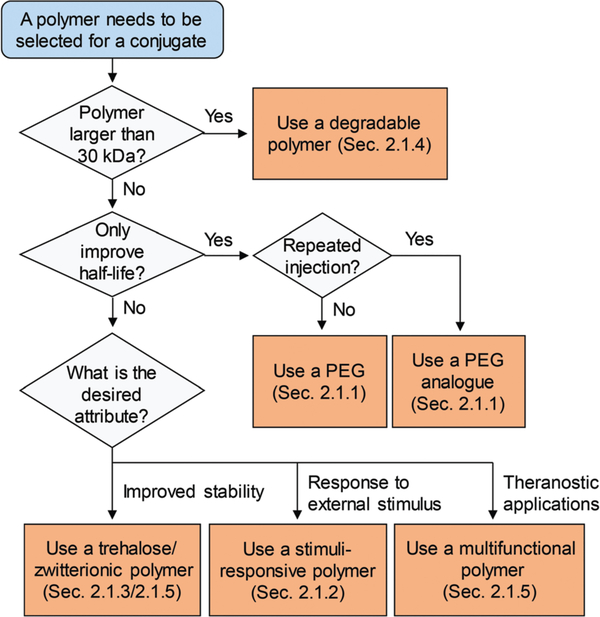
A summary of the polymer selection process.
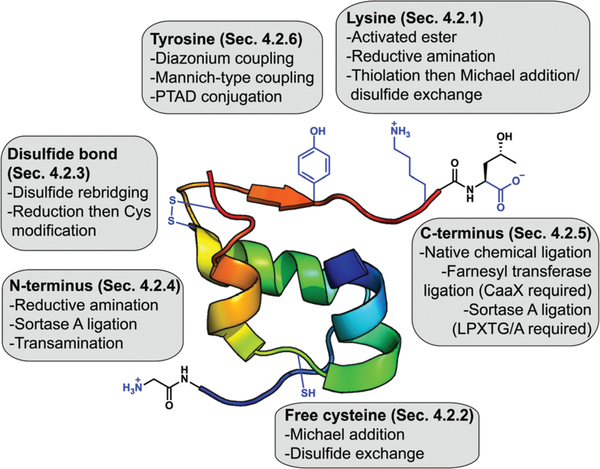
Commonly used conjugation chemistries for different protein residues (PDB ID: 4INS).
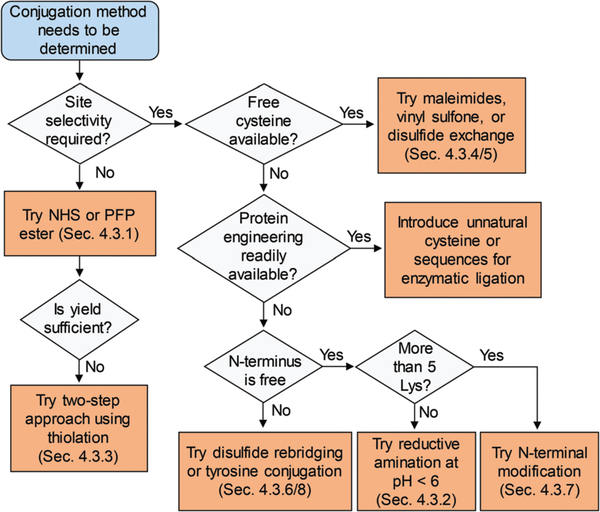
A summary of the conjugation chemistry selection process. Adapted with permission from ref. . Copyright 2011 Springer Nature.

Insulin-trehalose polymer conjugate. The conjugate synthesized by non-selective route was used for (a) in vivo pharmacokinetics (n = 5) and (b) bioactivity in mice after heating (90 °C, 30 min) (n = 5). (c) Synthesis of LysB29 selective conjugate by the grafting-from approach. Adapted with permission from ref. and . Copyright 2017–2018 American Chemical Society.

Imaging biodistribution of PEGylated diabody using PET. (a) Conjugation of PEG and metal chelator to diabody (Dia). (b) Structures of maleimide PEG, linear (Mal-PEG-L) and branched (Mal-PEG-B), and metal chelator used (isothiocyanate desferrioxamine, NCS-DFO). (c) PET-CT images obtained from a mouse injected with 89Zr-DFO-Dia-PEG20k-B, 89Zr-DFO-Dia-PEG20k-L, or 89Zr-DFO-Dia-PEG40k-B, with a white arrow indicating the location of the tumor. Adapted with permission from ref. . Copyright 2018 Elsevier.
References
-
- Leader B, Baca QJ and Golan DE, Nat. Rev. Drug Discovery, 2008, 7, 21–39. - PubMed
-
- Samanen J, Introduction to Biological and Small Molecule Drug Research and Development, Elsevier, 2013, pp. 161–203.
-
- McGrath NA, Brichacek M and Njardarson JT, J. Chem. Educ, 2010, 87, 1348–1349.
-
- Duncan R, Nat. Rev. Drug Discovery, 2003, 2, 347–360. - PubMed
-
- Pelegri-O’Day EM, Lin E-W and Maynard HD, J. Am. Chem. Soc, 2014, 136, 14323–14332. - PubMed
Publication types
MeSH terms
Substances
Grants and funding
LinkOut - more resources
Full Text Sources
Other Literature Sources
