


KOOS-JR Demonstrates Psychometric Limitations in Measuring Knee Health in Individuals After ACL Reconstruction
- PMID: 30444674
- PMCID: PMC6537326
- DOI: 10.1177/1941738118812454
KOOS-JR Demonstrates Psychometric Limitations in Measuring Knee Health in Individuals After ACL Reconstruction
Abstract
Background: Measurement properties of the short form of the Knee injury and Osteoarthritis Outcome Score (KOOS-JR) are not established in individuals after anterior cruciate ligament reconstruction (ACLR). The purpose of this study was to determine the extent to which the KOOS-JR measures the construct of knee health in individuals post-ACLR using Rasch analysis.
Hypothesis: The KOOS-JR will fit the Rasch model, but significant ceiling effects will be present.
Study design: Cross-sectional study.
Level of evidence: Level 3.
Methods: Rasch analysis of the KOOS-JR from 166 individuals 10 months post-ACLR was conducted. Unidimensionality, a key criterion of the Rasch model, was evaluated using confirmatory factor analysis. Model fit of the rating scale, items, and persons were evaluated. Mean square fit statistics ≥1.6 and standardized z-scores ≥2.0 were indicative of person or item misfit. Additionally, reliability indicators including person reliability and separation indices were examined.
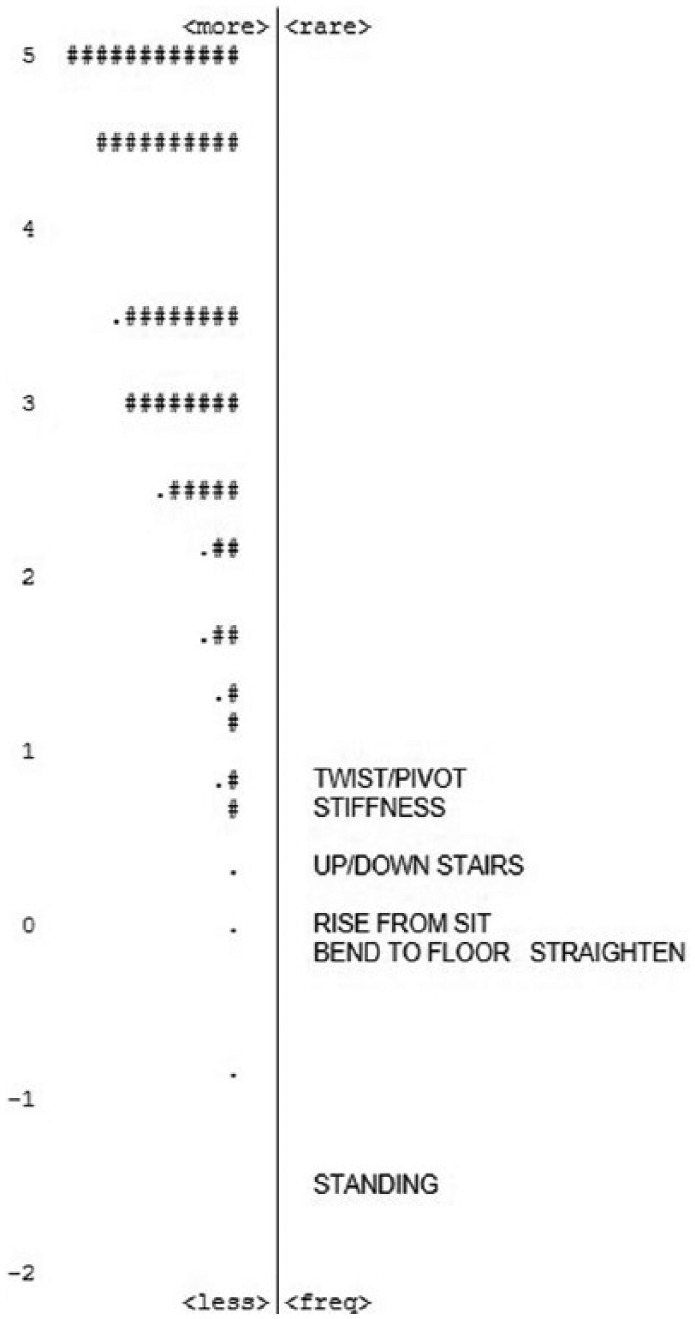
Results: The KOOS-JR fit the criteria of unidimensionality. All items demonstrated model fit; however, ceiling effects were noted (n = 36; 22%). Person reliability was low (0.47). Calculation of person strata revealed that the KOOS-JR did not separate participants into more than 1 stratum. The mean person measure was 3.56 logits higher than the mean item measure, indicating that this sample is skewed toward increased knee health.
Conclusion: Although the KOOS-JR represented a unidimensional construct with items and persons fitting the Rasch model, several limitations were noted: ceiling effects, low person reliability, and poor person differentiation. Ceiling effects indicate that many individuals in this sample experienced better knee health than the KOOS-JR items were able to measure.
Clinical relevance: Evaluating the measurement properties of the KOOS-JR is necessary to determine its clinical value in sports medicine. In later stages after ACLR recovery, administration of the KOOS-JR may not be adequate.
Keywords: KOOS-JR; Rasch; anterior cruciate ligament reconstruction; patient-reported outcomes; rehabilitation.
Conflict of interest statement
The authors report no potential conflicts of interest in the development and publication of this article. This project was supported by the South Carolina Clinical & Translational Research (SCTR) Institute, with an academic home at the Medical University of South Carolina, through NIH Grant Numbers TL1 TR001451 and UL1 TR001450.
Figures
References
-
- Ardern CL, Taylor NF, Feller JA, Webster KE. Fifty-five per cent return to competitive sport following anterior cruciate ligament reconstruction surgery: an updated systematic review and meta-analysis including aspects of physical functioning and contextual factors. Br J Sports Med. 2014;48:1543-1552. - PubMed
-
- Ardern CL, Taylor NF, Feller JA, Whitehead TS, Webster KE. Psychological responses matter in returning to preinjury level of sport after anterior cruciate ligament reconstruction surgery. Am J Sports Med. 2013;41:1549-1558. - PubMed
-
- Arrindell WA, van der Ende J. An empirical test of the utility of the observations-to-variables ratio in factor and components analysis. Appl Psychol Meas. 1985;9:165-178.
-
- Bond TG, Fox CM. Why measurement is fundamental. In: Bond TG, Fox CM, eds. Applying the Rasch Model: Fundamental Measurement in the Human Sciences. 2nd ed. New York, NY: Routledge; 2012:1-14.
MeSH terms
Grants and funding
LinkOut - more resources
Full Text Sources
Medical
Research Materials
