Towards a molecular basis of ubiquitin signaling: A dual-scale simulation study of ubiquitin dimers
- PMID: 30444864
- PMCID: PMC6268000
- DOI: 10.1371/journal.pcbi.1006589
Towards a molecular basis of ubiquitin signaling: A dual-scale simulation study of ubiquitin dimers
Abstract
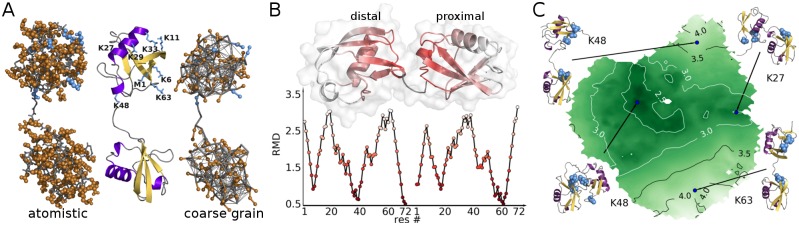
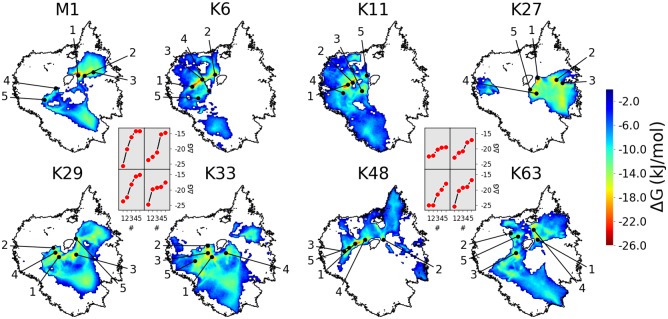
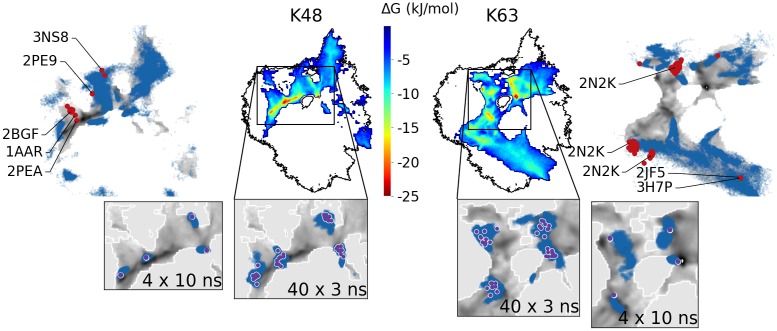
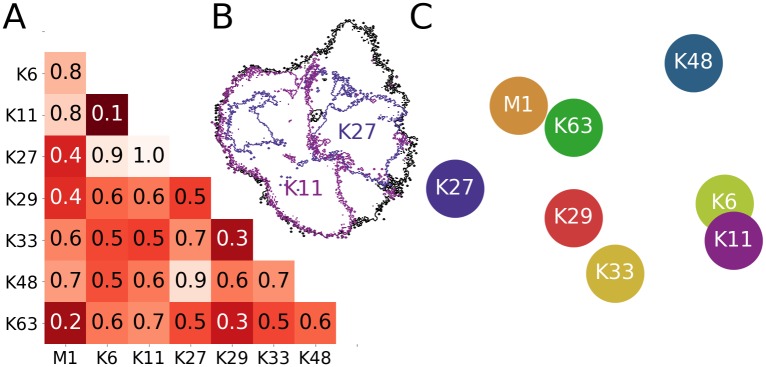
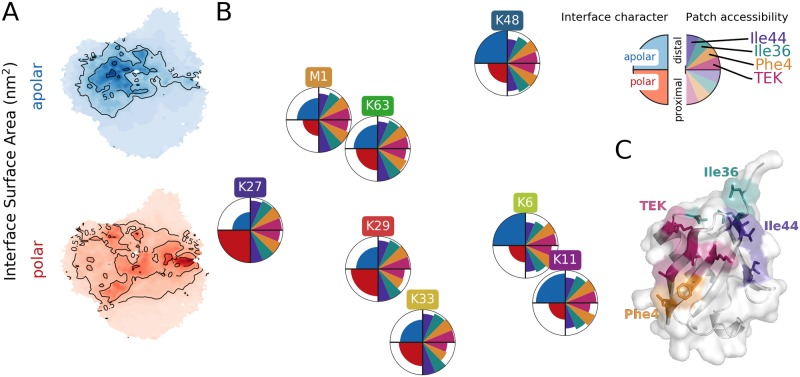
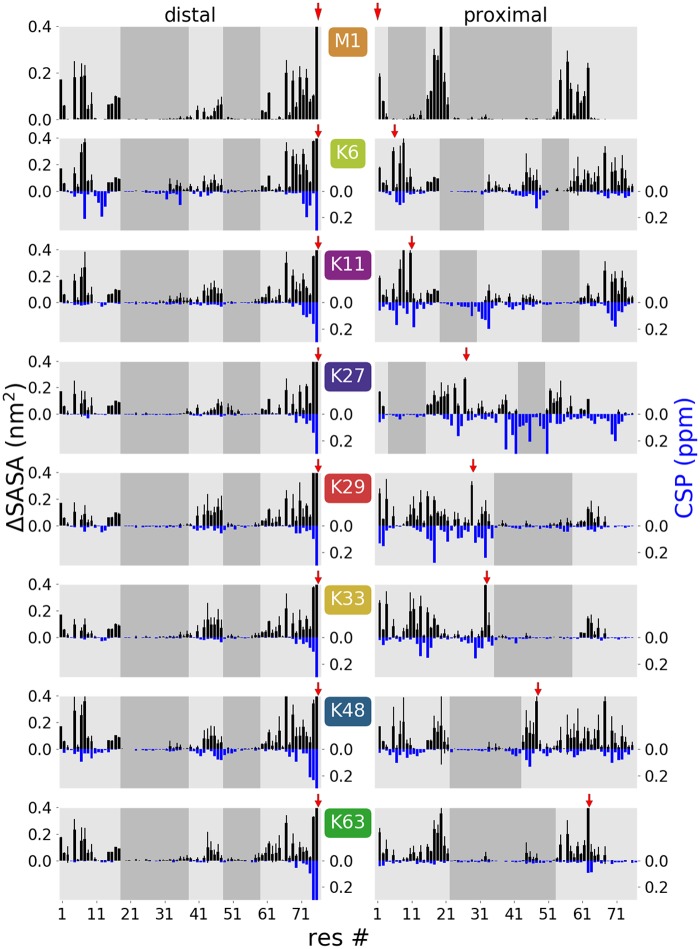
Covalent modification of proteins by ubiquitin or ubiquitin chains is one of the most prevalent post-translational modifications in eukaryotes. Different types of ubiquitin chains are assumed to selectively signal respectively modified proteins for different fates. In support of this hypothesis, structural studies have shown that the eight possible ubiquitin dimers adopt different conformations. However, at least in some cases, these structures cannot sufficiently explain the molecular basis of the selective signaling mechanisms. This indicates that the available structures represent only a few distinct conformations within the entire conformational space adopted by a ubiquitin dimer. Here, molecular simulations on different levels of resolution can complement the structural information. We have combined exhaustive coarse grained and atomistic simulations of all eight possible ubiquitin dimers with a suitable dimensionality reduction technique and a new method to characterize protein-protein interfaces and the conformational landscape of protein conjugates. We found that ubiquitin dimers exhibit characteristic linkage type-dependent properties in solution, such as interface stability and the character of contacts between the subunits, which can be directly correlated with experimentally observed linkage-specific properties.
Conflict of interest statement
The authors have declared that no competing interests exist.
Figures
References
-
- Hershko A, Ciechanover A. The Ubiquitin System. Annu Rev Biochem. 1998;67(1):425–479. 10.1146/annurev.biochem.67.1.425 - DOI - PubMed
-
- Kravtsova-Ivantsiv Y, Sommer T, Ciechanover A. The Lysine48-Based Polyubiquitin Chain Proteasomal Signal: Not a Single Child Anymore. Angew Chem Int Ed. 2012;52(1):192–198. 10.1002/anie.201205656 - DOI - PubMed
-
- Swatek KN, Komander D. Ubiquitin Modifications. Cell Res. 2016;26(4):399–422. 10.1038/cr.2016.39 - DOI - PMC - PubMed
-
- Komander D, Rape M. The Ubiquitin Code. Annu Rev Biochem. 2012;81(1):203–229. 10.1146/annurev-biochem-060310-170328 - DOI - PubMed
-
- Dikic I, Wakatsuki S, Walters KJ. Ubiquitin-binding Domains—from Structures to Functions. Nat Rev Mol Cell Biol. 2009;10(10):659–671. 10.1038/nrm2767 - DOI - PMC - PubMed
Publication types
MeSH terms
Substances
LinkOut - more resources
Full Text Sources