


Mild Cognitive Impairment that Does Not Progress to Dementia: A Population-Based Study
- PMID: 30444944
- PMCID: PMC6367026
- DOI: 10.1111/jgs.15642
Mild Cognitive Impairment that Does Not Progress to Dementia: A Population-Based Study
Abstract
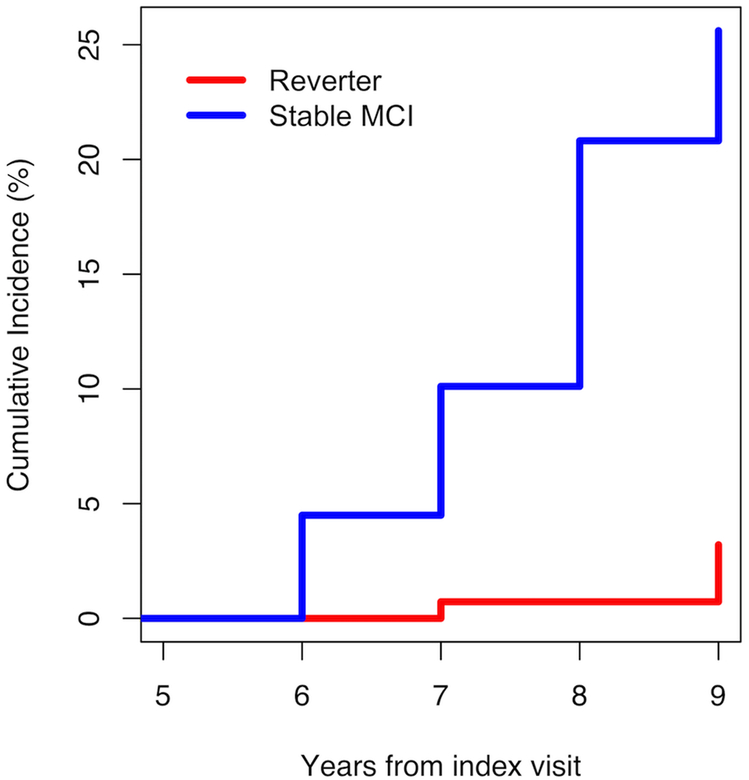
Background/objective: In population studies, most individuals with mild cognitive impairment (MCI) do not progress to dementia in the near term, but rather remain stable MCI or revert to normal cognition. Here, we characterized MCI subgroups with different outcomes over 5 years.
Setting/participants: A population-based cohort (N=1603).
Measurements: Clinical Dementia Rating (CDR); self-reported medical conditions, subjective cognitive concerns, self-rated health, depressive symptoms, blood pressure, medications, blood pressure, APOE genotype, cognitive domain composite scores.
Design: We compared 3 MCI subgroups who progressed to dementia (n=86), stabilized at MCI (n=384), or reverted to normal (n=252), to those who remained consistently normal (n=881), defining MCI as CDR = 0.5 and dementia as CDR≥1. Using multinomial logistic regression models adjusted for demographics, we examined the associations of each group with selected baseline characteristics.
Results: With the normal group for reference, worse subjective cognitive concerns, functional impairments, self-rated health, and depressive symptoms were associated with being in any MCI group. Taking more prescription medications was associated with being in the stable MCI and reverter groups; diabetes and low diastolic blood pressure were associated with stable MCI. The APOE4 genotype was associated with stable and progressive MCI; stroke was associated with progressive MCI. All MCI subgroups were likely to have lower mean composite scores in all cognitive domains and more operationally defined impairments in attention, language, and executive function; reverters were more likely to lack memory and visuospatial impairments.
Conclusions: MCI subgroups with different 5-year outcomes had some distinct characteristics suggesting different underlying causes. The progressors, unlike the reverters, had a profile broadly typical of Alzheimer's disease; the stable MCIs had other, including vascular, morbidity. These data shed light on the heterogeneity of MCI in the population. J Am Geriatr Soc 67:232-238, 2019.
Keywords: aging; cognition; epidemiology.
© 2018, Copyright the Author Journal compilation © 2018, The American Geriatrics Society.
Conflict of interest statement
CONFLICTS OF INTEREST. Dr. Ganguli served on the “AD Patient Journey Working Group” for Biogen, Inc., in 2016 and 2017. All other authors have no potential conflicts to disclose.
Figures
References
-
- Gauthier S, Reisberg B, Zaudig M, et al. Mild cognitive impairment. Lancet. 2006;367:1262–1270. - PubMed
-
- Petersen RC. Clinical practice. Mild cognitive impairment. N Engl J Med. 2011;364:2227–2234. - PubMed
-
- Ganguli M The unbearable lightness of MCI. Int Psychogeriatr. 2014;26:353–359. - PubMed
-
- Larrieu S, Letenneur L, Orgogozo JM, et al. Incidence and outcome of mild cognitive impairment in a population-based prospective cohort. Neurology. 2002;59:1594–1599. - PubMed
-
- Ganguli M, Dodge HH, Shen C, DeKosky ST. Mild cognitive impairment, amnestic type: an epidemiologic study. Neurology. 2004;63:115–121. - PubMed
Publication types
MeSH terms
Substances
Grants and funding
LinkOut - more resources
Full Text Sources
Medical
Miscellaneous
