


An integrative review of potential enablers and barriers to accessing mental health services in Ghana
- PMID: 30445980
- PMCID: PMC6240297
- DOI: 10.1186/s12961-018-0382-1
An integrative review of potential enablers and barriers to accessing mental health services in Ghana
Abstract
Introduction: The importance of accessible mental health treatment is a global concern, particularly when one in five people will experience a mental health problem in their lifespan. This is no less important in Ghana; however, no studies have yet attempted to appraise and synthesise the potential enablers and barriers to accessing services in Ghana. The aim of this integrative review is therefore to identify and synthesise existing evidence on the barriers and enablers to accessing mental health services in Ghana.
Methods: A search of the published literature was conducted using Medline, EMBASE, PsycINFO, CINAHL (EBSCO), Web of Science, and Scopus electronic databases. The search was limited to papers published in English and within 2000-2018. Using pre-defined inclusion and exclusion criteria, two reviewers independently screened the titles and abstracts of the retrieved papers. A data extraction form and a Critical Appraisal Checklist were used to extract and appraise data, respectively. The integrative review incorporates both qualitative and quantitative data into a single synthesis.
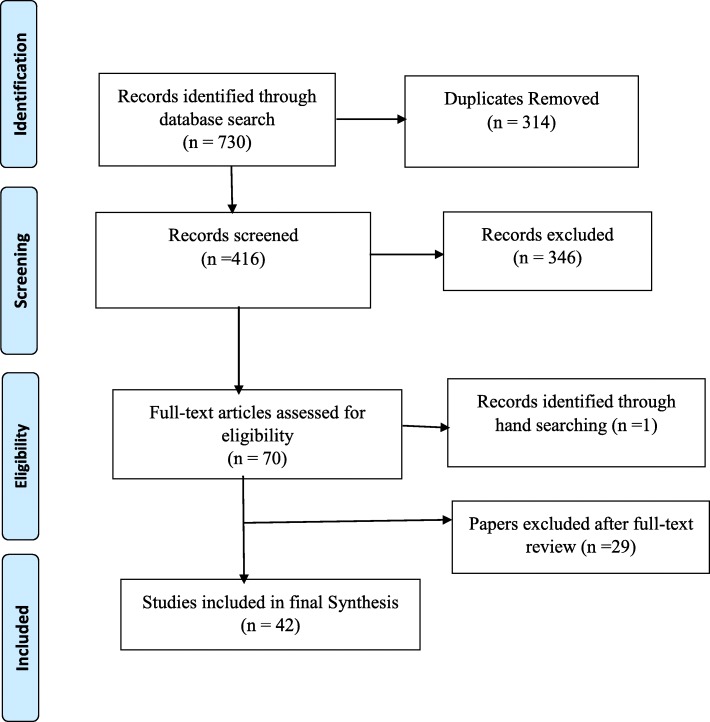
Results: Out of 42 papers that met the inclusion criteria, 50% used qualitative methods, 33.3% used mixed methods and 16.7% used quantitative methods alone. The potential barriers in accessing mental health services were attitudinal, knowledge about services, treatment cost, transportation and geographical proximity, as well as perceived efficacy of medication. Similarly, the health systems factors contributing to barriers were low priority, limited funding sources, irregular medicine supply, limited services for marginalised groups and poor state of psychiatric facilities, together with poor management of mental health cadres. The potential enablers for service users involved increased decentralisation and integration, task-shifting and existing support services.
Conclusion: The existing evidence on mental health in Ghana is skewed towards weaknesses in the systems and stigma, with rationally little, or no, evidence or emphasis on the effectiveness, or quality of mental health services. These attributes largely neglect the provision of psychiatric services for marginalised mental health service user groups, including children, adolescents, people with disabilities and the elderly.
Keywords: Access; Barriers; Facilitators; Ghana; Mental health; Psychiatry; Service users; Systems.
Conflict of interest statement
Ethics approval and consent to participate
Not applicable.
Consent for publication
Not applicable.
Competing interests
The authors declare that they have no competing interests.
Publisher’s Note
Springer Nature remains neutral with regard to jurisdictional claims in published maps and institutional affiliations.
Figures
References
-
- World Health Organization . Depression and Other Common Mental Disorders: Global Health Estimates 2017. Geneva: WHO; 2017.
-
- World Health Organization. Mental Health Situational Analysis in Ghana 2017. http://www.who.int/mental_health/policy/country/ghana/en/. Accessed 23 Feb 2017.
-
- World Health Organization . Mental Health: A State of Well-being. 2014.
Publication types
MeSH terms
LinkOut - more resources
Full Text Sources
Medical
Molecular Biology Databases
Miscellaneous
