


Individual risk assessment tool for school-age asthma prediction in UK birth cohort
- PMID: 30447026
- PMCID: PMC6446726
- DOI: 10.1111/cea.13319
Individual risk assessment tool for school-age asthma prediction in UK birth cohort
Abstract
Background: Current published asthma predictive tools have moderate positive likelihood ratios (+LR) but high negative likelihood ratios (-LR) based on their recommended cut-offs, which limit their clinical usefulness.
Objective: To develop a simple clinically applicable asthma prediction tool within a population-based birth cohort.
Method: Children from the Manchester Asthma and Allergy Study (MAAS) attended follow-up at ages 3, 8 and 11 years. Data on preschool wheeze were extracted from primary-care records. Parents completed validated respiratory questionnaires. Children were skin prick tested (SPT). Asthma at 8/11 years (school-age) was defined as parentally reported (a) physician-diagnosed asthma and wheeze in the previous 12 months or (b) ≥3 wheeze attacks in the previous 12 months. An asthma prediction tool (MAAS APT) was developed using logistic regression of characteristics at age 3 years to predict school-age asthma.
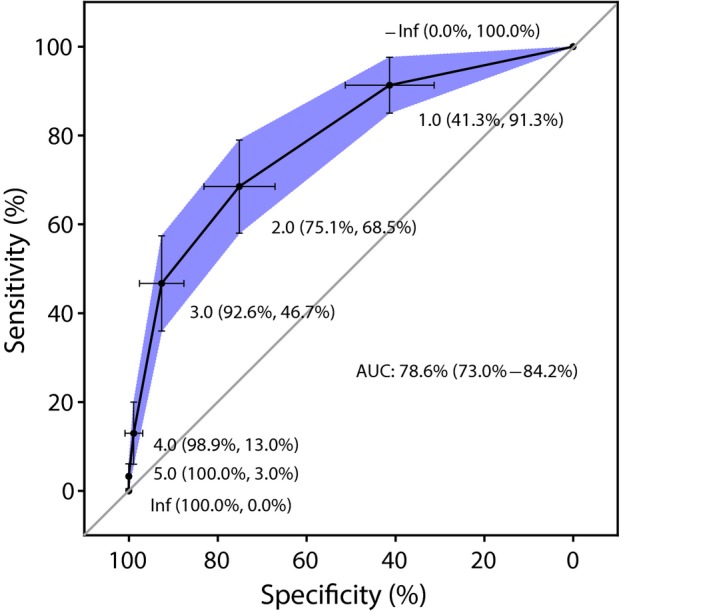
Results: Of 336 children with physician-confirmed wheeze by age 3 years, 117(35%) had school-age asthma. Logistic regression selected 5 significant risk factors which formed the basis of the MAAS APT: wheeze after exercise; wheeze causing breathlessness; cough on exertion; current eczema and SPT sensitisation(maximum score 5). A total of 281(84%) children had complete data at age 3 years and were used to test the MAAS APT. Children scoring ≥3 were at high risk of having asthma at school-age (PPV > 75%; +LR 6.3, -LR 0.6), whereas children who had a score of 0 had very low risk(PPV 9.3%; LR 0.2).
Conclusion: MAAS APT is a simple asthma prediction tool which could easily be applied in clinical and research settings.
© 2018 The Authors. Clinical & Experimental Allergy Published by John Wiley & Sons Ltd.
Figures
References
-
- Kuehni CE, Brooke AM, Silverman M. Prevalence of wheeze during childhood: retrospective and prospective assessment. Eur Resp J. 2000;16:81‐85. - PubMed
-
- Kurukulaaratchy RJ, Matthews S, Arshad SH. Does environment mediate earlier onset of the persistent childhood asthma phenotype? Pediatrics. 2004;113:345‐350. - PubMed
-
- Martinez FD, Wright AL, Taussig LM Holberg CJ, Halonen M, Morgan WJ. Asthma and wheezing in the first six years of life. The Group Health Medical Associates. N Engl J Med 1995;322:133‐138. - PubMed
