Review
. 2018 Nov;8(1):10.1128/ecosalplus.ESP-0002-2018.
doi: 10.1128/ecosalplus.ESP-0002-2018.

Aminoglycoside Revival: Review of a Historically Important Class of Antimicrobials Undergoing Rejuvenation

Affiliations
Review

Aminoglycoside Revival: Review of a Historically Important Class of Antimicrobials Undergoing Rejuvenation

Alisa W Serio et al. EcoSal Plus. 2018 Nov.

Abstract

Aminoglycosides are cidal inhibitors of bacterial protein synthesis that have been utilized for the treatment of serious bacterial infections for almost 80 years. There have been approximately 15 members of this class approved worldwide for the treatment of a variety of infections, many serious and life threatening. While aminoglycoside use declined due to the introduction of other antibiotic classes such as cephalosporins, fluoroquinolones, and carbapenems, there has been a resurgence of interest in the class as multidrug-resistant pathogens have spread globally. Furthermore, aminoglycosides are recommended as part of combination therapy for empiric treatment of certain difficult-to-treat infections. The development of semisynthetic aminoglycosides designed to overcome common aminoglycoside resistance mechanisms, and the shift to once-daily dosing, has spurred renewed interest in the class. Plazomicin is the first new aminoglycoside to be approved by the FDA in nearly 40 years, marking the successful start of a new campaign to rejuvenate the class.


Figures
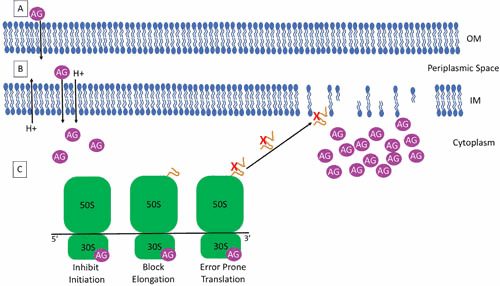
Figure 1
Figure 1
Mechanism of aminoglycoside uptake by Gram-negative bacterial cells and inhibition of protein synthesis. (A) Positively charged aminoglycosides (AG) enter the cell via electrostatic binding to the negatively charged components of the outer membrane (OM) including phospholipids and LPS in Gram-negative bacteria or teichoic acid in Gram-positive bacteria. This binding allows access of the AG to the periplasmic space. (B) A small number of AGs cross the inner membrane (IM) using the proton motive force and into the cytoplasm in an energy-dependent manner. (C) In the cytoplasm, AGs bind the 16S rRNA of the 30S ribosomal subunit where they inhibit initiation of translation, block elongation of translation, and induce error-prone translation. Mistranslated proteins are hypothesized to cause damage to the IM, facilitating AG entry into the cytoplasm.
Figure 2
Figure 2
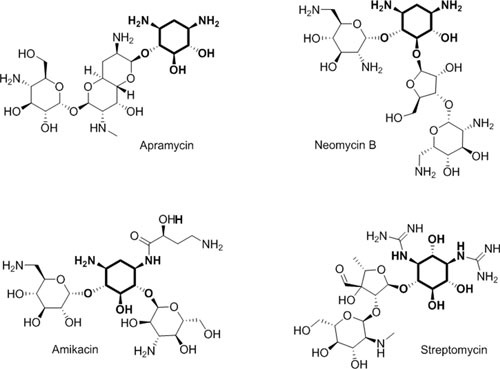
Four aminoglycoside structural groups. Structures of representative aminoglycosides, including the atypical aminoglycosides streptomycin and apramycin, 4,6-substituted amikacin and the 4,5-substituted neomycin B. The deoxystreptamine or streptidine rings are in bold. ©Cold Spring Harbor Press (171), used with permission.
Figure 3
Figure 3
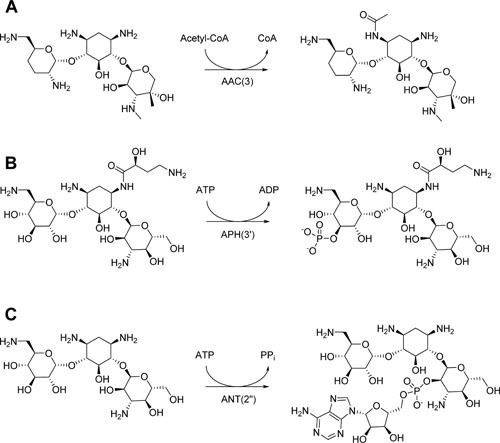
Chemical modification of aminoglycosides by aminoglycoside-modifying enzymes. (A) An example of chemical modification of gentamicin catalyzed by aminoglycoside acetyltransferase AAC(3). (B) An example of chemical modification of amikacin catalyzed by aminoglycoside phosphotransferase APH(3′). (C) An example of chemical modification of kanamycin catalyzed by the aminoglycoside nucleotidyltransferase ANT(2″). ©Cold Spring Harbor Press (171), used with permission.
Figure 4
Figure 4
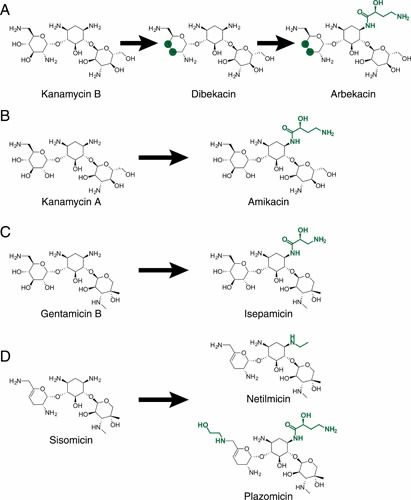
Semisynthetic aminoglycosides. (A) Kanamycin B scaffold with modification to dibekacin and subsequent modification to arbekacin. (B) Kanamycin A scaffold with modification to amikacin. (C) Gentamicin B scaffold with modification to isepamicin. (D) Sisomicin scaffold with modification to netilmicin and with modification to plazomicin. Green highlights indicate new chemical modifications; green circles indicate removal of hydroxyl groups.

References

    1. Kresge N, Simoni RD, Hill RL. 2004. Selman Waksman: the father of antibiotics. J Biol Chem 279:e7.
    1. Woodruff HB, Selman A. 2014. Selman A. Waksman, winner of the 1952 Nobel Prize for physiology or medicine. Appl Environ Microbiol 80:2–8. [PubMed] - PMC - PubMed
    1. Ristuccia AM, Cunha BA. 1985. An overview of amikacin. Ther Drug Monit 7:12–25. - PubMed
    1. Aggen JB, Armstrong ES, Goldblum AA, Dozzo P, Linsell MS, Gliedt MJ, Hildebrandt DJ, Feeney LA, Kubo A, Matias RD, Lopez S, Gomez M, Wlasichuk KB, Diokno R, Miller GH, Moser HE. 2010. Synthesis and spectrum of the neoglycoside ACHN-490. Antimicrob Agents Chemother 54:4636–4642. [PubMed] - PMC - PubMed
    1. Landman D, Babu E, Shah N, Kelly P, Bäcker M, Bratu S, Quale J. 2010. Activity of a novel aminoglycoside, ACHN-490, against clinical isolates of Escherichia coli and Klebsiella pneumoniae from New York City. J Antimicrob Chemother 65:2123–2127. [PubMed] - PubMed

MeSH terms

LinkOut - more resources