Review
. 2018 Dec:65:580-592.
doi: 10.1016/j.intimp.2018.10.026. Epub 2018 Nov 14.

Immune regulation and anti-cancer activity by lipid inflammatory mediators

Affiliations
Review

Immune regulation and anti-cancer activity by lipid inflammatory mediators

Saraswoti Khadge et al. Int Immunopharmacol. 2018 Dec.

Abstract

Rodent and clinical studies have documented that myeloid cell infiltration of tumors is associated with poor outcomes, neutrophilia and lymphocytopenia. This contrasts with increased lymphocyte infiltration of tumors, which is correlated with improved outcomes. Lifestyle parameters, such as obesity and diets with high levels of saturated fat and/or omega (ω)-6 polyunsaturated fatty acids (PUFAs), can influence these inflammatory parameters, including an increase in extramedullary myelopoiesis (EMM). While tumor secretion of growth factors (GFs) and chemokines regulate tumor-immune-cell crosstalk, lifestyle choices also contribute to inflammation, abnormal pathology and leukocyte infiltration of tumors. A relationship between obesity and high-fat diets (notably saturated fats in Western diets) and inflammation, tumor incidence, metastasis and poor outcomes is generally accepted. However, the mechanisms of dietary promotion of an inflammatory microenvironment and targeted drugs to inhibit the clinical sequelae are poorly understood. Thus, modifications of obesity and dietary fat may provide preventative or therapeutic approaches to control tumor-associated inflammation and disease progression. Currently, the majority of basic and clinical research does not differentiate between obesity and fatty acid consumption as mediators of inflammatory and neoplastic processes. In this review, we discuss the relationships between dietary PUFAs, inflammation and neoplasia and experimental strategies to improve our understanding of these relationships. We conclude that dietary composition, notably the ratio of ω-3 vs ω-6 PUFA regulates tumor growth and the frequency and sites of metastasis that together, impact overall survival (OS) in mice.

Keywords: High fat diet; Immune escape; Infiltration; Inflammation; MDSC; PUFA; TAM; Tumor induction; Tumor progression.


Figures

Fig. 1.
Fig. 1.
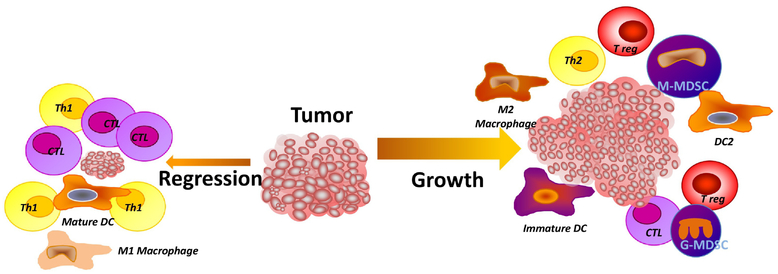
Leukocytes that infiltrate a tumor can regulate their growth rate, progression and may facilitate metastasis. Tumor regression is associated with tumor infiltration by dendritic cells (DCs), cytotoxic T cells (CTL) and type 1 T-helper cells (Th-1). Contrasting with this, tumor growth is facilitated by immune mediated immunosuppression and neoangiogenesis in association with infiltration by myeloid-derived suppressor cells, (MDSCs), immature DCs, pDCs, M2 macrophages, as well as T regulatory (T-reg) cells and a low frequency of CD4+ and CD8+ effector T cells. Further, the expansion of and infiltration by myeloid cell populations, including immunosuppressive sub-populations, is regulated in part, by colony stimulating factors (CSFs), and chemokines secreted by tumor cells, dietary ω−6 poly-unsaturated fatty acids (PUFAs) and saturated fatty acids (SFAs).
Fig. 2.
Fig. 2.
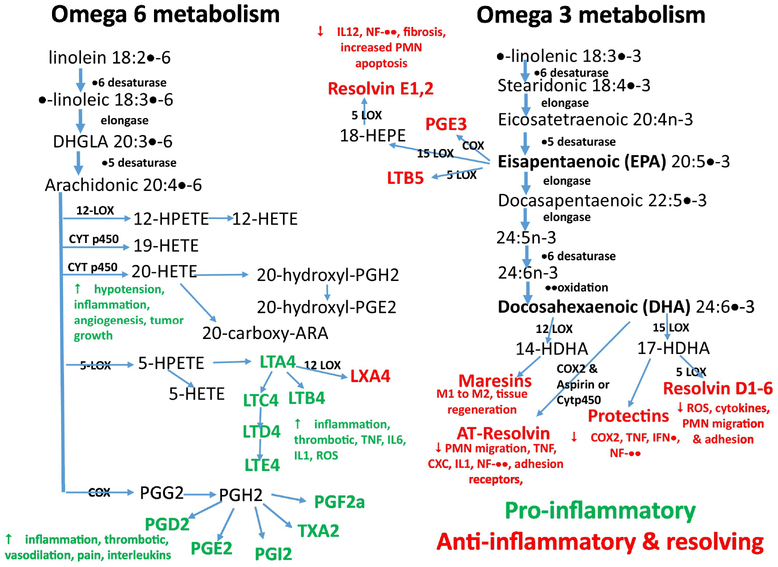
This figure is an outline of eicosanoid mediator synthesis pathways from arachidonic acid (AA) and resolvin related mediators from α-linolenic acid (ALA) and their inflammatory and anti-inflammatory functions. COX, cyclooxygenase; CYT p450 cytochrome, p450; chemokine subtype, CXC; HETE, hydroxyeicosatetraenoic acid; HDHA, hydroxyldocosahexaenoic acid; HPETE, hydroperoxyeicosatetraenoic acid; HPDHA, hydroperoxydocosahexaenoic acid; HPEPE, hydroperoxyeicosapentaenoic acid; IL, interleukin, IFN, interferon; LOX, lipoxygenase; LT, leukotriene; LX, lipoxin; PG, prostaglandin; PMN, polymorphonuclear leukocytes; ROS, reactive oxygen synthetase; TNF, tumor necrosis factor, TX, thromboxane.
Fig. 3:
Fig. 3:
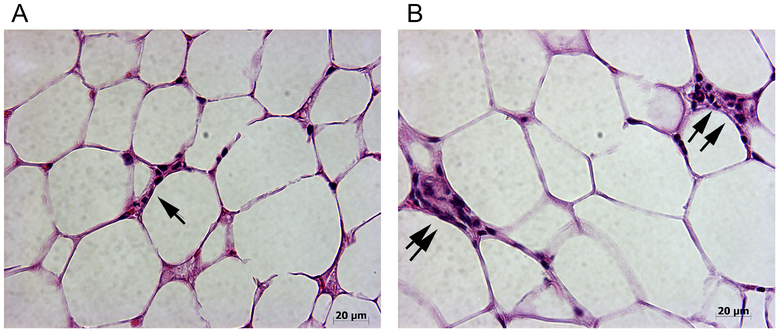
Dietary PUFA regulation of mammary adipose tissue inflammation Crown-like-structures (CLS) were analysed in H & E stained sections of mammary fat pad from mice that received the differing PUFA composition diets for 20 weeks5. MFP from mice fed ω−3 diet (Fig. 3A) and ω−6 diet (Fig. 3B). Mice given the ω−3 diet had fewer and smaller CLS relative to mice given an ω−6 diet. Single arrow indicates small CLS and double arrows indicated large CLS. Note the difference in size of the adipocytes in the MFPs of mice on the different diets, i.e. the adipocytes are significantly larger in the mice given ω−6 diets. Images were taken at 400x magnification.
Fig. 4:
Fig. 4:. Dietary PUFA regulation of mammary tumor growth and survival:
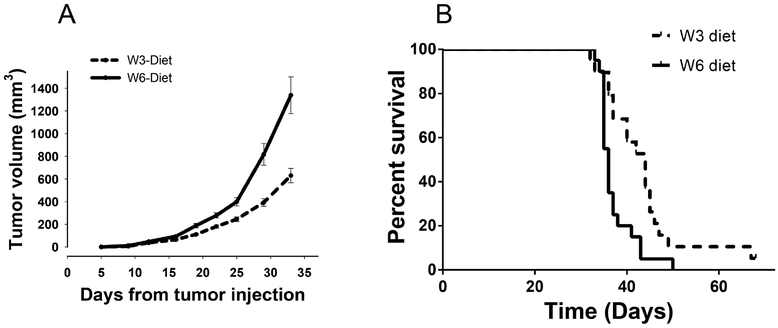
Groups of mice fed ω−6 and ω−3 diets for 10 weeks5, were injected orthotopically with 4T1 cells. Tumor volume was recorded twice a week and plotted with average tumor volume per dietary group (Fig. 4A) (n=20). Survival days were compared between the dietary groups (Fig. 4B) (n=20) (p<0.05).

References

    1. Krusinska B, Hawrysz I, Wadolowska L, Slowinska MA, Biernacki M, Czerwinska A, Golota JJ: Associations of Mediterranean Diet and a Posteriori Derived Dietary Patterns with Breast and Lung Cancer Risk: A Case-Control Study. Nutrients 2018, 10. - PMC - PubMed
    1. Simopoulos AP: Evolutionary aspects of diet, the omega-6/omega-3 ratio and genetic variation: nutritional implications for chronic diseases. Biomed Pharmacother 2006, 60:502–7. - PubMed
    1. Black HS, Rhodes LE: Potential Benefits of Omega-3 Fatty Acids in Non-Melanoma Skin Cancer. J Clin Med 2016, 5. - PMC - PubMed
    1. Miccadei S, Masella R, Mileo AM, Gessani S: omega3 Polyunsaturated Fatty Acids as Immunomodulators in Colorectal Cancer: New Potential Role in Adjuvant Therapies. Frontiers in immunology 2016, 7:486. - PMC - PubMed
    1. Khadge S, Sharp JG, Thiele GM, McGuire TR, Klassen LW, Duryee MJ, Britton HC, Dafferner AJ, Beck J, Black PN, DiRusso CC, Talmadge J: Dietary omega-3 and omega-6 polyunsaturated fatty acids modulate hepatic pathology. The Journal of nutritional biochemistry 2018, 52:92–102. - PMC - PubMed