


BioJupies: Automated Generation of Interactive Notebooks for RNA-Seq Data Analysis in the Cloud
- PMID: 30447998
- PMCID: PMC6265050
- DOI: 10.1016/j.cels.2018.10.007
BioJupies: Automated Generation of Interactive Notebooks for RNA-Seq Data Analysis in the Cloud
Abstract
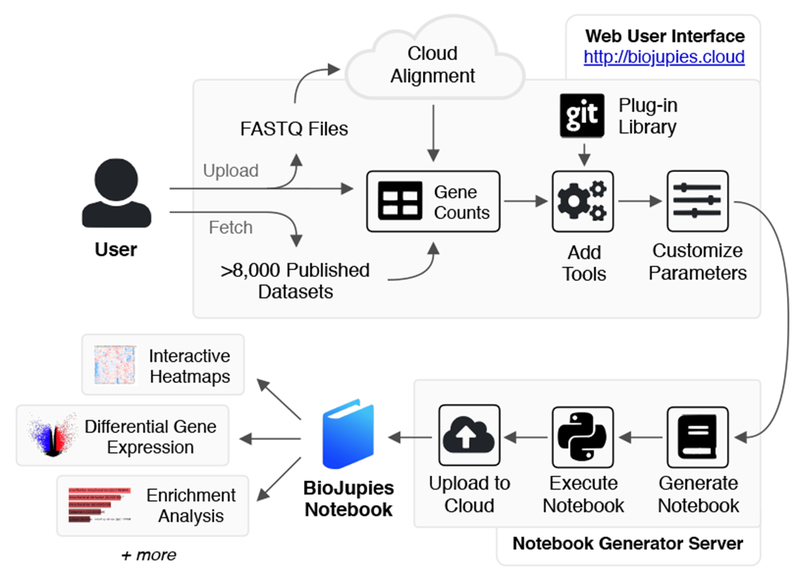
BioJupies is a web application that enables the automated creation, storage, and deployment of Jupyter Notebooks containing RNA-seq data analyses. Through an intuitive interface, novice users can rapidly generate tailored reports to analyze and visualize their own raw sequencing files, gene expression tables, or fetch data from >9,000 published studies containing >300,000 preprocessed RNA-seq samples. Generated notebooks have the executable code of the entire pipeline, rich narrative text, interactive data visualizations, differential expression, and enrichment analyses. The notebooks are permanently stored in the cloud and made available online through a persistent URL. The notebooks are downloadable, customizable, and can run within a Docker container. By providing an intuitive user interface for notebook generation for RNA-seq data analysis, starting from the raw reads all the way to a complete interactive and reproducible report, BioJupies is a useful resource for experimental and computational biologists. BioJupies is freely available as a web-based application from http://biojupies.cloud.
Keywords: Data Commons; Jupyter Notebook; RNA-seq; bioinformatics; data visualization; enrichment analysis; pipeline; systems biology.
Copyright © 2018 Elsevier Inc. All rights reserved.
Conflict of interest statement
Declaration of Interests
The authors declare no competing interests.
Figures
References
-
- Amstutz P, Crusoe MR, Tijanić N, Chapman B, Chilton J, Heuer M, Kartashov A, Leehr D, Ménager H, and Nedeljkovich M (2016). Common Workflow Language, v1. 0.
-
- Baumer B, Cetinkaya-Rundel M, Bray A, Loi L, and Horton NJ (2014). R Markdown: Integrating a reproducible analysis tool into introductory statistics. arXiv preprint arXiv:14021894.
-
- Bray NL, Pimentel H, Melsted P, and Pachter L (2016). Near-optimal probabilistic RNA-seq quantification. Nature biotechnology 34, 525. - PubMed
-
- Chang W, Cheng J, Allaire JJ, Xie Y, and McPherson J (2015). Shiny: web application framework for R. R package version 011 1, 106.
Publication types
MeSH terms
Grants and funding
LinkOut - more resources
Full Text Sources
Other Literature Sources
