


Preclinical Models for Studying NASH-Driven HCC: How Useful Are They?
- PMID: 30449681
- PMCID: PMC6326872
- DOI: 10.1016/j.cmet.2018.10.012
Preclinical Models for Studying NASH-Driven HCC: How Useful Are They?
Abstract
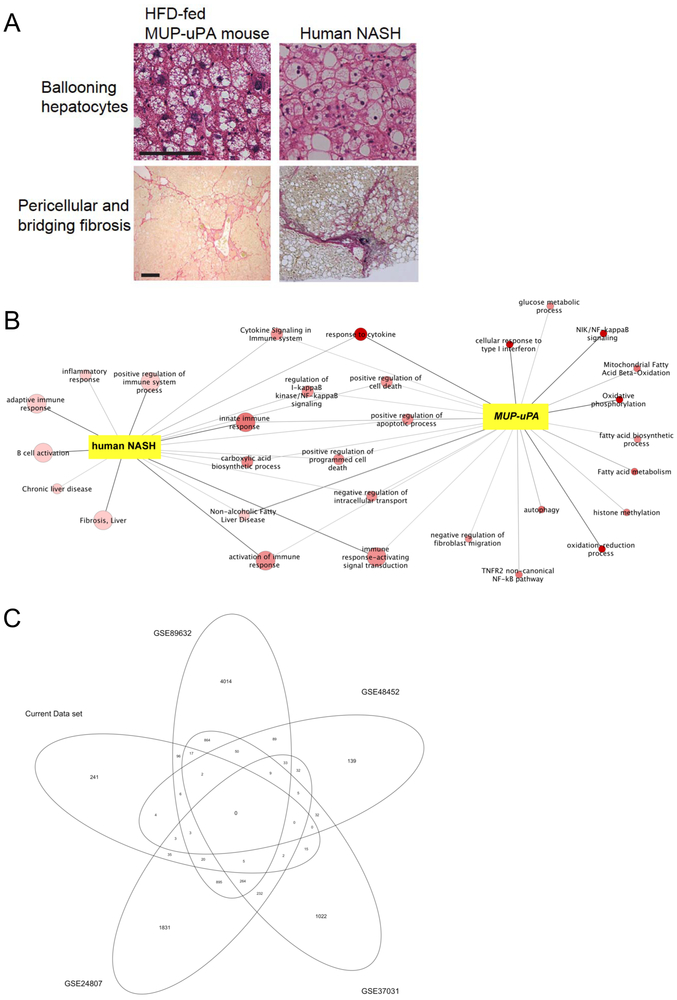
Hepatocellular carcinoma (HCC) is one of the most fatal and fastest-growing cancers. Recently, non-alcoholic steatohepatitis (NASH) has been recognized as a major HCC catalyst. However, it is difficult to decipher the molecular mechanisms underlying the pathogenesis of NASH and understand how it progresses to HCC by studying humans. Progress in this field depends on the availability of reliable preclinical models amenable to genetic and functional analyses and exhibiting robust NASH-to-HCC progression. Although numerous mouse models of NASH have been described, many do not faithfully mimic the human disease and few reliably progress to HCC. Here, we review current literature on the molecular etiology of NASH-related HCC and critically evaluate existing mouse models and their suitability for studying this malignancy. We also compare human transcriptomic and histopathological profiles with data from MUP-uPA mice, a reliable model of NASH-driven HCC that has been useful for evaluation of HCC-targeting immunotherapies.
Keywords: RNA-seq; fatty liver; hepatocellular carcinoma; mouse models; non-alcoholic steatohepatitis; obesity.
Copyright © 2018 Elsevier Inc. All rights reserved.
Figures
References
-
- Adams LA, Lymp JF, St Sauver J, Sanderson SO, Lindor KD, Feldstein A, and Angulo P (2005). The natural history of nonalcoholic fatty liver disease: a population-based cohort study. Gastroenterology 129, 113–121. - PubMed
Publication types
MeSH terms
Grants and funding
- R01 CA155120/CA/NCI NIH HHS/United States
- R01 DK120714/DK/NIDDK NIH HHS/United States
- R37 AI043477/AI/NIAID NIH HHS/United States
- P42 ES010337/ES/NIEHS NIH HHS/United States
- R01 CA211794/CA/NCI NIH HHS/United States
- P30 DK063491/DK/NIDDK NIH HHS/United States
- R01 CA118165/CA/NCI NIH HHS/United States
- U01 AA022614/AA/NIAAA NIH HHS/United States
- U01 AA027681/AA/NIAAA NIH HHS/United States
- P50 AA011999/AA/NIAAA NIH HHS/United States
- R01 AI043477/AI/NIAID NIH HHS/United States
- R01 CA234128/CA/NCI NIH HHS/United States
- R01 CA127923/CA/NCI NIH HHS/United States
- R01 CA198103/CA/NCI NIH HHS/United States
LinkOut - more resources
Full Text Sources
Other Literature Sources
Medical
Molecular Biology Databases
Miscellaneous
