


Fingertip Reactive Hyperemia Peripheral Arterial Tonometry Score Predicts Response to Biventricular Pacing
- PMID: 30449989
- PMCID: PMC6236571
- DOI: 10.6515/ACS.201811_34(6).20180518A
Fingertip Reactive Hyperemia Peripheral Arterial Tonometry Score Predicts Response to Biventricular Pacing
Abstract
Purpose: The objectives of this study were to: (i) evaluate endothelial function via fingertip reactive hyperemia peripheral arterial tonometry (RH-PAT) among heart failure (HF) patients receiving cardiac resynchronization therapy (CRT), (ii) assess the effects of CRT on RH-PAT score, and (iii) investigate whether RH-PAT score can identify CRT response.
Methods: A total of 63 patients (61.8 ± 10.3 years; 50 males; left ventricular (LV) ejection fraction 24.3 ± 3.9%) with HF who received CRT were enrolled. Endothelial function via RH-PAT was assessed 1 day before and 6 months after CRT. Minnesota Living with Heart Failure Questionnaire (MLWHFQ) was used to assess clinical improvements. CRT response was defined as a reduction in LV end-systolic volume ≥ 15% at 6 months.
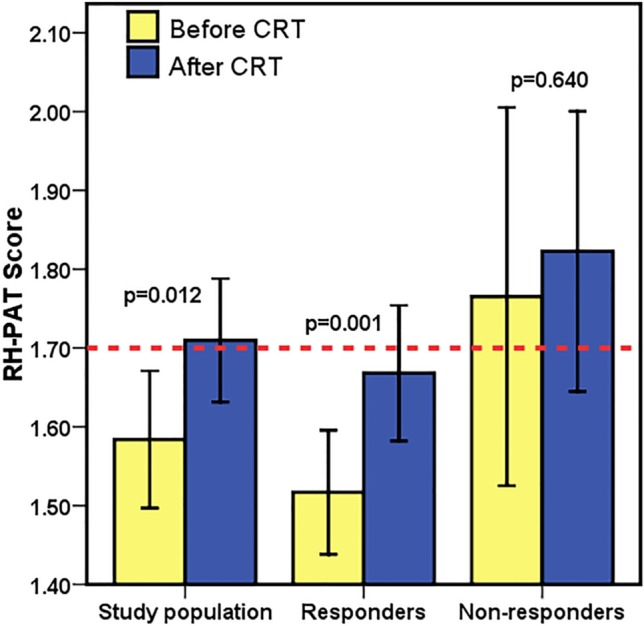
Results: A RH-PAT score of < 1.7 signified a cut-off for endothelial dysfunction (ED). Baseline ED was observed among 43 (68.3%) patients and was more prevalent in responders (76.1% vs. 47.1%, p = 0.037). RH-PAT score improved 6 months after CRT (1.58 ± 0.35 vs. 1.71 ± 0.31, p = 0.012). A RH-PAT score of < 1.7 was a significant independent predictor of CRT response in multivariate logistic regression analysis (β = 1.275, OR = 3.512, 95% CI = 1.231-11.477, p = 0.032). The severity of ED was an independent predictor of LV reverse remodeling (β = -8.873, p = 0.015). Spearman's correlation analysis revealed moderate positive correlations between an improvement in RH-PAT (ΔRH-PAT) and LV reverse remodeling (r = 0.461, p = 0.001) and MLWHFQ score (r = 0.440, p = 0.001).
Conclusions: ED detected via RH-PAT could predict the response to CRT. The RH-PAT score increased 6 months after CRT and was correlated with echocardiographic and clinical improvements.
Keywords: Cardiac resynchronization therapy; Endothelial dysfunction; Heart failure; Peripheral arterial tonometry; Response.
Figures


References
-
- Deanfield J, Donald A, Ferri C, et al. Endothelial function and dysfunction. Part I: methodological issues for assessment in the different vascular beds: a statement by the Working Group on Endothelin and Endothelial Factors of the European Society of Hypertension. J Hypertens. 2005;23:7–17. - PubMed
-
- Yeboah J, Crouse JR, Hsu FC, et al. Brachial flow-mediated dilation predicts incident cardiovascular events in older adults: the Cardiovascular Health Study. Circulation. 2007;115:2390–2397. - PubMed
-
- Akar JG, Al-Chekakie MO, Fugate T, et al. Endothelial dysfunction in heart failure identifies responders to cardiac resynchronization therapy. Heart Rhythm. 2008;5:1229–1235. - PubMed
-
- Van Wagoner DR. Is homocysteine a mediator of atrial dysfunction or just another marker of endothelial dysfunction? Europace. 2008;10:899–900. - PubMed
LinkOut - more resources
Full Text Sources
Research Materials
Miscellaneous