Review
. 2018 Oct;7(5):599-608.
doi: 10.21037/tlcr.2018.08.03.

Update on the management of malignant peritoneal mesothelioma

Affiliations
Review

Update on the management of malignant peritoneal mesothelioma

Paul H Sugarbaker. Transl Lung Cancer Res. 2018 Oct.

Abstract

Malignant peritoneal mesothelioma (MPM) is a rare disease whose natural history is confined to the peritoneal space. Systemic chemotherapy has little impact on survival of patients with MPM. A surgical procedure with a goal of resection of all visible evidence of disease, called cytoreductive surgery (CRS) has been utilized in MPM patients. Also, regional chemotherapy with hyperthermic intraperitoneal chemotherapy (HIPEC) and normothermic intraperitoneal chemotherapy long-term (NIPEC-LT) have been effectively utilized in MPM patients. In the absence of CRS and HIPEC the median survival of MPM patients is approximately 1 year. The aggressive surgical approach plus regional chemotherapy has increased the median survival to more than 5 years. With NIPEC-LT added on, 70% 5-year survival has been reported. Knowledgeable patient selection for treatment is mandatory. The use of CRS, HIPEC and NIPEC-LT has greatly benefited patients with MPM. Global application of these treatments is indicated.

Keywords: Epithelial peritoneal mesothelioma; cisplatin; cytoreductive surgery (CRS); doxorubicin; early postoperative intraperitoneal chemotherapy (EPIC); hyperthermic perioperative chemotherapy (HIPEC); ifosfamide; normothermic intraperitoneal chemotherapy (NIPEC); paclitaxel.


Conflict of interest statement

Conflicts of Interest: The author has no conflicts of interest to declare.

Figures
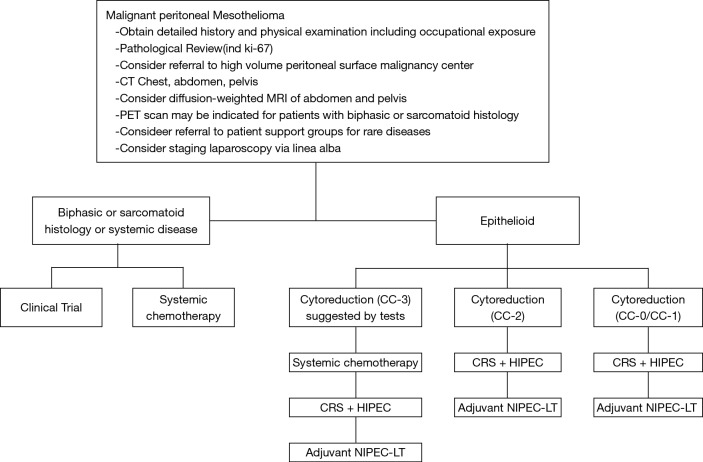
Figure 1
Figure 1
Algorithm for management of patients with malignant peritoneal mesothelioma. CRS, cytoreductive surgery; CT, computed tomography; HIPEC, hyperthermic perioperative chemotherapy; NIPEC-LT, normothermic intraperitoneal chemotherapy long-term; MRI, magnetic resonance imaging; PET, positron emission tomography.
Figure 2
Figure 2
The predictive value of CT findings by a tree-structured diagram (from reference with permission). CT, computed tomography; AC, adequate cytoreduction; SC, suboptimal cytoreduction; SB/SBM, small bowel and small bowel mesentery.
Figure 3
Figure 3
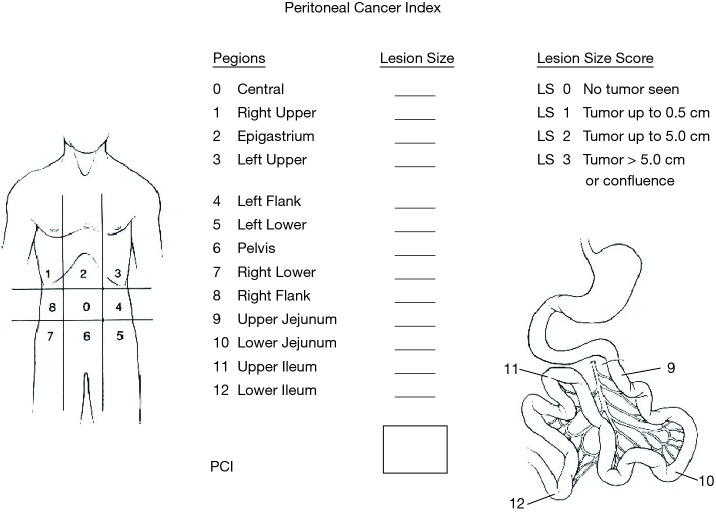
The PCI. The PCI combines size and distribution parameters to determine a numerical score. The LS is used to quantitate the size of peritoneal nodules. LS-0 indicates no tumor seen, LS-1 indicates tumor implants up to 0.5 cm, LS-2 indicates tumor implants between 0.5 and 5 cm, and LS-3 indicates tumor implants larger than 5 cm or a layering of cancer. The distribution of tumor is determined within the 13 abdominopelvic regions. (From reference with permission: this figure was first published in Jacquet P, Sugarbaker PH. Current methodologies for clinical assessment of patients with peritoneal carcinomatosis. J Exp Clin Cancer Res 1996;15:49-58 and is available under a Creative Commons Attribution License 4.0). PCI, peritoneal cancer index; LS, lesion size.
Figure 4
Figure 4
Laparoscopy port site recurrence. Surgical trauma plus access of malignant cells to the abdominal wall may cause rapid disease progression within rectus muscles bilaterally.
Figure 5
Figure 5
Survival of patients with malignant peritoneal mesothelioma in 2 different treatment groups. Group 1 is CRS plus HIPEC plus NIPEC-LT. Group 2 is cytoreductive surgery plus hyperthermic perioperative chemotherapy (P=0.0033). CRS, cytoreductive surgery; HIPEC, hyperthermic perioperative chemotherapy; NIPEC-LT, normothermic intraperitoneal chemotherapy long-term.

References

    1. Moolgavkar SH, Meza R, Turim J. Pleural and peritoneal mesotheliomas in SEER: age effects and temporal trends, 1973-2005. Cancer Causes Control 2009;20:935-44. 10.1007/s10552-009-9328-9 - DOI - PubMed
    1. Moertel CG. Peritoneal mesothelioma. Gastroenterology 1972;63:346-50. - PubMed
    1. WINSLOW DJ , TAYLOR HB. Malignant peritoneal mesotheliomas: a clinicopathological analysis of 12 fatal cases. Cancer 1960;13:127-36. 10.1002/1097-0142(196001/02)13:1<127::AID-CNCR2820130124>3.0.CO;2-6 - DOI - PubMed
    1. Antman KH, Blum RH, Greenberger JS, et al. Multimodality therapy for malignant mesothelioma based on a study of natural history. Am J Med 1980;68:356-62. 10.1016/0002-9343(80)90103-5 - DOI - PubMed
    1. Brenner J, Sordillo PP, Magill GB, et al. Malignant peritoneal mesothelioma: review of 25 patients. Am J Gastroenterol 1981;75:311-3. - PubMed