


Transcriptional control of natural killer cell differentiation
- PMID: 30450565
- PMCID: PMC6329199
- DOI: 10.1111/imm.13017
Transcriptional control of natural killer cell differentiation
Abstract
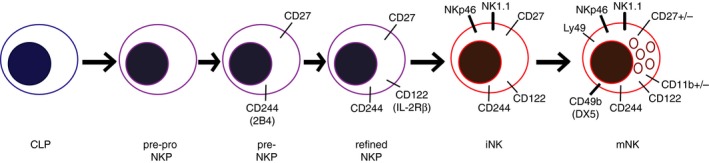
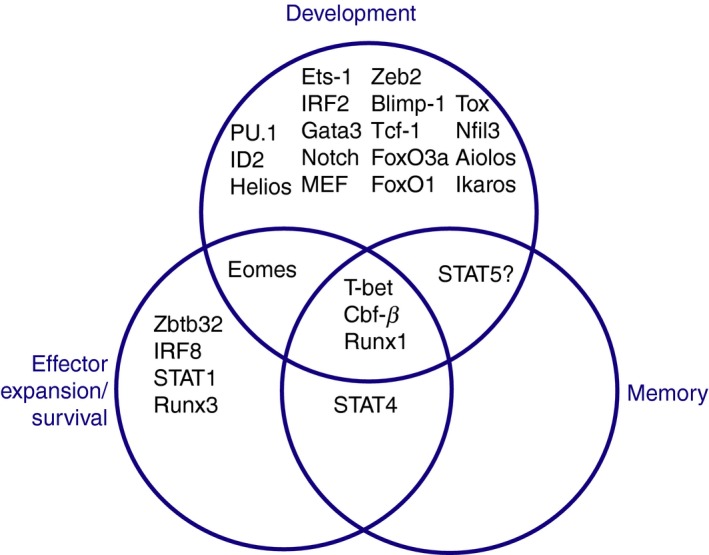
Natural killer (NK) cells are highly specialized cytotoxic lymphocytes that provide protection against pathogens and malignant cells. They develop from common lymphoid progenitors via a multi-stage lineage commitment and differentiation process that gives rise to mature NK cells with potent cytotoxic functionality. Although generally considered cells of the innate immune system, recent studies have demonstrated that NK cells have the capacity to mount immune responses with features of adaptive immunity, including robust antigen-specific clonal-like expansion and the generation of long-lived memory cells that mediate enhanced recall responses. Here, we discuss specific transcription factors that have been shown to commonly and uniquely regulate NK cell development and effector and memory responses in experimental mouse models.
Keywords: development; epigenetics; memory; transcription factors.
© 2018 John Wiley & Sons Ltd.
Figures
References
-
- Artis D, Spits H. The biology of innate lymphoid cells. Nature 2015; 517:293–301. - PubMed
-
- Spits H, Artis D, Colonna M, Diefenbach A, Di Santo JP, Eberl G et al Innate lymphoid cells – a proposal for uniform nomenclature. Nat Rev Immunol 2013; 13:145–9. - PubMed
-
- Di Santo JP. Natural killer cell developmental pathways: a question of balance. Annu Rev Immunol 2006; 24:257–86. - PubMed
-
- Sitnicka E. Early cellular pathways of mouse natural killer cell development. J Innate Immun 2011; 3:329–36. - PubMed
-
- Tang Y, Peitzsch C, Charoudeh HN, Cheng M, Chaves P, Jacobsen SE et al Emergence of NK‐cell progenitors and functionally competent NK‐cell lineage subsets in the early mouse embryo. Blood 2012; 120:63–75. - PubMed
Publication types
MeSH terms
Grants and funding
LinkOut - more resources
Full Text Sources
