


Little evidence for Fast Mapping (FM) in adults: A review and discussion
- PMID: 30451079
- PMCID: PMC6711760
- DOI: 10.1080/17588928.2018.1542376
Little evidence for Fast Mapping (FM) in adults: A review and discussion
Abstract
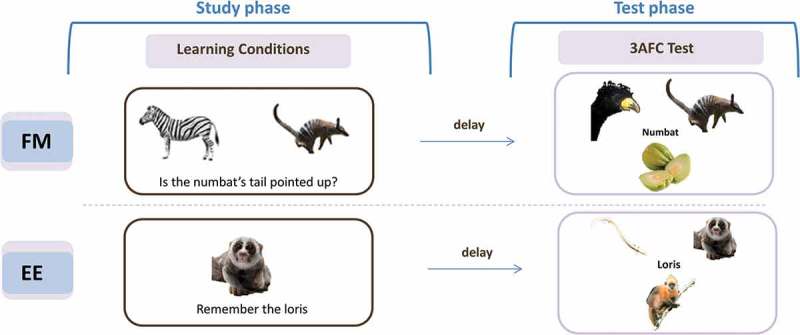
Conventional memory theory proposes that the hippocampus is initially responsible for encoding new information, before this responsibility is gradually transferred to the neocortex. Therefore, a report in 2011 by Sharon et al. of hippocampal-independent learning in humans was notable. These authors reported normal learning of new object-name associations under a Fast Mapping (FM) procedure in adults with hippocampal damage, who were amnesic according to more conventional explicit memorisation procedures. FM is an incidental learning paradigm, inspired by vocabulary acquisition in children, which is hypothesised to allow rapid, cortical-based memory formation. In the years since the original report, there has been, understandably, a growing interest in adult FM, not only because of its theoretical importance, but also because of its potential to help rehabilitate individuals with memory problems. We review the FM literature in individuals with amnesia and in healthy adults, using both explicit and implicit memory measures. Contrary to other recent reviews, we conclude that the evidence for FM in adults is weak, and restraint is needed before assuming the phenomenon exists.
Keywords: Fast Mapping; episodic encoding; hippocampus; learning; memory.
Figures
Comment in
-
Fast mapping is a laboratory task, not a cognitive capacity.Cogn Neurosci. 2019 Jul-Oct;10(4):223-225. doi: 10.1080/17588928.2019.1573810. Epub 2019 Feb 4. Cogn Neurosci. 2019. PMID: 30669945 Free PMC article.
-
Why would a special FM process exist in adults, when it does not appear to exist in children?Cogn Neurosci. 2019 Jul-Oct;10(4):221-222. doi: 10.1080/17588928.2019.1574260. Epub 2019 Feb 4. Cogn Neurosci. 2019. PMID: 30676265
-
Addressing misconceptions of fast mapping in adults.Cogn Neurosci. 2019 Jul-Oct;10(4):226-228. doi: 10.1080/17588928.2019.1593955. Epub 2019 Mar 20. Cogn Neurosci. 2019. PMID: 30894061
-
Why and how the co-occurring familiar object matters in Fast Mapping (FM)? Insights from computational models.Cogn Neurosci. 2019 Jul-Oct;10(4):229-231. doi: 10.1080/17588928.2019.1593121. Epub 2019 Mar 21. Cogn Neurosci. 2019. PMID: 30894067
-
Little evidence for fast mapping in adults with developmental amnesia.Cogn Neurosci. 2019 Jul-Oct;10(4):215-217. doi: 10.1080/17588928.2019.1593123. Epub 2019 Mar 21. Cogn Neurosci. 2019. PMID: 30894071
-
Long-term fragility: Interference susceptibility may be an inherent characteristic of memory traces acquired through fast mapping.Cogn Neurosci. 2019 Jul-Oct;10(4):218-220. doi: 10.1080/17588928.2019.1593122. Epub 2019 Mar 21. Cogn Neurosci. 2019. PMID: 30894075
-
Other 'routes in'? Has the 'fast' in the fast mapping concept led us astray?Cogn Neurosci. 2019 Jul-Oct;10(4):213-214. doi: 10.1080/17588928.2019.1593124. Epub 2019 Mar 21. Cogn Neurosci. 2019. PMID: 30895846
-
Fast mappers, slow learners: Word learning without hippocampus is slow and sparse irrespective of methodology.Cogn Neurosci. 2019 Jul-Oct;10(4):210-212. doi: 10.1080/17588928.2019.1593120. Epub 2019 Mar 21. Cogn Neurosci. 2019. PMID: 30898013 Free PMC article.
-
Reasons to doubt the generalizability, reliability, and diagnosticity of fast mapping (FM) for rapid lexical integration.Cogn Neurosci. 2019 Jul-Oct;10(4):234-236. doi: 10.1080/17588928.2019.1600487. Epub 2019 Apr 9. Cogn Neurosci. 2019. PMID: 30966979
-
Evidence for fast mapping in adults - Moderating factors yet need to be identified.Cogn Neurosci. 2019 Jul-Oct;10(4):232-233. doi: 10.1080/17588928.2019.1605986. Epub 2019 Apr 22. Cogn Neurosci. 2019. PMID: 30973046
-
Response to commentaries on our review of Fast Mapping in adults.Cogn Neurosci. 2019 Jul-Oct;10(4):237-240. doi: 10.1080/17588928.2019.1651709. Epub 2019 Aug 9. Cogn Neurosci. 2019. PMID: 31394963 Free PMC article.
References
-
- Alishahi A., Fazly A., & Stevenson S. (2008). Fast mapping in word learning: What probabilities tell us In Clark A., & Toutanova K. (Eds.), Proceedings of the 12th conference on computational natural language learning, CoNLL 2008 (pp. 57–64). Manchester: UK.
-
- Andrews S. (1996). Lexical retrieval and selection processes: Effects of transposed-letter confusability. Journal of Memory and Language, 35(6), 775–800.
-
- Axelsson E. L., & Horst J. S. (2014). Contextual repetition facilitated word learning via fast mapping. Acta Psychologia, 152, 95–99. - PubMed
-
- Bakker I., Takashima A., van Hell J. G., Janzen G., & McQueen J. G. (2014). Competition from unseen or unheard novel words: Lexical consolidation across modalities. Journal of Memory and Language, 73(1), 116–130.
Publication types
MeSH terms
Grants and funding
LinkOut - more resources
Full Text Sources
Medical
