. 2019 Jul;10(4):1032-1040.
doi: 10.1111/jdi.12977. Epub 2019 Jan 1.

Secular changes in clinical manifestations of kidney disease among Japanese adults with type 2 diabetes from 1996 to 2014

Affiliations

Secular changes in clinical manifestations of kidney disease among Japanese adults with type 2 diabetes from 1996 to 2014

Shinji Kume et al. J Diabetes Investig. 2019 Jul.

Abstract

Aims/introduction: Diabetic kidney disease is characterized by increased albuminuria and/or a reduced glomerular filtration rate (GFR). We analyzed secular changes in the prevalence of albuminuria and reduced estimated GFR (eGFR) in Japanese patients with type 2 diabetes, and identified factors associated with these changes.

Materials and methods: Using 1996, 2001, 2006 and 2014 cohort data from the Japanese serial cross-sectional studies conducted at Shiga University of Medical Science, secular changes in the prevalence of diabetic kidney disease (albuminuria and/or reduced eGFR), patient characteristics and their associations were analyzed.

Results: The prevalence of microalbuminuria and macroalbuminuria decreased over time, whereas the prevalence of moderately reduced eGFR (30-60 mL/min/1.73 m2 ) and severely reduced eGFR (<30 mL/min/1.73 m2 ) increased. Severely reduced eGFR was observed mainly in the patients with macroalbuminuria, regardless of year. Conversely, the prevalence of moderately reduced eGFR increased in the patients without macroalbuminuria. Both macroalbuminuria and moderately reduced eGFR without macroalbuminuria in the 2014 cohort were refractory to the recently recommended intensive therapy. Finally, we showed that obesity accompanied by vascular dysfunction was a risk factor for the development of albuminuria, and that age-dependent arterial stiffness was associated with reduced eGFR without macroalbuminuria in the 2014 cohort.

Conclusions: During the past 20 years in Japan, the prevalence of albuminuria declined, whereas that of reduced eGFR increased. Additionally, obesity- and high age-related vascular damage seems to be associated with macroalbuminuria and reduced eGFR without macroalbuminuria, respectively.

Keywords: albuminuria; diabetic kidney disease; diabetic nephropathy.


Figures

Figure 1
Figure 1
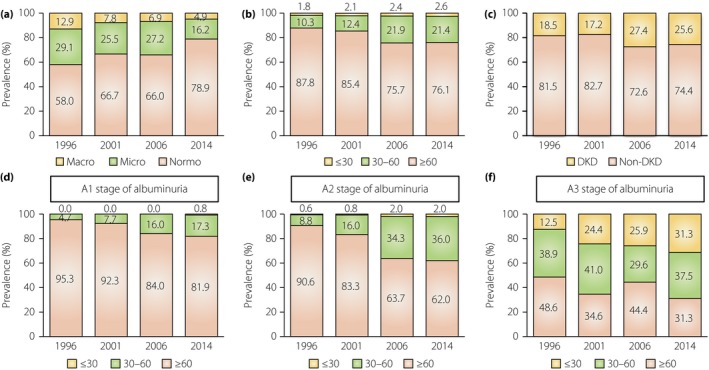
Secular changes in the prevalence of albuminuria and reduced estimated glomerlular filtration rate (eGFR). (a) The prevalence of albuminuria in the 1996, 2001, 2006 and 2014 cohorts. (b) The prevalence of a reduced eGFR in the indicated cohorts. (c) The prevalence of diabetic kidney disease (DKD), defined by albuminuria and/or a reduced eGFR (≤60 mL/min/1.73 m2) in the indicated cohorts. (d–f) The prevalence of a reduced eGFR in the stages of (d) normoalbuminuria, (e) microalbuminuria and (f) macroalbuminuria.
Figure 2
Figure 2
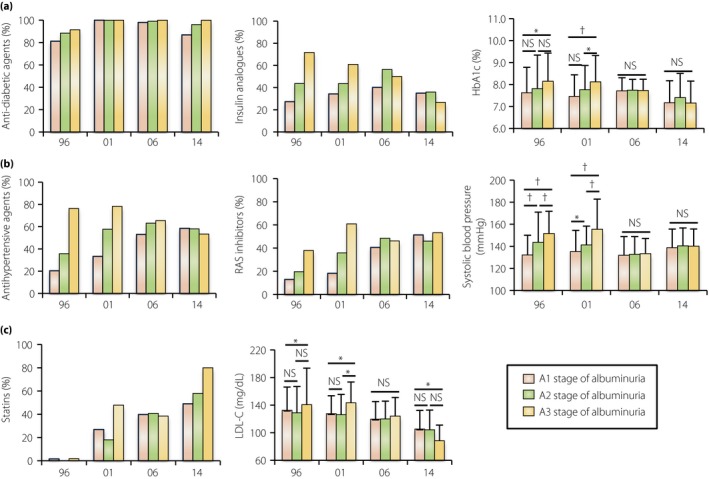
Changes in the clinical characteristics in the type 2 diabetes patients with different stages of albuminuria. (a) The use rate of any antidiabetic agents and insulin analogs, and hemoglobin A1c (HbA1c) value in the different albuminuria stages in the 1996, 2001, 2006 and 2014 cohorts. (b) The use rate of any antihypertensive agents and renin–angiotensin system (RAS) inhibitors, and systolic blood pressure in the different cohorts. (c) The use rate of statins and low‐density lipoprotein cholesterol (LDL‐C) value in the different cohorts. Data are the mean ± standard deviation. *P < 0.05, P < 0.01. NS, not statistically significant.
Figure 3
Figure 3
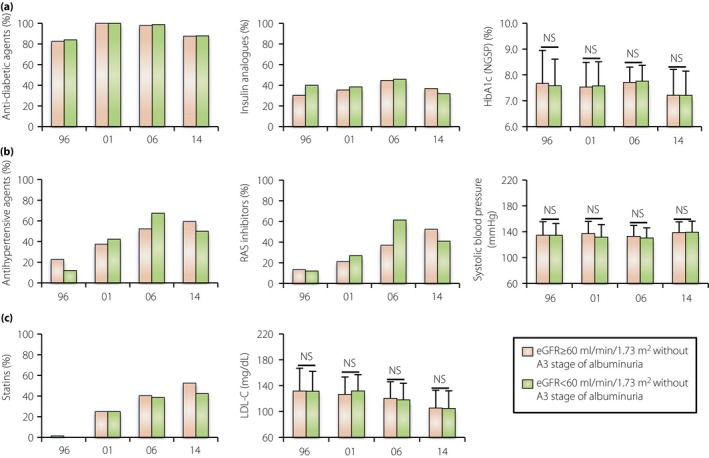
Changes in the clinical characteristics of patients with type 2 diabetes with different categories of estimated glomerular filtration rate (eGFR) decline without macroalbuminuria. (a) The rate of use of any anti‐diabetic agents and insulin analogs and the hemoglobin A1c (HbA1c) level in the different eGFR stages in the 1996, 2001, 2006 and 2014 cohorts. (b) The rate of use of any antihypertensive agents and renin–angiotensin system (RAS) inhibitors and the systolic blood pressure in the different cohorts. (c) The rate of use of statins and the low‐density lipoprotein cholesterol (LDL‐C) level in the different cohorts. Data are the mean ± standard deviation. NS, not statistically significant.
Figure 4
Figure 4
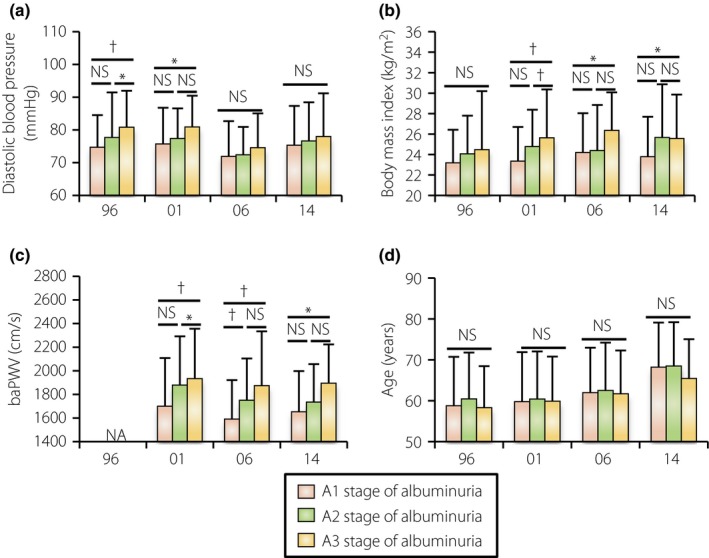
Secular changes in the clinical parameters in different albuminuria stages. (a) Diastolic blood pressure, (b) body mass index, (c) brachial‐ankle pulse wave velocity (baPWV) and (d) age in the different albuminuria stages in the 1996, 2001, 2006 and 2014 cohorts. Data are the mean ± standard deviation. *P < 0.05, P < 0.01. NS, not statistically significant.
Figure 5
Figure 5
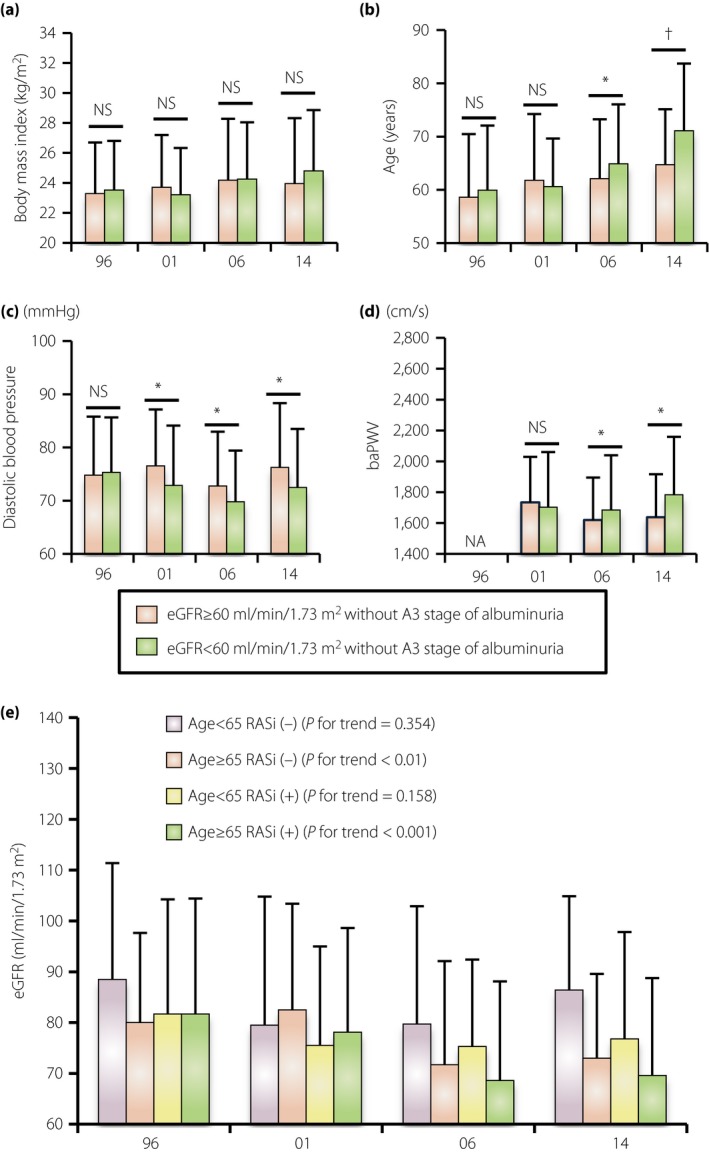
Secular changes in the clinical parameters in different estimated glomerular filtration rate (eGFR) categories. (a) Body mass index, (b) age, (c) diastolic blood pressure (d) and brachial‐ankle pulse wave velocity (baPWV) in the different eGFR categories without macroalbuminuria. (e) Mean eGFR values in four different cohorts, which were divided by age and renin–angiotensin system (RAS) use among the patients with a reduced GFR without macroalbuminuria (trend analysis was carried out with the Jonckheere–Terpstra trend test. P‐value of <0.05 considered statistically significant). Data are the mean ± standard deviation. *P < 0.05, P < 0.01. NS, not statistically significant.

References

    1. Eijkelkamp WB, Zhang Z, Remuzzi G, et al Albuminuria is a target for renoprotective therapy independent from blood pressure in patients with type 2 diabetic nephropathy: post hoc analysis from the Reduction of Endpoints in NIDDM with the Angiotensin II Antagonist Losartan (RENAAL) trial. J Am Soc Nephrol 2007; 18: 1540–1546. - PubMed
    1. Katayama S, Moriya T, Tanaka S, et al Low transition rate from normo‐ and low microalbuminuria to proteinuria in Japanese type 2 diabetic individuals: the Japan Diabetes Complications Study (JDCS). Diabetologia 2011; 54: 1025–1031. - PMC - PubMed
    1. Moriya T, Tanaka S, Kawasaki R, et al Diabetic retinopathy and microalbuminuria can predict macroalbuminuria and renal function decline in Japanese type 2 diabetic patients: Japan Diabetes Complications Study. Diabetes Care 2013; 36: 2803–2809. - PMC - PubMed
    1. Wada T, Haneda M, Furuichi K, et al Clinical impact of albuminuria and glomerular filtration rate on renal and cardiovascular events, and all‐cause mortality in Japanese patients with type 2 diabetes. Clin Exp Nephrol 2014; 18: 613–620. - PubMed
    1. Yokoyama H, Araki S, Honjo J, et al Association between remission of macroalbuminuria and preservation of renal function in patients with type 2 diabetes with overt proteinuria. Diabetes Care 2013; 36: 3227–3233. - PMC - PubMed

MeSH terms