


The Toll pathway inhibits tissue growth and regulates cell fitness in an infection-dependent manner
- PMID: 30451683
- PMCID: PMC6279345
- DOI: 10.7554/eLife.39939
The Toll pathway inhibits tissue growth and regulates cell fitness in an infection-dependent manner
Abstract
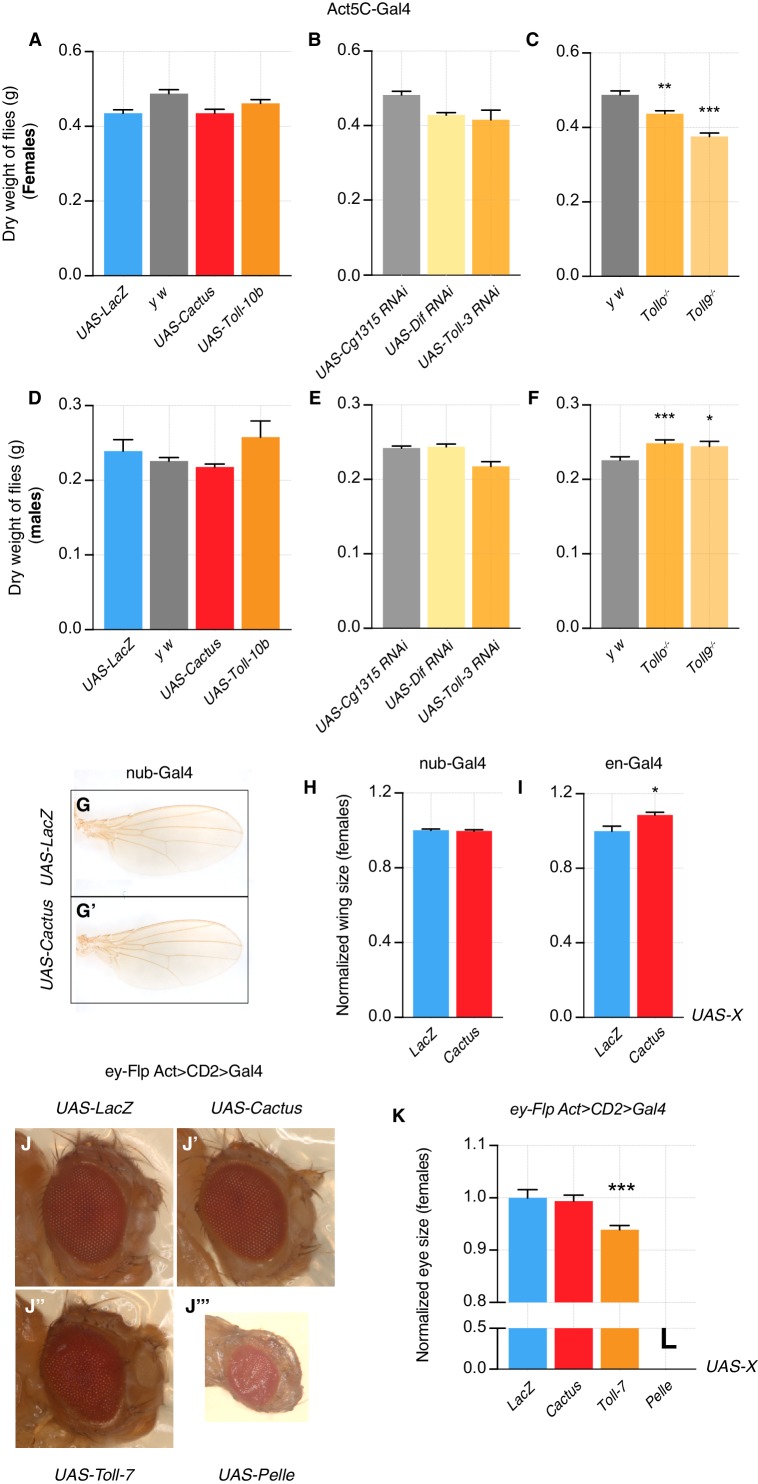
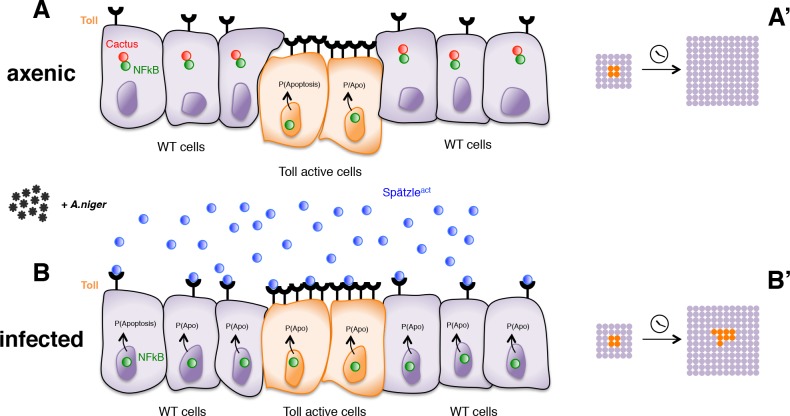
The Toll pathway regulates the cellular response to infection via the transcriptional upregulation of antimicrobial peptides. In Drosophila, apart from its role in innate immunity, this pathway has also been reported to be important for the elimination of loser cells in a process referred to as cell competition, which can be locally triggered by secreted factors released from winner cells. In this work, we provide evidence that the inhibition of Toll signaling not only increases the fitness of loser cells, but also bestows a clonal growth advantage on wild-type cells. We further demonstrate that this growth advantage depends on basal infection levels since it is no longer present under axenic conditions but exacerbated upon intense pathogen exposure. Thus, the Toll pathway functions as a fine-tuned pro-apoptotic and anti-proliferative regulator, underlining the existence of a trade-off between innate immunity and growth during development.
Keywords: D. melanogaster; Toll pathway; cell competition; cell fitness; cell growth; developmental biology; innate Immunity.
© 2018, Germani et al.
Conflict of interest statement
FG, DH, DS, EM, KB No competing interests declared
Figures




References
-
- Beura LK, Hamilton SE, Bi K, Schenkel JM, Odumade OA, Casey KA, Thompson EA, Fraser KA, Rosato PC, Filali-Mouhim A, Sekaly RP, Jenkins MK, Vezys V, Haining WN, Jameson SC, Masopust D. Normalizing the environment recapitulates adult human immune traits in laboratory mice. Nature. 2016;532:512–516. doi: 10.1038/nature17655. - DOI - PMC - PubMed
Publication types
MeSH terms
Substances
LinkOut - more resources
Full Text Sources
Molecular Biology Databases
