. 2018 Nov 19:10.1038/nbt.4297.
doi: 10.1038/nbt.4297. Online ahead of print.

RNAi modulation of placental sFLT1 for the treatment of preeclampsia

Affiliations

RNAi modulation of placental sFLT1 for the treatment of preeclampsia

Anton A Turanov et al. Nat Biotechnol. .

Abstract

Preeclampsia is a placentally induced hypertensive disorder of pregnancy that is associated with substantial morbidity and mortality to mothers and fetuses. Clinical manifestations of preterm preeclampsia result from excess circulating soluble vascular endothelial growth factor receptor FLT1 (sFLT1 or sVEGFR1) of placental origin. Here we identify short interfering RNAs (siRNAs) that selectively silence the three sFLT1 mRNA isoforms primarily responsible for placental overexpression of sFLT1 without reducing levels of full-length FLT1 mRNA. Full chemical stabilization in the context of hydrophobic modifications enabled productive siRNA accumulation in the placenta (up to 7% of injected dose) and reduced circulating sFLT1 in pregnant mice (up to 50%). In a baboon preeclampsia model, a single dose of siRNAs suppressed sFLT1 overexpression and clinical signs of preeclampsia. Our results demonstrate RNAi-based extrahepatic modulation of gene expression with nonformulated siRNAs in nonhuman primates and establish a path toward a new treatment paradigm for patients with preterm preeclampsia.


Conflict of interest statement

Conflict of interest

A.K. discloses ownership of stock in RXi Pharmaceuticals and Advirna. S.A.K. is a consultant to Thermofisher Scientific and owns stock in Aggamin Therapeutics. Other authors declare no conflict of interest.

Figures
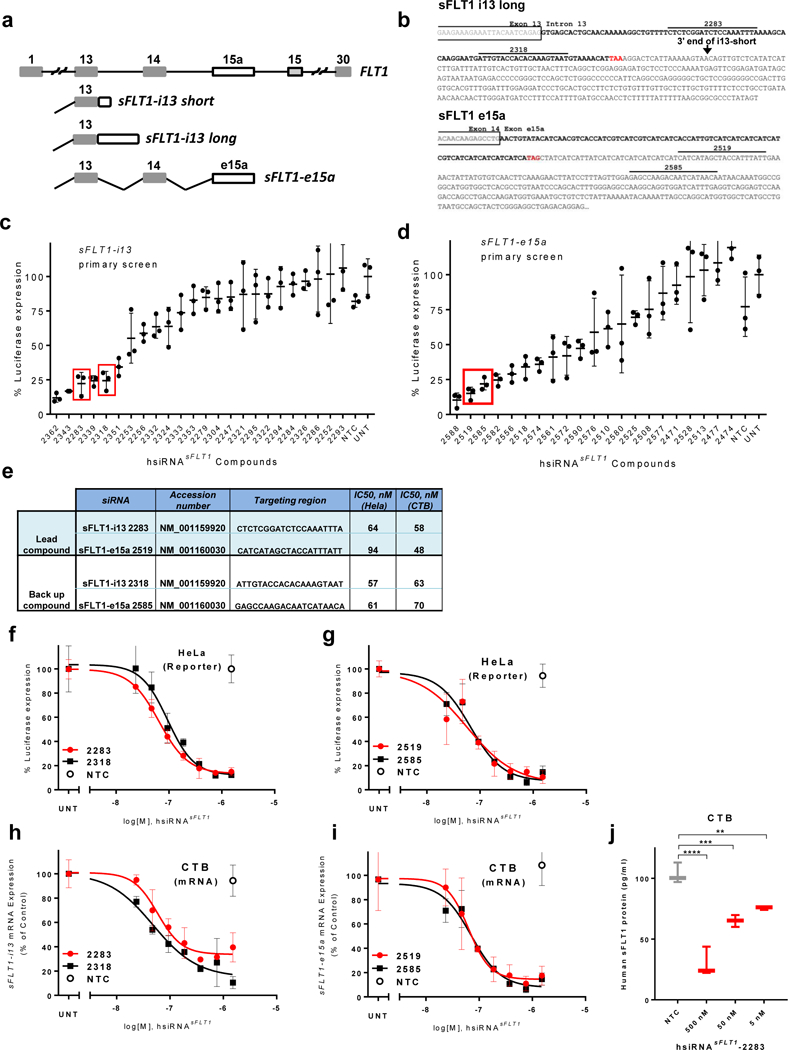
Figure 1.
Figure 1.. Development of hydrophobically modified, chemically stabilized hsiRNA compounds against sFLT1.
a. Schematic representation of exon-intron structure of sFLT1-i13 and sFLT1-e15a mRNAs. b. sFLT1-i13 and sFLT1-e15a unique sequence regions. Locations of lead siRNA target sites are indicated. Stop codons are shown in red. c-d. Results of screen for hsiRNAs (1.5 μM) that silence sFLT1-i13 and sFLT1-e15a using luciferase-based reporters in HeLa cells. siRNA numbers correspond to the 5’ position of the siRNA target site in the mRNA. UNT, untreated control, NTC, non-targeting control. (n=3, mean ± SD). Solid bars indicate lead compounds selected for further evaluation. e. siRNAs targeting sFLT1-i13 and sFLT1-e15a. f-g. Dose-response curves of lead hsiRNAsFLT1 silencing of sFLT1-i13 and sFLT1-e15a luciferase reporters in HeLa cells. h-i. Dose-response curves of lead hsiRNAsFLT1 silencing of sFLT1-i13 and sFLT1-e15a mRNAs in cytotrophoblast (CTB) cells. (n=3, mean ± SD). j. sFlt1 protein levels produced by CTB cells treated with hsiRNAsFLT1-2283 or hsiRNANTC. Level of sFlt1 protein was measured by ELISA (n=2, mean ± SD) (**P<0.01, *P,<0.05, ns - not significant, one-way ANOVA).
Figure 2.
Figure 2.. Efficient silencing of sFLT1 by hsiRNAsFLT1-2283/2519 mixture in vitro.
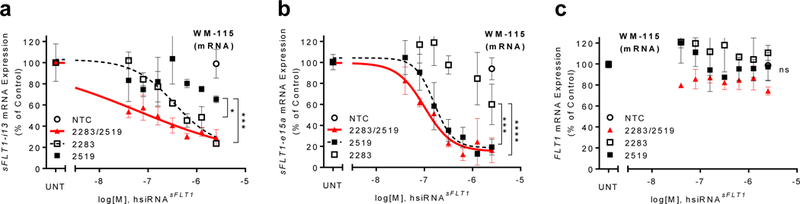
a-c.Dose-response silencing of sFLT1-i13, sFLT1-e15a, or Flt1 mRNAs respectively, by individual hsiRNAs or the equimolar hsiRNAsFLT1-2283/2519 mixture in WM-115 cells. mRNA levels were measured using QuantiGene® 2 (Affymetrix) and normalized to the housekeeping gene FLT1 (n=3, mean ± SD). NTC - non-targeting control (****P<0.0001, ***P<0.001, *P<0.05, ns - not significant; two-way ANOVA).
Figure 3.
Figure 3.. Full chemical stabilization of cholesterol-conjugated hsiRNAs enables systemic delivery to placental labyrinth.
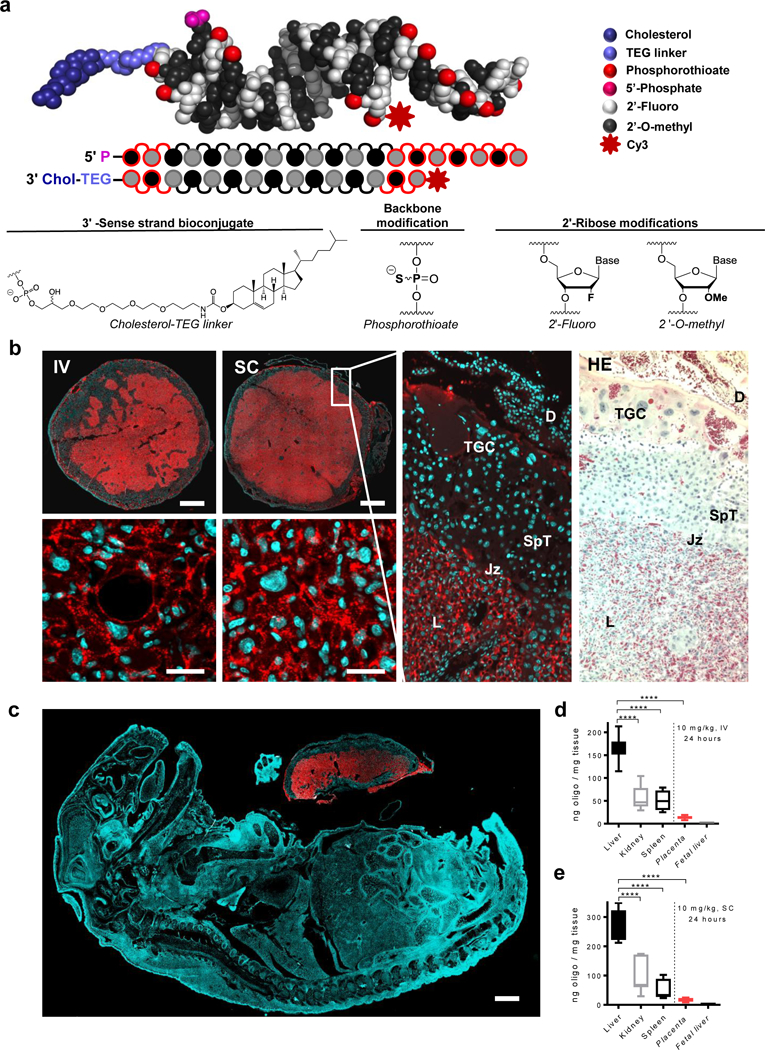
a. Structure and chemical composition of fully chemically-stabilized cholesterol-conjugated siRNAs (hsiRNA). b. Distribution of Cy3-hsiRNAsFLT1-2283 (red) in placentas of mice following intravenous (IV) or subcutaneous (SC) injection. Nuclei were stained with DAPI (blue). Matched slides were stained with hematoxylin and eosin (HE). Scale bars, 1 mm (upper panels), 25 μm (lower panels). c. Distribution of Cy3-labeled hsiRNAsFLT1-2283 (red) in mouse fetus. Nuclei were stained with DAPI (blue). Representative image of two experiments in which the dam received an IV injection of Cy3-labeled hsiRNAsFLT1-2283. d-e. Bar graphs of hsiRNAsFLT1-2283 levels in indicated tissues of mice from b. Guide strand levels were measure using the PNA hybridization assay. (n=3, mean ± SD). TGC, Trophoblast Giant Cells; SpT, Spongio Trophoblast; L, Labyrinth; Jz, Junctional zone; D, Decidua. (****P<0.0001; one-way ANOVA).
Figure 4.
Figure 4.. Efficient silencing of sFLT1 mRNA and protein by hsiRNAsFLT1 in pregnant mice.
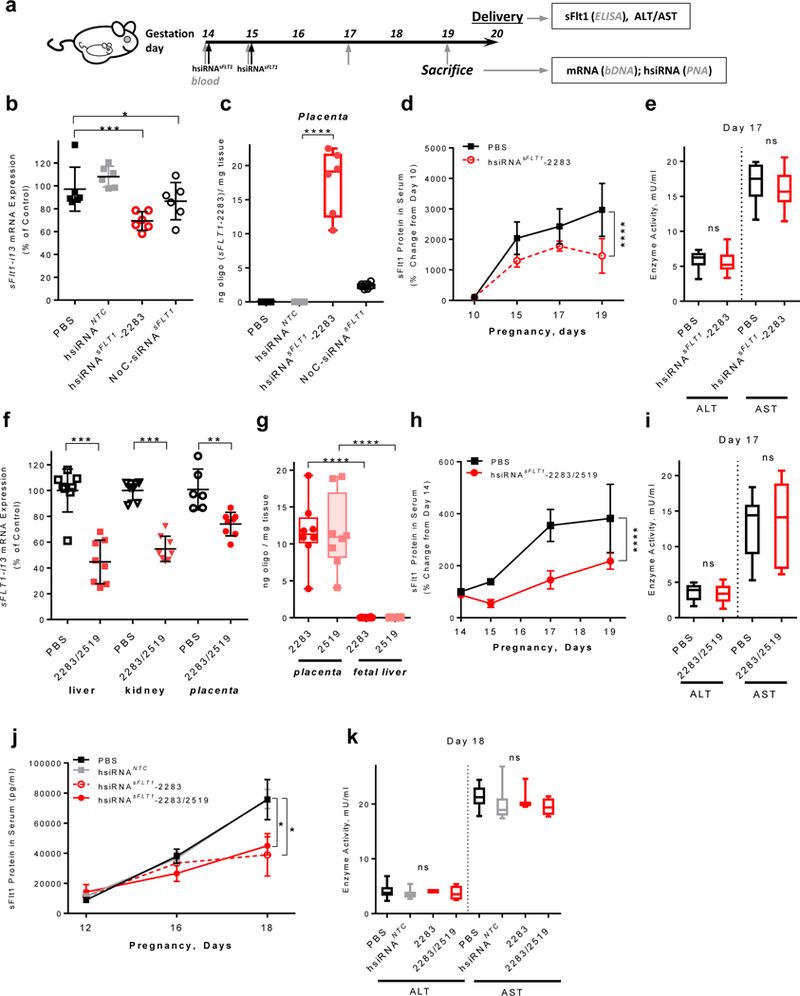
a.Experimental design for in vivo testing of siRNA. Pregnant CD1 mice were injected with 20 mg/kg of hsiRNAsFLT1 (IV, tail vein) on days E14 and E15, and sacrificed on day E19 or allowed to deliver pups on day E20. Blood was collected on the indicated days (gray vertical arrows). Samples were prepared at the end points for the indicated assays. b. sFLT1-i13 mRNA levels in placentas of mice treated with PBS, hsiRNANTC, hsiRNAsFLT1, or NoC-siRNAsFLT1. mRNAs were measured QuantiGene® 2 (Affymetrix) and levels were normalized to housekeeping gene (mFlt1), and presented as percent of PBS control (n=6, mean ± SD). c. Amount of hsiRNA accumulated in indicated tissues five days after first injection of mice from b. Measured by PNA hybridization assay. d. sFlt1 protein levels measured by ELISA (n=9, mean ± SD). e. ALT/AST enzymes activities at day E17 in mice injected with PBS or hsiRNAsFLT1 from d. f. sFLT1-i13 mRNA levels in liver, kidney, or placenta of CD1 mice injected (IV, tail vein) on day E14 and E15 with equimolar hsiRNAsFLT1-2283/2519 mixture and sacrificed at E19. mRNA levels were measured QuantiGene® 2 (Affymetrix), normalized to Flt1, and presented as percent of PBS control (n=8, mean ± SD). g. Amount of hsiRNA accumulated in fetal tissues (placenta and liver) from mice from f, five days after injection. Measured by PNA hybridization assay. h. sFlt1 protein levels from mice injected with hsiRNAsFLT1-2283/2519 measured by ELISA (n=8, mean ± SD). i. ALT/AST enzyme activities on day E17 in mice injected with equimolar hsiRNAsFLT1-2283/2519 mixture from h. j. sFlt1 protein levels from mice injected with PBS, hsiRNANTC, hsiRNAsFLT1-2283 and hsiRNAsFLT1-2283/2519 (2× 20 mg/kg) measured by ELISA (n=10 for PBS and NTC, n=4 for hsiRNAsFLT1; mean ± SEM). k. ALT/AST enzyme activities on day E18 in mice injected in j. (****P<0.0001, ***P<0.001, **P<0.01, *P<0.05, ns - not significant; one-way ANOVA for b, c, e, f, g, i and k; two-way ANOVA for d, h and j).
Figure 5.
Figure 5.. hsiRNAsFLT1-2283/2519 treatment lowers sFLT1 serum levels and normalize blood pressure and proteinuria in NHP model of PE.
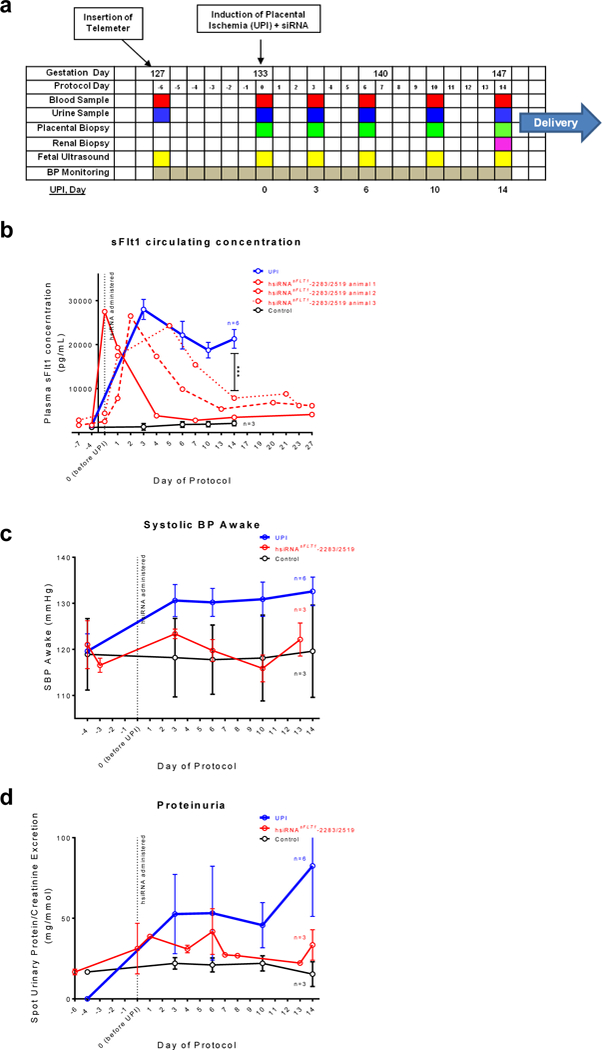
a. The timeline for uteroplacental ischemia induction (UPI) model of PE in pregnant baboon. Data collected for hsiRNAsFLT1-2283/2519-treated UPI animals (n=3, mean ±SEM), PBS treated UPI animals (n=6, mean ±SEM), and controls (sham surgery, no UPI) (n=3, mean ±SEM) (***P<0.001, two-way ANOVA; UPI vs hsiRNAsFLT1). b. sFLT1 serum concentration measured by ELISA c. Systolic blood pressure (BP, awake) plotted from telemetry recordings. d. Proteinuria presented as spot protein/creatinine ratio.

Comment in

References

    1. Stevens W et al. Short-term costs of preeclampsia to the United States health care system. American journal of obstetrics and gynecology 217, 237–248 e216 (2017). - PubMed
    1. Maynard SE et al. Excess placental soluble fms-like tyrosine kinase 1 (sFlt1) may contribute to endothelial dysfunction, hypertension, and proteinuria in preeclampsia. The Journal of clinical investigation 111, 649–658 (2003). - PMC - PubMed
    1. Levine RJ et al. Circulating angiogenic factors and the risk of preeclampsia. The New England journal of medicine 350, 672–683 (2004). - PubMed
    1. Heydarian M et al. Novel splice variants of sFlt1 are upregulated in preeclampsia. Placenta 30, 250–255 (2009). - PubMed
    1. Young BC, Levine RJ & Karumanchi SA Pathogenesis of preeclampsia. Annual review of pathology 5, 173–192 (2010). - PubMed