


Recruitment of the motor system during music listening: An ALE meta-analysis of fMRI data
- PMID: 30452442
- PMCID: PMC6242316
- DOI: 10.1371/journal.pone.0207213
Recruitment of the motor system during music listening: An ALE meta-analysis of fMRI data
Abstract
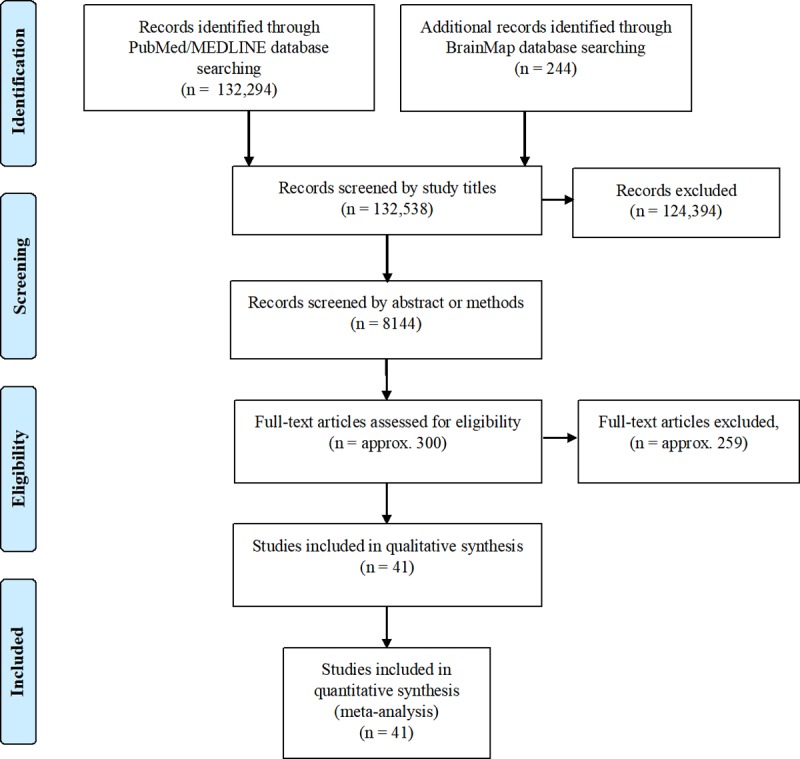
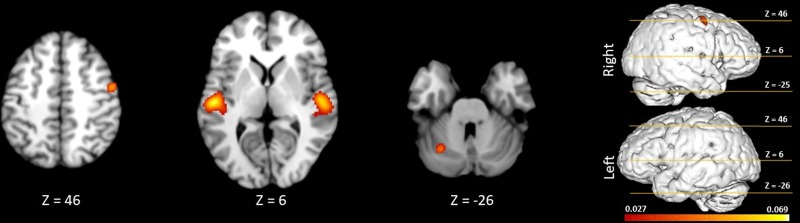
Several neuroimaging studies have shown that listening to music activates brain regions that reside in the motor system, even when there is no overt movement. However, many of these studies report the activation of varying motor system areas that include the primary motor cortex, supplementary motor area, dorsal and ventral pre-motor areas and parietal regions. In order to examine what specific roles are played by various motor regions during music perception, we used activation likelihood estimation (ALE) to conduct a meta-analysis of neuroimaging literature on passive music listening. After extensive search of the literature, 42 studies were analyzed resulting in a total of 386 unique subjects contributing 694 activation foci in total. As suspected, auditory activations were found in the bilateral superior temporal gyrus, transverse temporal gyrus, insula, pyramis, bilateral precentral gyrus, and bilateral medial frontal gyrus. We also saw the widespread activation of motor networks including left and right lateral premotor cortex, right primary motor cortex, and the left cerebellum. These results suggest a central role of the motor system in music and rhythm perception. We discuss these findings in the context of the Action Simulation for Auditory Prediction (ASAP) model and other predictive coding accounts of brain function.
Conflict of interest statement
The authors have declared that no competing interests exist.
Figures
References
-
- Baumann S, Koeneke S, Schmidt CF, Meyer M, Lutz K, Jancke L. A network for audio-motor coordination in skilled pianists and non-musicians. Brain Res. 2007;1161: 65–78. 10.1016/j.brainres.2007.05.045 - DOI - PubMed
-
- Meister IG, Krings T, Foltys H, Boroojerdi B, Müller M, Töpper R, et al. Playing piano in the mind—An fMRI study on music imagery and performance in pianists. Cogn Brain Res. 2004;19: 219–228. 10.1016/j.cogbrainres.2003.12.005 - DOI - PubMed
-
- Bangert M, Peschel T, Schlaug G, Rotte M, Drescher D, Hinrichs H, et al. Shared networks for auditory and motor processing in professional pianists: Evidence from fMRI conjunction. Neuroimage. 2006;30: 917–926. 10.1016/j.neuroimage.2005.10.044 - DOI - PubMed
-
- Bengtsson SL, Ullén F, Henrik Ehrsson H, Hashimoto T, Kito T, Naito E, et al. Listening to rhythms activates motor and premotor cortices. Cortex. 2009;45: 62–71. 10.1016/j.cortex.2008.07.002 - DOI - PubMed
-
- Chen JL, Penhune VB, Zatorre RJ. Listening to musical rhythms recruits motor regions of the brain. Cereb Cortex. 2008;18: 2844–2854. 10.1093/cercor/bhn042 - DOI - PubMed
