


Links Between Behavior Change Techniques and Mechanisms of Action: An Expert Consensus Study
- PMID: 30452535
- PMCID: PMC6636885
- DOI: 10.1093/abm/kay082
Links Between Behavior Change Techniques and Mechanisms of Action: An Expert Consensus Study
Abstract
Background: Understanding the mechanisms through which behavior change techniques (BCTs) can modify behavior is important for the development and evaluation of effective behavioral interventions. To advance the field, we require a shared knowledge of the mechanisms of action (MoAs) through which BCTs may operate when influencing behavior.
Purpose: To elicit expert consensus on links between BCTs and MoAs.
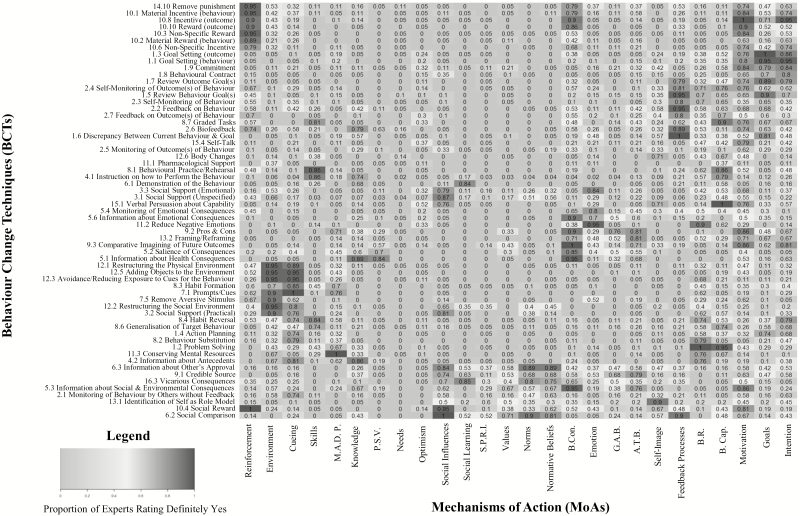
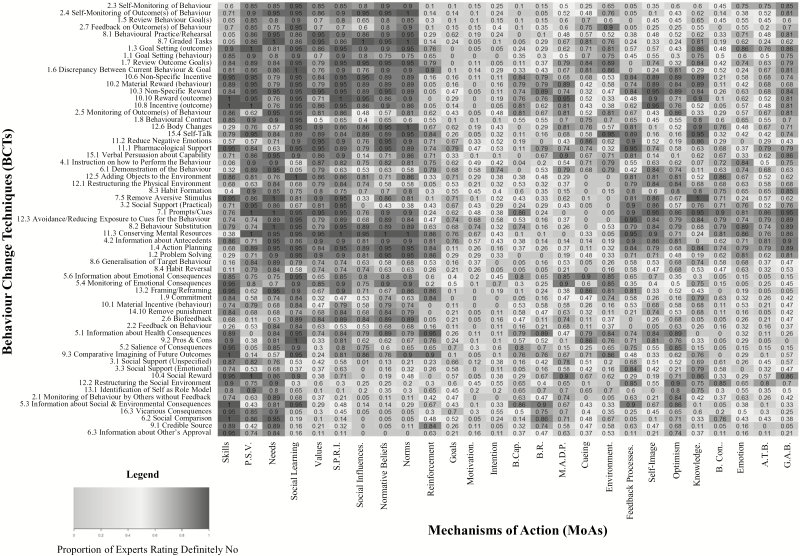
Methods: In a modified Nominal Group Technique study, 105 international behavior change experts rated, discussed, and rerated links between 61 frequently used BCTs and 26 MoAs. The criterion for consensus was that at least 80 per cent of experts reached agreement about a link. Heat maps were used to present the data relating to all possible links.
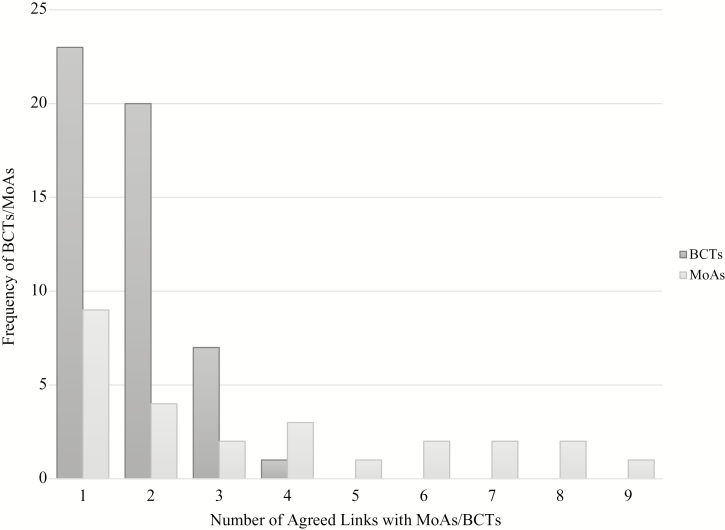
Results: Of 1,586 possible links (61 BCTs × 26 MoAs), 51 of 61 (83.6 per cent) BCTs had a definite link to one or more MoAs (mean [SD] = 1.44 [0.96], range = 1-4), and 20 of 26 (76.9 per cent) MoAs had a definite link to one or more BCTs (mean [SD] = 3.27 [2.91], range = 9). Ninety (5.7 per cent) were identified as "definite" links, 464 (29.2 per cent) as "definitely not" links, and 1,032 (65.1 per cent) as "possible" or "unsure" links. No "definite" links were identified for 10 BCTs (e.g., "Action Planning" and "Behavioural Substitution") and for six MoAs (e.g., "Needs" and "Optimism").
Conclusions: The matrix of links between BCTs and MoAs provides a basis for those developing and synthesizing behavioral interventions. These links also provide a framework for specifying empirical tests in future studies.
Keywords: Behavior change; Behavior change technique; Expert consensus; Mechanism of action; Methodology; Theory.
© The Author(s) 2018. Published by Oxford University Press on behalf of the Society of Behavioral Medicine.
Figures
References
-
- Kontis V, Mathers CD, Rehm J, et al. Contribution of six risk factors to achieving the 25 × 25 non-communicable disease mortality reduction target: a modelling study. Lancet. 2014;384:427–437. - PubMed
-
- de Bruin M, Oberjé EJM, Viechtbauer W, et al. Effectiveness and cost-effectiveness of a nurse-delivered intervention to improve adherence to treatment for HIV: a pragmatic, multicentre, open-label, randomised clinical trial. Lancet Infect Dis. 2017;17:595–604. - PubMed
-
- Marteau T, Hollands G, Kelly M, et al. Changing Population Behavior and Reducing Health Disparities: Exploring the POTENTIAl of “choice architecture” Interventions. Emerging Behavioral and Social Science Perspectives on Population Health. Agency for Healthcare Research and Quality and Office of Behavioral and Social Sciences Research: AHRQ Publication: Rockville; 2015.
-
- National Institute for Health and Care Excellence (NICE). Behaviour Change: Individual Approaches.2014; 49. Available at http://guidance.nice.org.uk/ph49
