Clinical Trial
. 2019 Jan 29;219(4):556-561.
doi: 10.1093/infdis/jiy565.

Detectable Vesicular Stomatitis Virus (VSV)-Specific Humoral and Cellular Immune Responses Following VSV-Ebola Virus Vaccination in Humans

Collaborators, Affiliations
Clinical Trial

Detectable Vesicular Stomatitis Virus (VSV)-Specific Humoral and Cellular Immune Responses Following VSV-Ebola Virus Vaccination in Humans

Joseph H Poetsch et al. J Infect Dis. .

Abstract

In response to the Ebola virus (EBOV) crisis of 2013-2016, a recombinant vesicular stomatitis virus (VSV)-based EBOV vaccine was clinically tested (NCT02283099). A single-dose regimen of VSV-EBOV revealed a safe and immunogenic profile and demonstrated clinical efficacy. While EBOV-specific immune responses to this candidate vaccine have previously been investigated, limited human data on immunity to the VSV vector are available. Within the scope of a phase 1 study, we performed a comprehensive longitudinal analysis of adaptive immune responses to internal VSV proteins following VSV-EBOV immunization. While no preexisting immunity to the vector was observed, more than one-third of subjects developed VSV-specific cytotoxic T-lymphocyte responses and antibodies.


Figures
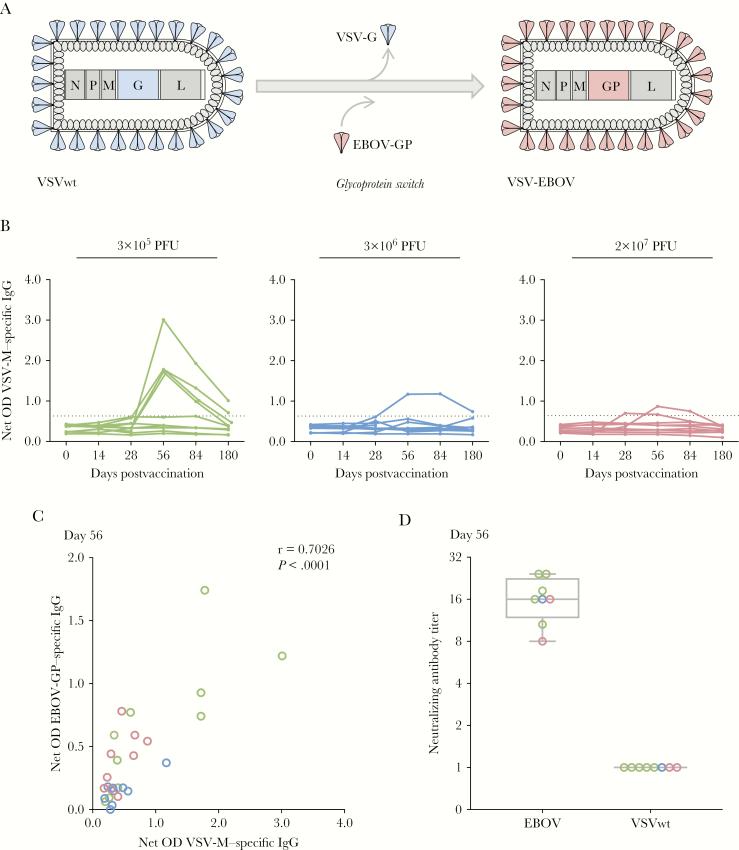
Figure 1.
Figure 1.
Humoral responses against vesicular stomatitis virus (VSV). A, Structure and design of VSV–Ebola virus (EBOV) vaccine. VSV glycoprotein G (G) is replaced by EBOV glycoprotein (GP), while nucleoprotein (N), phosphoprotein (P), matrix protein (M), and RNA-dependent RNA polymerase (L) correspond to the VSV backbone vector. B, VSV-M–specific antibodies were generated following VSV-EBOV immunization in humans. VSV-M antibody titers were assessed by enzyme-linked immunosorbent assay at baseline and days 14, 28, 56, 84, and 180 postvaccination. Results are expressed as corrected optical density (OD) values. The dashed line depicts the threshold for a positive antibody response, calculated as the median on day 0 of all subjects ± 3 standard deviations. VSV-M–specific antibodies are detectable in 8 subjects (3 × 10⁵ plaque-forming units [PFU], 5 of 10 subjects; 3 × 10⁶ PFU, 1 of 10 subjects; 2 × 10⁷ PFU, 2 of 9 subjects). C, Positive correlation between OD values of VSV-M and EBOV-GP–specific immunoglobulin G (IgG) at day 56 postvaccination. D, VSV-M–positive subjects were analyzed for generation of neutralizing antibodies against VSV wild-type (VSVwt; (n = 8). Neutralizing antibodies against infectious EBOV isolate Mayinga but not against VSV-M were detected. Statistical analysis was performed with Mann–Whitney–Wilcoxon test.
Figure 2.
Figure 2.
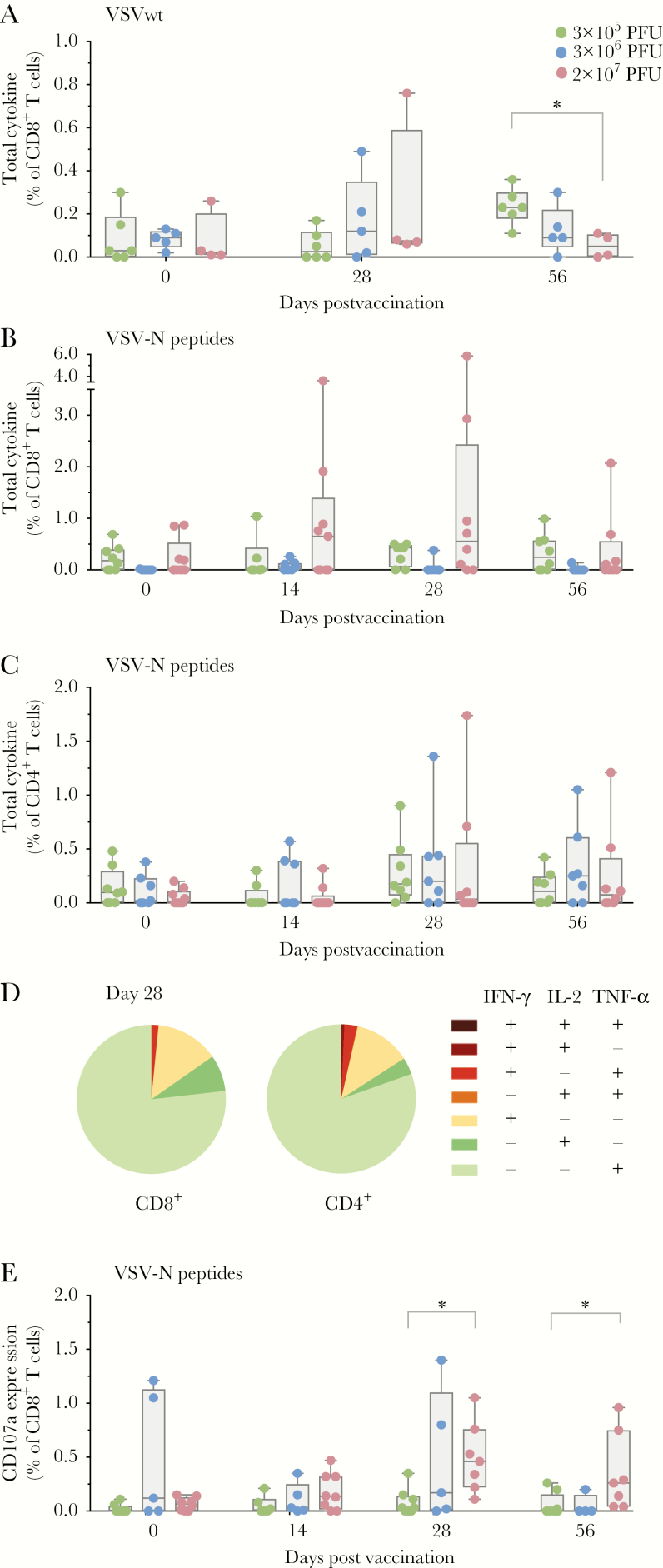
Antigen-specific T cells against vesicular stomatitis virus (VSV). A, VSV wild-type (VSVwt)–specific T-cell responses. Peripheral blood mononuclear cells were stimulated with ultraviolet-inactivated VSVwt. Graph depicts the observed interferon gamma (IFN-γ)/interleukin 2 (IL-2)/tumor necrosis factor alpha (TNF-α) secretion of CD8+ T cells measured by flow cytometry. Each dot represents summarized cytokine responses of CD8+ T cells for 1 subject (3 × 10⁵ plaque-forming units [PFU]: n = 6; 3 × 10⁶ PFU: n = 5; 2 × 10⁷ PFU: n = 4). A significant intergroup difference between the low- and high-dose group was observed on day 56 (Mann–Whitney test, P = .01). B and C, Cytokine responses of CD8+ and CD4+ T cells (IFN-γ/IL-2/TNF-α) following stimulation with VSV nucleoprotein (VSV-N) overlapping peptide pools, respectively. Cytokine secretion was measured by flow cytometry (3 × 10⁵ PFU: n = 8; 3 × 10⁶ PFU: n = 7; 2 × 10⁷ PFU: n = 9). D, Pie charts represent the functionality of specific T cells to VSV-N peptide pools at day 28 following immunization. Shown are the proportions of VSV-N–specific memory CD8+ (left) and CD4+ (right) cells that produce any combinations of the 3 measured cytokines. Pie charts represent the mean value of 9 subjects from the high-dose cohort. E, Cytotoxic T-lymphocyte (CTL) response following stimulation with VSV-N peptides. Flow cytometry analysis of the degranulation marker CD107a in the CD8+ T-cell subset (3 × 10⁵ PFU: n = 10; 3 × 10⁶ PFU: n = 5; 2 × 10⁷ PFU: n = 8). The magnitude of CTL responses revealed significant intergroup differences on days 28 and 56 (Mann–Whitney–Wilcoxon test, P = .0045 and P = .0095, respectively). Comparing T-cell responses following VSV-N peptide stimulation revealed an increased response to VSV-N peptides in 3 vaccinees, showing induced cytokine or CD107a expression in CD8+ or CD4+ T cells. Box and whiskers show minimum to maximum; line shows the median. Statistical analysis was performed with Mann–Whitney–Wilcoxon test (*P < .05). Green: 3 × 10⁵ PFU; blue: 3 × 10⁶ PFU; red: 2 × 10⁷ PFU.

References

    1. Agnandji ST, Huttner A, Zinser ME, et al. Phase 1 trials of rVSV Ebola vaccine in Africa and Europe. N Engl J Med 2016; 374:1647–60. - PMC - PubMed
    1. Coller BG, Blue J, Das R, et al. Clinical development of a recombinant Ebola vaccine in the midst of an unprecedented epidemic. Vaccine 2017; 35:4465–9. - PubMed
    1. Geisbert TW, Feldmann H. Recombinant vesicular stomatitis virus-based vaccines against Ebola and Marburg virus infections. J Infect Dis 2011; 204(Suppl 3):S1075–81. - PMC - PubMed
    1. Marzi A, Robertson SJ, Haddock E, et al. Ebola vaccine. VSV-EBOV rapidly protects macaques against infection with the 2014/15 Ebola virus outbreak strain. Science 2015; 349:739–42. - PMC - PubMed
    1. Henao-Restrepo AM, Longini IM, Egger M, et al. Efficacy and effectiveness of an rVSV-vectored vaccine expressing Ebola surface glycoprotein: interim results from the Guinea ring vaccination cluster-randomised trial. Lancet 2015; 386:857–66. - PubMed

Publication types

Associated data