An Application of the Medical Research Council's Guidelines for Evaluating Complex Interventions: A Usability Study Assessing Smartphone-Connected Listening Devices in Adults With Hearing Loss
- PMID: 30452751
- PMCID: PMC6437711
- DOI: 10.1044/2018_AJA-IMIA3-18-0019
An Application of the Medical Research Council's Guidelines for Evaluating Complex Interventions: A Usability Study Assessing Smartphone-Connected Listening Devices in Adults With Hearing Loss
Abstract
Purpose: The purpose of this study is to provide an example of the Medical Research Council's guidelines for evaluating complex health care interventions in the context of smartphone-connected listening devices in adults with hearing loss.
Method: Twenty existing hearing aid users trialed 1 of the following smartphone-connected listening devices: made-for-smartphone hearing aids, a personal sound amplification product, and a smartphone "hearing aid" application used with either wireless or wired earphones. Following 2 weeks of use in their everyday lives, participants completed self-report outcome measures.
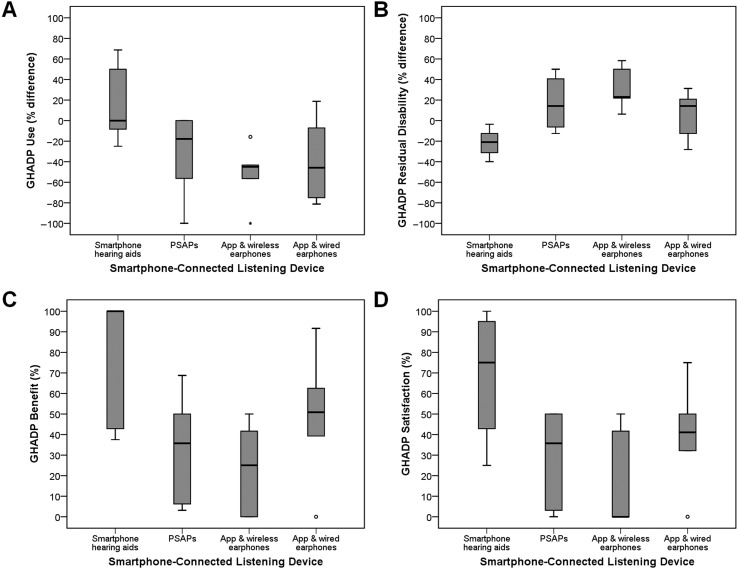
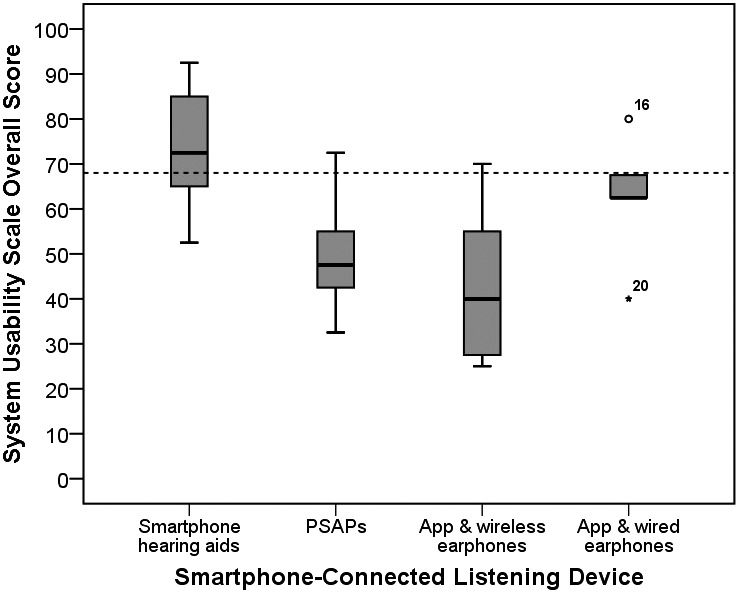
Results: Relative to conventional hearing aids, self-reported use, benefit, and satisfaction were higher, and residual disability was lower for made-for-smartphone hearing aids. The converse was found for the other smartphone-connected listening devices trialed. Similarly, overall usability was judged to be "above average" for the made-for-smartphone hearing aids, but "below average" for the remaining devices.
Conclusions: This developmental work, guided by the Medical Research Council's framework, lays the foundation for feasibility and pilot studies, leading to high-quality research assessing the effectiveness of smartphone-connected listening devices. This future evidence is necessary to guide health care commissioners and policymakers when considering new service delivery models for adults living with hearing loss.
Figures
References
-
- Amlani A. M., Taylor B., Levy C., & Robbins R. (2013). Utility of smartphone-based hearing aid applications as a substitute to traditional hearing aids. The Hearing Review, 20(13), 16–18.
-
- Barker A. B., Leighton P., & Ferguson M. A. (2017). Coping together with hearing loss: A qualitative meta-synthesis of the psychosocial experiences of people with hearing loss and their communication partners. International Journal of Audiology, 56(5), 297–305. - PubMed
-
- Bragi. (2015). The Dash. Retrieved from https://support.bragi.com/hc/en-us/categories/200470531-The-Dash
-
- Brooke J. (1996). SUS: A “quick and dirty” usability scale. In Jordan P. W., Thomas B., Weerdmeester B. A., & McClelland I. L. (Eds.), Usability evaluation in industry (pp. 189–194). London, United Kingdom: Taylor & Francis.
MeSH terms
Grants and funding
LinkOut - more resources
Full Text Sources
Medical