


Mitochondrial dysfunction induces muscle atrophy during prolonged inactivity: A review of the causes and effects
- PMID: 30452895
- PMCID: PMC6783132
- DOI: 10.1016/j.abb.2018.11.005
Mitochondrial dysfunction induces muscle atrophy during prolonged inactivity: A review of the causes and effects
Abstract
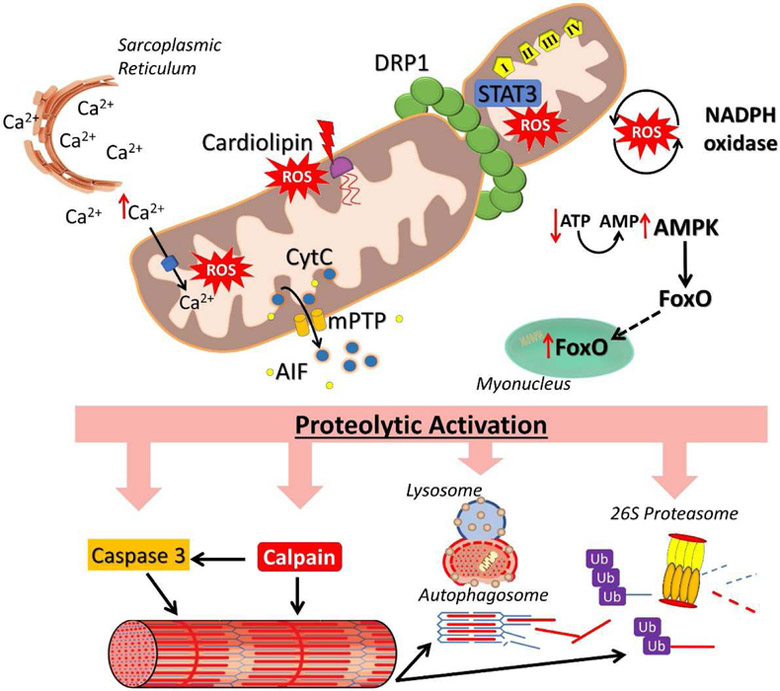
Prolonged skeletal muscle inactivity (e.g. limb immobilization, bed rest, mechanical ventilation, spinal cord injury, etc.) results in muscle atrophy that manifests into a decreased quality of life and in select patient populations, a higher risk of morbidity and mortality. Thus, understanding the processes that contribute to muscle atrophy during prolonged periods of muscle disuse is an important area of research. In this regard, mitochondrial dysfunction has been directly linked to the muscle wasting that occurs during extended periods of skeletal muscle inactivity. While the concept that mitochondrial dysfunction contributes to disuse muscle atrophy has been contemplated for nearly 50 years, the mechanisms connecting mitochondrial signaling events to skeletal muscle atrophy remained largely unexplained until recently. Indeed, emerging evidence reveals that mitochondrial dysfunction and the associated mitochondrial signaling events are a requirement for several forms of inactivity-induced skeletal muscle atrophy. Specifically, inactivity-induced alterations in skeletal muscle mitochondria phenotype and increased ROS emission, impaired Ca2+ handling, and release of mitochondria-specific proteolytic activators are established occurrences that promote fiber atrophy during prolonged periods of muscle inactivity. This review highlights the evidence that directly connects mitochondrial dysfunction and aberrant mitochondrial signaling with skeletal muscle atrophy and discusses the mechanisms linking these interconnected phenomena.
Keywords: Cell signaling; Disuse muscle atrophy; Mitochondrial dysfunction; Muscle wasting; Proteolysis; Reactive oxygen species.
Published by Elsevier Inc.
Figures
References
-
- Newman AB, Kupelian V, Visser M, Simonsick EM, Goodpaster BH, Kritchevsky SB, et al. Strength, but not muscle mass, is associated with mortality in the health, aging and body composition study cohort. J Gerontol A Biol Sci Med Sci 2006;61(1):72–7. Epub 2006/02/04. PubMed PMID: 16456196. - PubMed
-
- Powers SK, Hudson MB, Nelson WB, Talbert EE, Min K, Szeto HH, et al. Mitochondria-targeted antioxidants protect against mechanical ventilation-induced diaphragm weakness. Crit Care Med 2011;39(7):1749–59. Epub 2011/04/05. doi: 10.1097/CCM.0b013e3182190b62. PubMed PMID: 21460706; PubMed Central PMCID: PMCPMC4995067. - DOI - PMC - PubMed
-
- Min K, Smuder AJ, Kwon OS, Kavazis AN, Szeto HH, Powers SK. Mitochondrial-targeted antioxidants protect skeletal muscle against immobilization-induced muscle atrophy. J Appl Physiol (1985). 2011;111(5):1459–66. Epub 2011/08/06. doi: 10.1152/japplphysiol.00591.2011. PubMed PMID: 21817113; PubMed Central PMCID: PMCPMC3220313. - DOI - PMC - PubMed
-
- Chacon-Cabrera A, Lund-Palau H, Gea J, Barreiro E. Time-Course of Muscle Mass Loss, Damage, and Proteolysis in Gastrocnemius following Unloading and Reloading: Implications in Chronic Diseases. PLoS One. 2016;11(10):e0164951. Epub 2016/10/30. doi: 10.1371/journal.pone.0164951. PubMed PMID: 27792730; PubMed Central PMCID: PMCPMC5085049. - DOI - PMC - PubMed
Publication types
MeSH terms
Substances
Grants and funding
LinkOut - more resources
Full Text Sources
Medical
Miscellaneous
