


Does coffee drinking have beneficial effects on bone health of Taiwanese adults? A longitudinal study
- PMID: 30453911
- PMCID: PMC6245613
- DOI: 10.1186/s12889-018-6168-0
Does coffee drinking have beneficial effects on bone health of Taiwanese adults? A longitudinal study
Abstract
Background: Results from studies investigating the association between coffee consumption and osteoporosis or bone mineral density (BMD) have been inconsistent. This longitudinal study was performed to assess the effect of coffee drinking on bone health of Taiwanese adults.
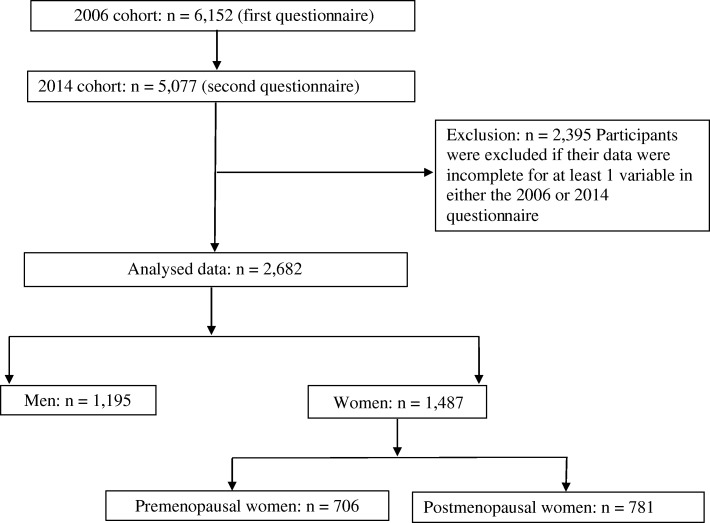
Methods: Data were retrieved from the Li-Shin (Landseed) Hospital in Taoyuan City. In 2006, 6152 participants completed a questionnaire on coffee drinking and other lifestyle factors. In 2014, 5077 of them were followed up. Nonetheless, a total of 2395 participants with incomplete data were excluded. The final analyses included 2682 participants comprising 1195 men and 1487 women (706 premenopausal and 781 postmenopausal). T-scores were derived from the osteo-sono assessment index (OSI) which is a surrogate of BMD. Coffee drinking was categorized as "no, medium, and high" based on the number of cups that were consumed per week in both 2006 and 2014.
Results: In general, medium and high coffee drinking were associated with higher T-scores. However, significant results were observed only among high drinkers (β = 0.158; P = 0.0038). Nonetheless, the test for linear trend was significant (P = 0.0046). After stratification by sex, medium and high coffee drinking were associated with higher T-scores. However, significant results were prominent only among high male drinkers (β = 0.237; P = 0.0067) and the test for trend was significant (P = 0.0161). Based on menopausal status, coffee drinking was associated with higher T-scores. Nevertheless, significant results were found only among premenopausal women (β = 0.233; P = 0.0355 and β = 0.234; P = 0.0152 for medium and high coffee drinking, respectively. The test for linear trend was significant (P = 0.0108).
Conclusion: Coffee drinking was significantly associated with higher T-scores hence, a lower risk of osteoporosis in men and premenopausal women.
Keywords: Coffee; Menopausal status; Osteoporosis risk; Sex; Taiwan.
Conflict of interest statement
Ethics approval and consent to participate
Participants signed informed consents prior to data collection. The study was approved by the institutional review board of Li-Shin (Landseed) Hospital (LSHIRB No./Protocol No.: 16–029-B1).
Consent for publication
Not applicable.
Competing interests
The authors declare that they have no competing interests.
Publisher’s Note
Springer Nature remains neutral with regard to jurisdictional claims in published maps and institutional affiliations.
Similar articles
-
Habitual tea drinking and bone mineral density in postmenopausal Turkish women: investigation of prevalence of postmenopausal osteoporosis in Turkey (IPPOT Study).Int J Vitam Nutr Res. 2007 Nov;77(6):389-97. doi: 10.1024/0300-9831.77.6.389. Int J Vitam Nutr Res. 2007. PMID: 18622949
-
Tea drinking and bone mineral density in older women.Am J Clin Nutr. 2000 Apr;71(4):1003-7. doi: 10.1093/ajcn/71.4.1003. Am J Clin Nutr. 2000. PMID: 10731510
-
Long-term coffee consumption in relation to fracture risk and bone mineral density in women.Am J Epidemiol. 2013 Sep 15;178(6):898-909. doi: 10.1093/aje/kwt062. Epub 2013 Jul 23. Am J Epidemiol. 2013. PMID: 23880351
-
Influence of Sex Differences on Serum Lipid Profiles among Habitual Coffee Drinkers: Evidence from 23,072 Taiwan Biobank Participants.Nutrients. 2023 May 31;15(11):2576. doi: 10.3390/nu15112576. Nutrients. 2023. PMID: 37299539 Free PMC article.
-
Osteoporotic fracture rate, bone mineral density, and bone metabolism in Taiwan.J Formos Med Assoc. 1997 Oct;96(10):802-5. J Formos Med Assoc. 1997. PMID: 9343979 Review.
Cited by
-
Association of caffeine intake and sleep duration with bone mineral density: a cross-sectional study from National Health and Nutrition Examination Survey between 2011 and 2018.BMC Musculoskelet Disord. 2025 Jan 13;26(1):43. doi: 10.1186/s12891-025-08300-z. BMC Musculoskelet Disord. 2025. PMID: 39806321 Free PMC article.
-
Coffee Brews: Are They a Source of Macroelements in Human Nutrition?Foods. 2021 Jun 9;10(6):1328. doi: 10.3390/foods10061328. Foods. 2021. PMID: 34207680 Free PMC article. Review.
-
Does Drinking Coffee and Tea Affect Bone Metabolism in Patients with Inflammatory Bowel Diseases?Nutrients. 2021 Jan 13;13(1):216. doi: 10.3390/nu13010216. Nutrients. 2021. PMID: 33451170 Free PMC article. Review.
-
Comparison between calcaneus quantitative ultrasound and the gold standard DXA in the ability to detect osteoporosis in chronic obstructive pulmonary disease patients.J Orthop Surg Res. 2023 Oct 16;18(1):778. doi: 10.1186/s13018-023-04211-8. J Orthop Surg Res. 2023. PMID: 37845656 Free PMC article.
-
Coffee Drinking and the Odds of Osteopenia and Osteoporosis in Middle-Aged and Older Americans: A Cross-Sectional Study in NHANES 2005-2014.Calcif Tissue Int. 2024 Apr;114(4):348-359. doi: 10.1007/s00223-024-01184-6. Epub 2024 Feb 17. Calcif Tissue Int. 2024. PMID: 38367050
References
MeSH terms
Substances
Grants and funding
LinkOut - more resources
Full Text Sources
Medical
