


Visualizing nationwide variation in medicare Part D prescribing patterns
- PMID: 30454029
- PMCID: PMC6245567
- DOI: 10.1186/s12911-018-0670-2
Visualizing nationwide variation in medicare Part D prescribing patterns
Abstract
Background: To characterize the regional and national variation in prescribing patterns in the Medicare Part D program using dimensional reduction visualization methods.
Methods: Using publicly available Medicare Part D claims data, we identified and visualized regional and national provider prescribing profile variation with unsupervised clustering and t-distributed stochastic neighbor embedding (t-SNE) dimensional reduction techniques. Additionally, we examined differences between regionally representative prescribing patterns for major metropolitan areas.
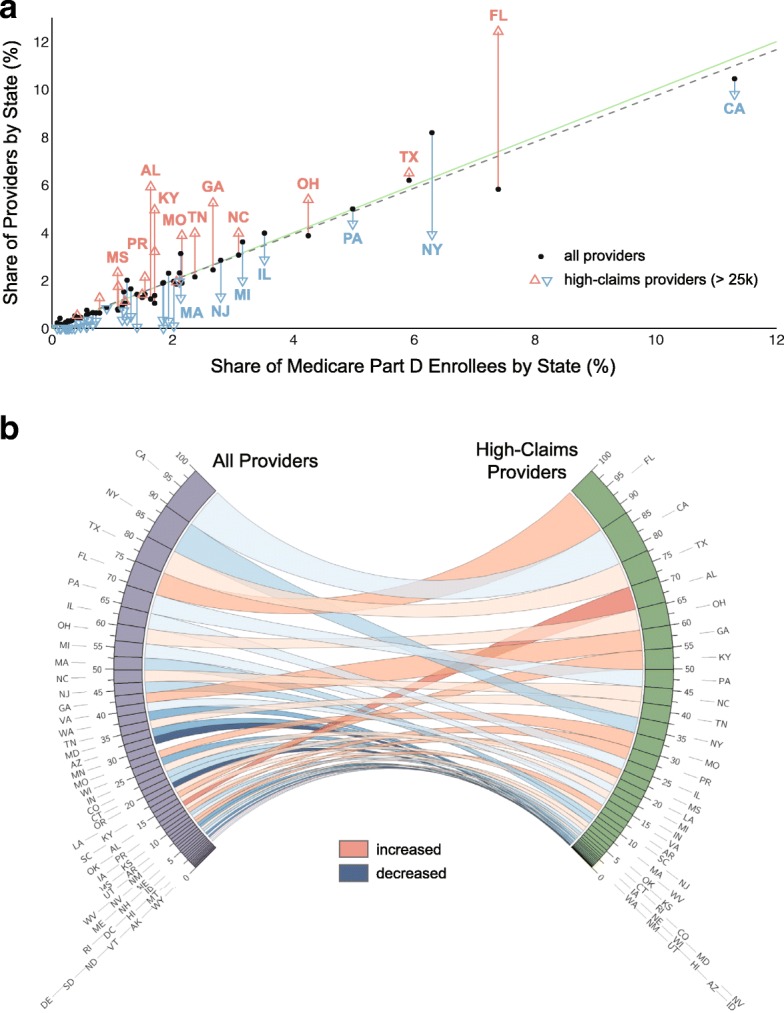
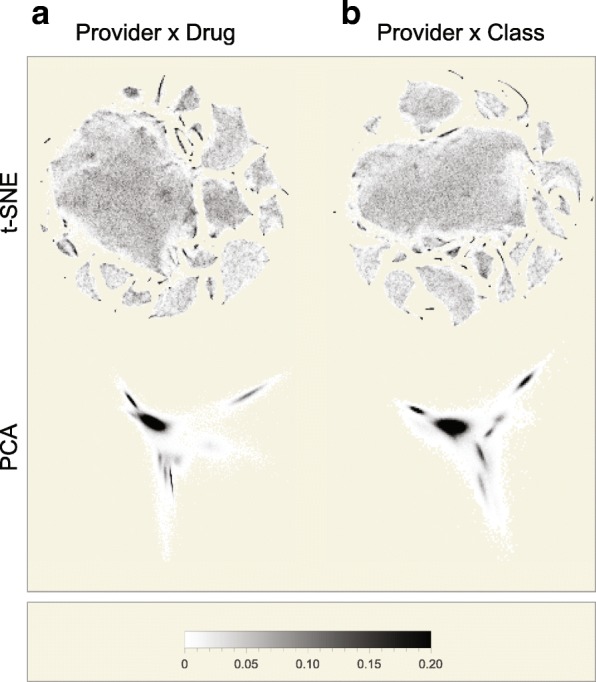
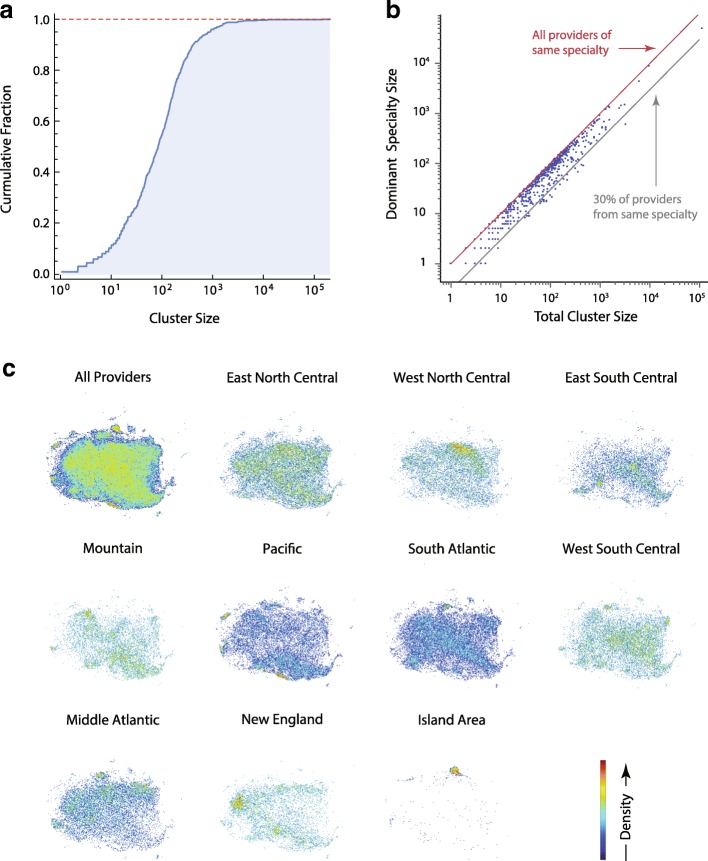
Results: Distributions of prescribing volume and medication diversity were highly skewed among over 800,000 Medicare Part D providers. Medical specialties had characteristic prescribing patterns. Although the number of Medicare providers in each state was highly correlated with the number of Medicare Part D enrollees, some states were enriched for providers with > 10,000 prescription claims annually. Dimension-reduction, hierarchical clustering and t-SNE visualization of drug- or drug-class prescribing patterns revealed that providers cluster strongly based on specialty and sub-specialty, with large regional variations in prescribing patterns. Major metropolitan areas had distinct prescribing patterns that tended to group by major geographical divisions.
Conclusions: This work demonstrates that unsupervised clustering, dimension-reduction and t-SNE visualization can be used to analyze and visualize variation in provider prescribing patterns on a national level across thousands of medications, revealing substantial prescribing variation both between and within specialties, regionally, and between major metropolitan areas. These methods offer an alternative system-wide and pattern-centric view of such data for hypothesis generation, visualization, and pattern identification.
Keywords: Healthcare variation; Machine learning; Medicare; Prescribing; t-SNE.
Conflict of interest statement
Ethics approval and consent to participate
Not applicable to this manuscript.
Consent for publication
Not applicable to this manuscript.
Competing interests
The authors declare that they have no competing interests.
Publisher’s Note
Springer Nature remains neutral with regard to jurisdictional claims in published maps and institutional affiliations.
Figures





References
Publication types
MeSH terms
Grants and funding
LinkOut - more resources
Full Text Sources
Medical
