


Patient reported barriers are associated with low physical and mental well-being in patients with co-morbid diabetes and chronic kidney disease
- PMID: 30454062
- PMCID: PMC6245917
- DOI: 10.1186/s12955-018-1044-2
Patient reported barriers are associated with low physical and mental well-being in patients with co-morbid diabetes and chronic kidney disease
Abstract
Background: Little is known about how patient reported barriers to health care impact the quality of life (HRQoL) of patients with comorbid disease. We investigated patient reported barriers to health care and low physical and mental well-being among people with diabetes and chronic kidney disease (CKD).
Methods: Adults with diabetes and CKD (estimated Glomerular Filtration Rate < 60 ml/min/1.73m2) were recruited and completed a questionnaire on barriers to health care, the 12-Item HRQoL Short Form Survey and clinical assessment. Low physical and mental health status were defined as mean scores < 50. Logistic regression models were used.
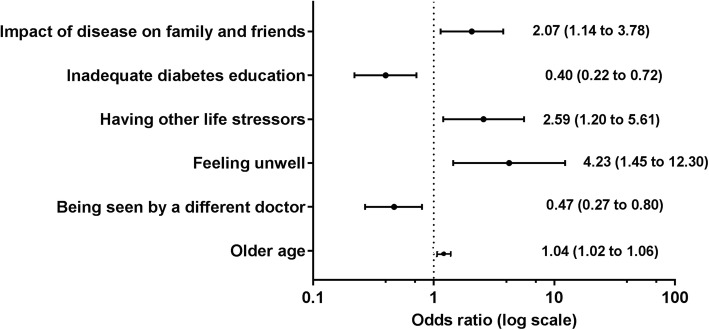
Results: Three hundred eight participants (mean age 66.9 ± 11 years) were studied. Patient reported 'impact of the disease on family and friends' (OR 2.07; 95% CI 1.14 to 3.78), 'feeling unwell' (OR 4.23; 95% CI 1.45 to 12.3) and 'having other life stressors that make self-care a low priority' (OR 2.59; 95% CI 1.20 to 5.61), were all associated with higher odds of low physical health status. Patient reported 'feeling unwell' (OR 2.92; 95% CI 1.07 to 8.01), 'low mood' (OR 2.82; 95% CI 1.64 to 4.87) and 'unavailability of home help' (OR 1.91; 95% CI 1.57 to 2.33) were all associated with higher odds of low mental health status. The greater the number of patient reported barriers the higher the odds of low mental health but not physical health status.
Conclusions: Patient reported barriers to health care were associated with lower physical and mental well-being. Interventions addressing these barriers may improve HRQoL among people with comorbid diabetes and CKD.
Keywords: Chronic kidney disease; Diabetes; Health related quality of life; Mental well-being; Patient reported barriers; Physical well-being.
Conflict of interest statement
Ethics approval and consent to participate
Approval for the Diabetes Renal Project was obtained from Monash University (CF12/4030–2,012,001,924), Monash Health (12,340 L), Alfred Health (526/12), Royal North Shore Hospital (1212-431 M), University of Sydney (2013/672) and Concord Hospital (LNRSSA/13/CRGH/139).
Consent for publication
All eligible patients provided a written informed consent after receiving an explanation of study procedures and aims and after having an opportunity to ask questions.
Competing interests
The authors declare that they have no competing interests.
Publisher’s Note
Springer Nature remains neutral with regard to jurisdictional claims in published maps and institutional affiliations.
Figures


References
MeSH terms
Grants and funding
LinkOut - more resources
Full Text Sources
Medical
