Review
. 2019 Feb;42(2):102-114.
doi: 10.1016/j.tins.2018.10.002. Epub 2018 Nov 16.

Novelty and Dopaminergic Modulation of Memory Persistence: A Tale of Two Systems

Affiliations
Review

Novelty and Dopaminergic Modulation of Memory Persistence: A Tale of Two Systems

Adrian J Duszkiewicz et al. Trends Neurosci. 2019 Feb.

Abstract

Adaptation to the ever-changing world is critical for survival, and our brains are particularly tuned to remember events that differ from previous experiences. Novel experiences induce dopamine release in the hippocampus, a process which promotes memory persistence. While axons from the ventral tegmental area (VTA) were generally thought to be the exclusive source of hippocampal dopamine, recent studies have demonstrated that noradrenergic neurons in the locus coeruleus (LC) corelease noradrenaline and dopamine in the hippocampus and that their dopamine release boosts memory retention as well. In this opinion article, we propose that the projections originating from the VTA and the LC belong to two distinct systems that enhance memory of novel events. Novel experiences that share some commonality with past ones ('common novelty') activate the VTA and promote semantic memory formation via systems memory consolidation. By contrast, experiences that bear only a minimal relationship to past experiences ('distinct novelty') activate the LC to trigger strong initial memory consolidation in the hippocampus, resulting in vivid and long-lasting episodic memories.

Keywords: dopamine; episodic memory; hippocampus; memory consolidation; novelty; semantic memory.


Figures

Figure I
Figure I
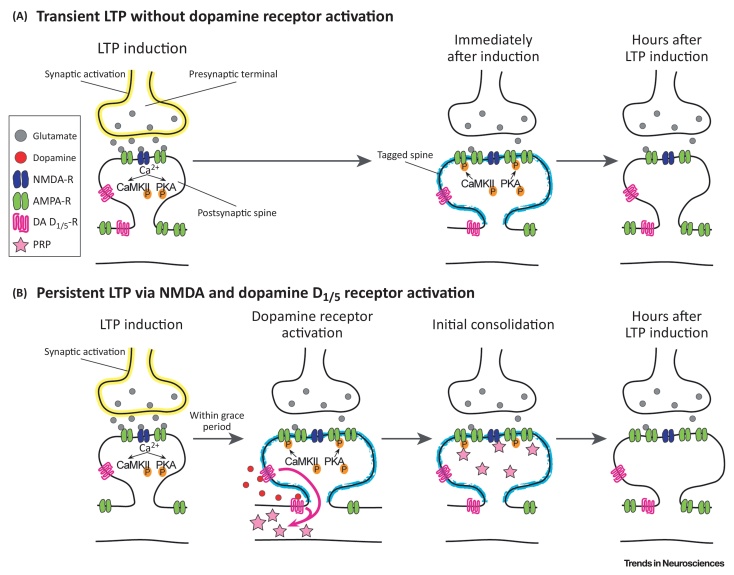
Dopamine D1/D5 Receptor Activation Promotes Initial Memory Consolidation within the Hippocampus. (A) N-methyl-d-aspartate (NMDA) receptor (NMDA-R) activation by presynaptic glutamate release coupled with postsynaptic depolarisation leads to transient long-term potentiation (LTP) of the synapse via Ca2+/calmodulin-dependent protein kinase II (CaMKII) and protein kinase A (PKA)–mediated α-amino-3-hydroxy-5-methyl-4-isoxazolepropionic acid (AMPA) receptor (AMPA-R) phosphorylation and their postsynaptic recruitment. The postsynaptic spine is also tagged for consolidation but in absence of plasticity-related proteins (PRPs) synaptic strength decays to baseline after several hours. (B) Activation of dopamine (DA) D1/D5 receptors (DA D1/5-R) leads to de novo PRP synthesis. If dopamine D1/D5 receptors are activated in the same neuron around the time of LTP induction, PRPs will be captured by the tagged synapses, leading to persistent LTP through initial consolidation.
Figure 1
Figure 1
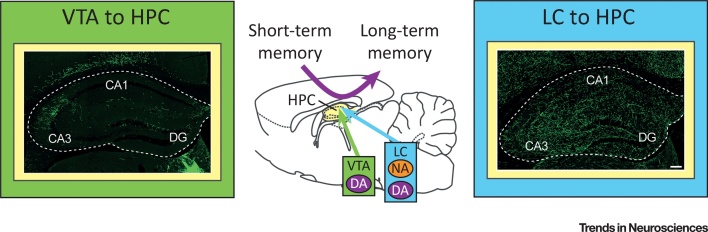
Two Dopaminergic Systems for Memory Consolidation. Both the ventral tegmental area (VTA; labelled green) and locus coeruleus (LC; cyan) project to the dorsal hippocampus in mice, but projections from LC (right panel) are denser than those from VTA (left). Both VTA and LC neurons can promote memory persistence via dopamine (DA) D1/D5 receptor-dependent mechanisms in the hippocampus and thus presumably via direct release of dopamine from their axons. Reproduced from .
Figure 2
Figure 2
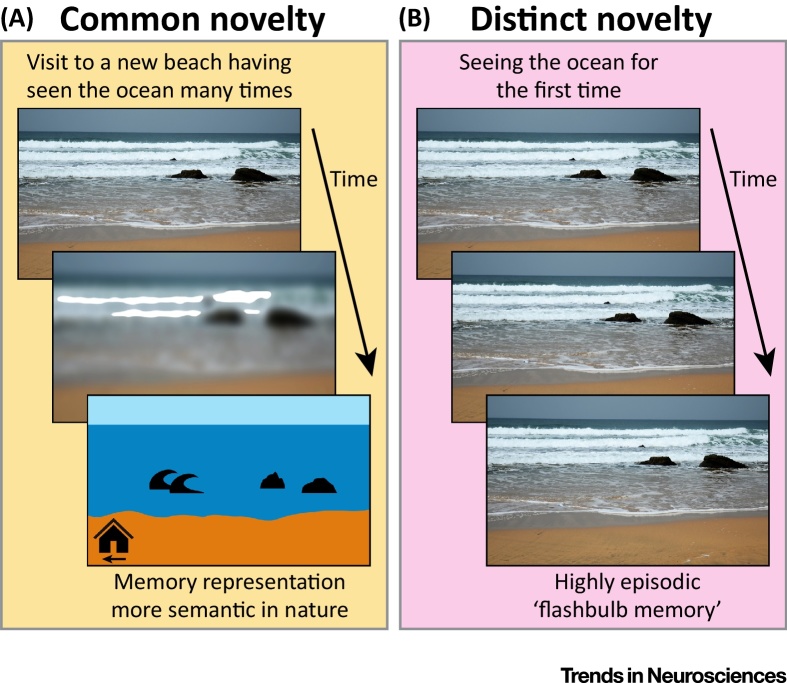
Common and Distinct Novel Experiences May Result in Differences in Memory Fate. (A) A first time visit to a new beach after having seen the ocean many times (common novelty) results in systems memory consolidation and incorporating the memory into pre-existing, neocortical networks (i.e., semantic knowledge). This semantic representation could reflect different aspects of the beach such as the general layout, the quality of the waves, or the way to a nearby bar. (B) By contrast, another person who has never seen the ocean before may retain the memory of a similar experience (e.g., visiting that same beach on the same day) differently. On seeing the vast expanse of the ocean and experiencing the crashing of the waves for the very first time (distinct novelty), they may experience a sense of amazement such that the detailed, hippocampal-dependent episodic memory trace is better retained for a longer time, through stronger initial memory consolidation.
Figure 3
Figure 3
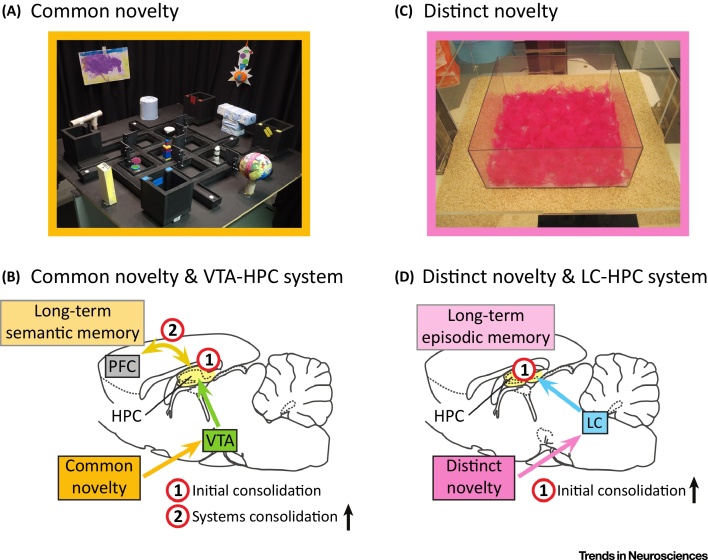
Key Figure: Two Forms of Novelty and Memory Consolidation (A) In the ‘crossword maze’ task, each day mice experience a new configuration of maze walls, reward location, and orientation of both local and surrounding spatial cues. This represents a highly novel environment, yet the task and characteristics of the surroundings share some common aspects with previous experiences. This represents a form of what we refer to as ‘common novelty’. Due to these common aspects it may be stored via updating of the pre-existing semantic networks in the neocortex. (B) We propose that such common novelty activates the ventral tegmental area-hippocampus (VTA-HPC) system to trigger initial memory consolidation, followed by increased systems memory consolidation between HPC and the prefrontal cortex (PFC), with enhanced sharp wave-ripple (SWR)-related reactivations aiding long-term retention of the memory trace and associated semantic information. Indeed, in crossword maze experiments, optogenetic activation of hippocampal VTA-tyrosine-hydroxylase expressing (TH+) axons increases hippocampal reactivation and enhances memory retention . (C) Completely new experiences pose unique challenges to the brain’s memory systems, as they cannot be as easily incorporated into memory representations already stored in the brain. We refer to this type of novelty as ‘distinct novelty’. In rodent experiments, distinct novelty can come in different forms, for instance altering floor substrates, or presenting dramatically distinct objects not previously experienced by the animal. (D) We propose that such distinct novelty activates the locus coeruleus (LC)-HPC system, boosting initial memory consolidation in HPC and enhancing retention of unrelated experiences (both preceding and subsequent ones, e.g., training in a maze), which results in long-term retention of a detailed episodic memory trace. It has been shown that LC-TH+ neurons (but not VTA-TH+ neurons) are sufficient to induce this ‘grace period’ of memory retention and are indispensable for it .

References

    1. Cenci M.A. Dopamine dysregulation of movement control in L-DOPA-induced dyskinesia. Trends Neurosci. 2007;30:236–243. - PubMed
    1. Dodson P.D. Representation of spontaneous movement by dopaminergic neurons is cell-type selective and disrupted in parkinsonism. Proc. Natl. Acad. Sci. U. S. A. 2016;113:E2180–E2188. - PMC - PubMed
    1. Schultz W. Behavioral dopamine signals. Trends Neurosci. 2007;30:203–210. - PubMed
    1. Steinberg E.E. A causal link between prediction errors, dopamine neurons and learning. Nat. Neurosci. 2013;16:966–973. - PMC - PubMed
    1. Chang C.Y. Brief optogenetic inhibition of dopamine neurons mimics endogenous negative reward prediction errors. Nat. Neurosci. 2016;19:111–116. - PMC - PubMed

Publication types