


Anesthetic and obstetric outcomes in pregnant women undergoing cesarean delivery according to body mass index: Retrospective analysis of a single-center experience
- PMID: 30455878
- PMCID: PMC6234280
- DOI: 10.1016/j.amsu.2018.10.023
Anesthetic and obstetric outcomes in pregnant women undergoing cesarean delivery according to body mass index: Retrospective analysis of a single-center experience
Abstract
Aim: To evaluate maternal, neonatal and anesthetic outcomes according to BMI in women undergoing cesarean section.
Background: Increased incidence rates of obesity and morbid obesity have been reported in the United States. Pregnant obese patients are at increased risk of maternal and fetal complications, and obstetric and anesthetic management of these patients is especially challenging.
Methods: A retrospective chart review of patients who underwent cesarean section in a single center between 2015 and 2016 was conducted. Anesthetic, obstetric and neonatal outcomes were analyzed in relation to levels of BMI.
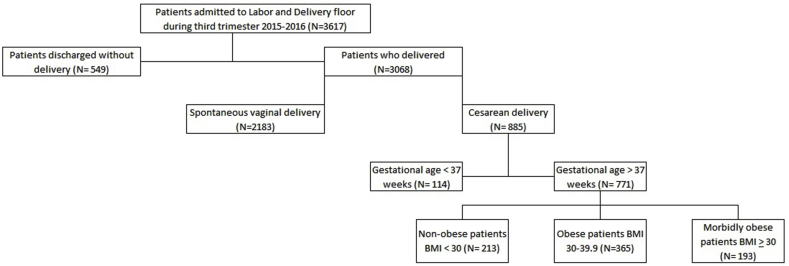
Results: Seven hundred and seventy one patients underwent cesarean section during the study period. The number of patients with normal BMI, obesity and morbid obesity was 213 (27.6%), 365 (47.3%) and 193 (25%), respectively. Sixty-one percent of the patients in morbidly obese group had at least one comorbidity (p < 0.01). We found no significant differences with respect to perioperative obstetric complications. Intraoperative blood loss was significantly higher in the morbidly obese group.
Conclusion: Increasing BMI is associated with comorbidities such as hypertension and diabetes mellitus, and with increased intraoperative blood loss. We were unable to detect differences in other obstetric, anesthetic and neonatal outcomes.
Keywords: Anesthesia; Body mass index; Maternal outcomes; Morbid obesity; Pregnancy.
Figures
References
-
- Finucane M.M., Stevens G.A., Cowan M.J., Danaei G., Lin J.K., Paciorek C.J., Singh G.M., Gutierrez H.R., Lu Y., Bahalim A.N., Farzadfar F., Riley L.M., Ezzati M. Global Burden of Metabolic Risk Factors of Chronic Diseases Collaborating Group (Body Mass Index). National, regional, and global trends in body-mass index since 1980: systematic analysis of health examination surveys and epidemiological studies with 960 country-years and 9·1 million participants. Lancet. 2011 Feb 12;377(9765):557–567. - PMC - PubMed
-
- Flegal K.M., Carroll M.D., Kit B.K., Ogden C.L. Prevalence of obesity and trends in the distribution of body mass index among US adults, 1999-2010. J. Am. Med. Assoc. 2012 Feb 1;307(5):491–497. - PubMed
-
- Poirier P., Alpert M.A., Fleisher L.A., Thompson P.D., Sugerman H.J., Burke L.E., Marceau P., Franklin B.A. American heart association obesity committee of council on nutrition, physical activity and metabolism, council on cardiopulmonary perioperative and critical care, council on cardiovascular surgery and anesthesia, council on cardiovas. Cardiovascular evaluation and management of severely obese patients undergoing surgery: a science advisory from the american heart association. Circulation. 2009 Jul 7;120(1):86–95. - PubMed
-
- Sturm R. Increases in clinically severe obesity in the United States, 1986-2000. Arch. Intern. Med. 2003 Oct 13;163(18):2146–2148. - PubMed
-
- Bogers R.P., Bemelmans W.J., Hoogenveen R.T., Boshuizen H.C., Woodward M., Knekt P., van Dam R.M., Hu F.B., Visscher T.L., Menotti A., Thorpe R.J., Jr., Jamrozik K., Calling S., Strand B.H., Shipley M.J., BMI-CHD Collaboration Investigators Association of overweight with increased risk of coronary heart disease partly independent of blood pressure and cholesterol levels: a meta-analysis of 21 cohort studies including more than 300 000 persons. Arch. Intern. Med. 2007 Sep 10;167(16):1720–1728. - PubMed
LinkOut - more resources
Full Text Sources
