


Case Reports
doi: 10.1002/ccr3.1800.
eCollection 2018 Nov.
Diagnostic pitfalls for GJB2-related hearing loss: A novel deletion detected by Array-CGH analysis in a Japanese patient with congenital profound hearing loss
Affiliations
- PMID: 30455902
- PMCID: PMC6230644
- DOI: 10.1002/ccr3.1800
Item in Clipboard
Case Reports
Diagnostic pitfalls for GJB2-related hearing loss: A novel deletion detected by Array-CGH analysis in a Japanese patient with congenital profound hearing loss
Clin Case Rep.
.
Abstract
Here, we report a novel deletion (copy number variation: CNV) in the GJB2 gene observed in a Japanese hearing loss patient. The deleted segment started in the middle of the GJB2 gene, but the GJB6 gene remained intact. This partial deletion in the GJB2 gene highlights the need for further improvements in GJB2 screening.
Keywords: CNV; GJB2 gene; novel deletion; profound hearing loss.
Figures
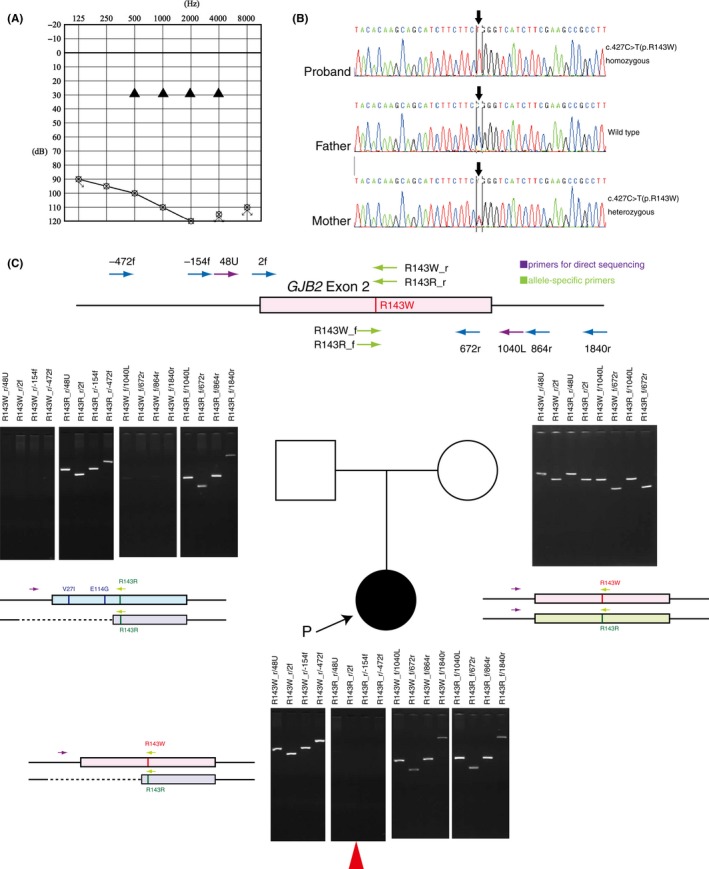
Pedigree and genomic DNA analysis. A, The audiograms of both ears in the proband of the family revealed profound hearing loss. Black triangles: the hearing threshold level via cochlear implant. B, Direct sequencing electropherograms of GJB 2 showing the p.R143W homozygote in the patient. C, Agarose gel electrophoresis of the PCR products in this family. In the patient and her mother, p.R143W‐specific amplified bands are observed. PCR products for p.R143R_r allele‐specific and upstream designed primers were absent (red arrowhead) in the patient only. For the wild‐type sample, all the corresponding amplified PCR fragments were observed except for PCR amplification by p.R143W‐specific primers
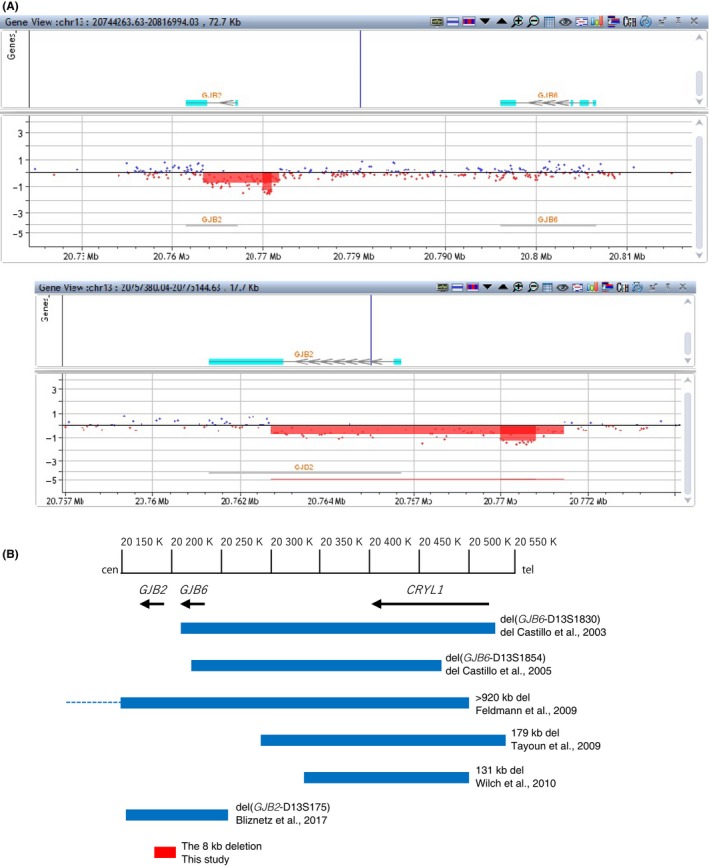
Location of deletions at the DFNB 1 locus on chromosome 13q12.11. A, Results of Array‐CGH for the GJB 2 gene region in the patient. Hybridization results are shown for the affected patient in whom an abnormality was identified by Array‐CGH . For each panel, the x‐axis marks the distance, in megabases, along the chromosome from the q telomere. The y‐axis marks the hybridization ratio plotted on a log2 scale. The patient shows a hemizygous deletion involving in the GJB 2 gene region based on analysis using CytoGenomics software. The area shown in red is depleted by one copy loss. The upper panel includes the region up to GJB 6, and the lower panel is an expanded image showing the approximate eight thousand base pair deletion. B, Schematic map of seven deletions. All genomic configurations are derived from NC_000013.11(Reference: GRC h38.p12 Primary Assembly)
References
-
- Morton CC, Nance WE. Newborn hearing screening‐a silent revolution. N Engl J Med. 2006;354:2151‐2164. - PubMed
-
- Smith RJ, Bale JF Jr, White KR. Sensorineural hearing loss in children. Lancet. 2005;365:879‐890. - PubMed
-
- Hamelmann C, Amedofu GK, Albrecht K, et al. Pattern of connexin 26 (GJB2) mutations causing sensorineural hearing impairment in Ghana. Hum Mutat. 2001;18:84‐85. - PubMed
Publication types
LinkOut - more resources
Full Text Sources
