


Effects of a physical activity intervention on schoolchildren's health-related quality of life: The active smarter kids (ASK) cluster-randomized controlled trial
- PMID: 30456052
- PMCID: PMC6234767
- DOI: 10.1016/j.pmedr.2018.11.002
Effects of a physical activity intervention on schoolchildren's health-related quality of life: The active smarter kids (ASK) cluster-randomized controlled trial
Abstract
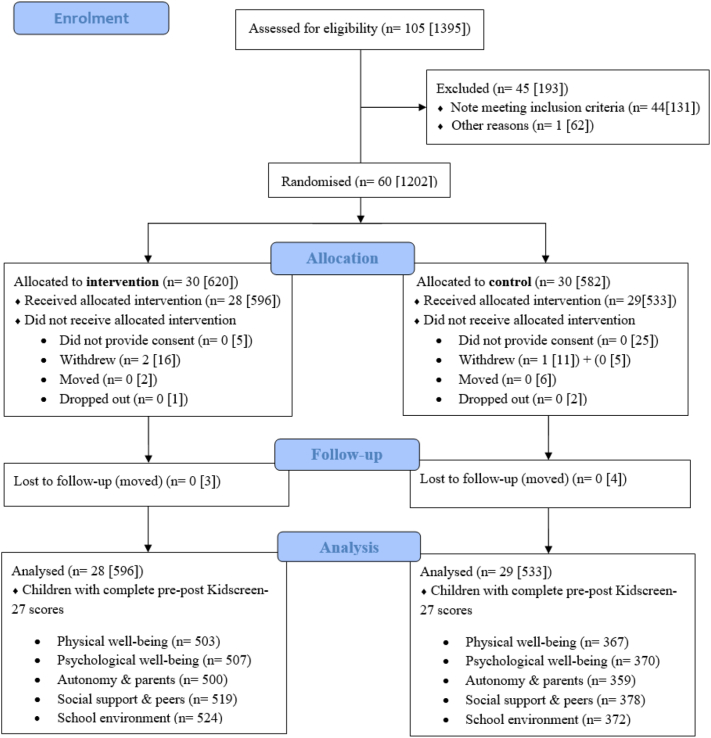
We investigated whether a seven-month (November 2014 to June 2015), school-based cluster-randomized controlled physical activity intervention improved health-related quality of life (HRQoL) in 10-year old children. The participants (N = 1229) from 57 elementary schools in Sogn og Fjordane County, Norway, were cluster-randomized by school either to the intervention (I) or control (C) group. The planned intervention in the 28 I-schools was 300 min of physical activity per week, compared to 135 min in the 29C-schools. HRQoL was assessed by self-report, using the Kidscreen-27 questionnaire. Objectively measured physical activity did not differ between the I-schools and C-schools during the intervention. No effect of the intervention was found for HRQoL: Physical well-being (P = 0.789), Psychological well-being (P = 0.682), Autonomy & parents (P = 0.662), Social support & peers (P = 0.828) and School environment (P = 0.074). In conclusion, the ASK school-based physical activity intervention showed no significant effect on HRQoL.
Keywords: Children; Health-related quality of life; Intervention; Kidscreen-27; Physical activity; RCT.
Figures
References
-
- Aadland E. Active Smarter Kids: A Cluster-randomized Controlled Trial (ASK) 2014. ClinicalTrails.gov
-
- Andersen J.R., Natvig G.K., Aadland E. Associations between health-related quality of life, cardiorespiratory fitness, muscle strength, physical activity and waist circumference in 10-year-old children: the ASK study. Qual. Life Res. 2017;26:3421–3428. - PubMed
-
- Fuller C.D., Braden C.J., Thomas C.R., Jr. Quality of life: from a tower of babel toward a unified voice. Int. J. Radiat. Oncol. Biol. Phys. 2004;58:1334–1335. - PubMed
LinkOut - more resources
Full Text Sources
Miscellaneous
